


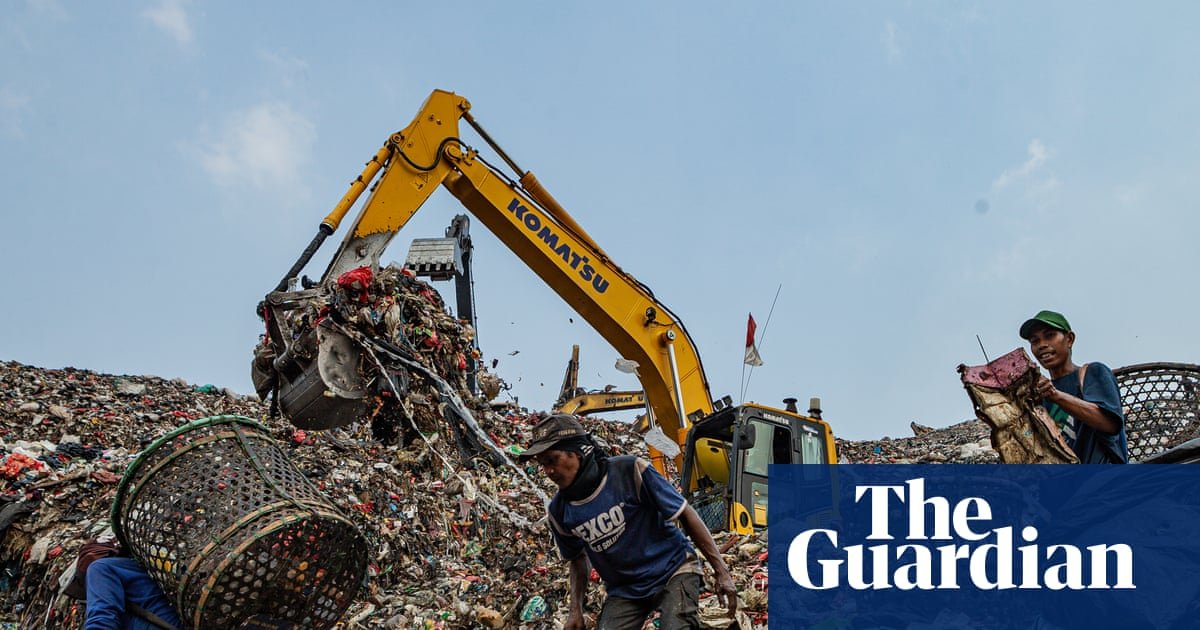
On the outskirts of Jakarta, a gigantic, billowing pile of garbage stretches over 100 hectares (247 acres) and looms over nearby villages. Every day, convoys of trucks roll into one of Asia’s largest landfills, dumping more trash.
Here, thousands of people live on the fringes of the site and earn income by picking up waste and salvaging scrap for resale. The work is dangerous, and earlier this year seven people were killed when one of the huge piles of rubbish caved in, burying them alive.
Second-generation waste pickers Rasta and his wife Suakeshi have been collecting recyclable materials at the Bantar Gebang Landfill since it opened in 1989.
“We’re just taking a risk here,” Rasta, a 55-year-old trash picker, said as he tearfully recalled the fatal accident. “If you don’t take the risk, you don’t eat it.”
Now, as the Indonesian government grapples with how to manage growing waste in the capital, the world’s largest city, those who depend on the site face an uncertain future. The site, known as Bantar Gebang, is well over capacity and the government wants to gradually close it down starting next year, raising questions about where the garbage will go and what will happen to the people who make a living there.
_________________
Bantar Gebang, about 40 km from Indonesia’s capital, looks like a rolling hill from a distance. When you get closer, the illusion will disappear. An irresistible smell of putrefaction hangs in the tropical air, and dark streams of leachate, a highly polluted water runoff, snake through piles of trash. Swarms of flies buzz over every passing truck.
Children play on the covered area of Bantar Gebang Landfill. There, geomembranes have been installed to reduce rainwater infiltration and landfill gas emissions.
Every day, about 8,000 tons of garbage arrive from Jakarta in 1,400 bright orange trucks.
Andy, 29, and his wife Wina, 43, are among the litter pickers working at the site. She was born in a village near a landfill and has been working there since childhood.
They earn about 100,000 to 200,000 rupiah (about AU$8 to 16) every day.
“Alhamdulillah (praise be to God), it’s not a lot, but it’s enough for our children’s schooling and for our daily meals,” he says.
 Aerial photo of a landfill
“It’s not physically fun,” he says of the job. “But if you work with friends, you can joke around.”
The workers tease each other as trucks rumble past in near-constant formation.
“Anjay!” exclaimed one of the workers as he discovered a highly prized Aqua brand water bottle, which costs more per kilo than other plastics.
Rustini, 48, stands in front of one of the towering piles of waste at the Bantar Gebang landfill.
Determined not to let her children follow in her footsteps, Rustini has spent more than 30 years collecting recyclables to send her children to school. She said she was “incredibly proud” that one of them is currently working in Taiwan and the other is preparing to move to Japan.
“Everything (for the children) came from here, even the smallest waste. This provided the children with a quality education to fight for their future.”
Karmidi, 32, started working in the field when he was just 10 years old. He is now married and has two young children. He scrapes up the waste with a hooked stick called a “ganko”.
He says the job is dirty, but he enjoys being his own boss and providing for his family.
Garbage trucks line up next to one of the towering piles of waste at Bantar Gebang Landfill, where trash arrives every day from Indonesia’s capital Jakarta.
“With this, I can work whenever I want, and the garbage doesn’t stop.”
He works at night, when it’s cooler but more dangerous as he and other waste pickers work in the dark, among dump trucks, bulldozers and excavators.
___________________
As Jakarta’s population has increased in recent decades, Bantar Gebang has grown and become a dumping ground for all kinds of waste. The facility is currently well over capacity and the government wants to shut it down.
It is believed that as many as 10,000 waste pickers live and work in and around Bantargebang Landfill, making a living collecting recyclable materials.
This comes amid growing concern across Indonesia, especially among young people, about rivers, beaches and roads becoming increasingly filled with trash. Opposition to burning waste is also growing.
In February, Indonesian President Prabowo Subianto declared a national “war” on waste after South Korean leaders described the popular tourist island of Bali as “filthy”.
The Ministry of the Environment has directed local governments to phase out all open dumping landfills, including setting up facilities to separate organics and recyclable materials.
The government wants to gradually move away from open dumping, starting from this year by ordering residents to separate their organic waste, and closing Bantar Gebang to general waste by the end of 2027, according to the Jakarta Environment Agency.
People separate waste in dangerous situations.
Ultimately, only “residual waste” will be accepted onto the site after organics and recycled materials have been removed. It would then be incinerated in a large-scale waste-to-energy plant, a facility that burns trash to generate electricity in a controlled environment. It is one of more than 30 similar facilities planned by state investment agency Danantara across Indonesia to solve the growing waste crisis, including in Bali, where construction began this month.
But activists doubt whether a viable alternative to take trash away from Bantargebang will be available in time. Activists say these plants will cost billions of dollars and require proper waste separation, which is rarely practiced in Indonesia.
 Workers picking up trash at Jakarta’s landfill
In Bali, a move to eliminate open dumping has already caused havoc. When Suwon Landfill was banned from accepting organic waste in April, unsorted garbage piled up on roads, fields and rivers. Much of it burned, spreading toxic fog over parts of the tourist island. The local government was forced to partially reverse this decision, allowing organic waste to be returned to the landfill several days a week.
Back in Jakarta, the uncertainty over Bantar Gebang’s future is causing concern.
Nur Aziza, a waste management expert at Gadjah Mada University, said if the site “is shut down with no alternative, it’s game over and you’ll see waste everywhere.”
Children walk past towering piles of waste.
Despite the risks, garbage picker Andy says his bigger fear is that Bantar Gebang will eventually close.
“We want to make sure our children have enough to eat and are happy. If the school closes, what options do we have?” he says.
