


Michelle Dugan Delgado has suffered from asthma for as long as she can remember. That’s why she always carries an inhaler and a face mask with her when she leaves the house – in case the wind picks up and there’s a sandstorm.
“I know it’s not safe to go outside,” she told DW. “It’s like living in a bubble. You have to protect yourself.”
If dust enters your lungs, it can trigger an asthma attack. Invisible bacteria, fungal spores, and viruses carried by dust can also cause life-threatening infections.
“If you go out and get caught in a sandstorm, there’s a very good chance you’ll get caught in something. That means you’ll end up in the hospital,” said the 35-year-old.
Duggan-Delgado is well aware of the risks. She has been hospitalized many times. Asthma also took a toll on her family. In 2009, his younger sister Marie died at the age of 16 due to an asthma attack.
“I couldn’t imagine taking her life,” she said. “It hurts to talk about this because I have a lot of survivor’s guilt.”
Dougan Delgado lives in the Coachella Valley, an agricultural center surrounded by desert in the far south of California. She believes that the poor air quality there is causing her and Marie to become ill.
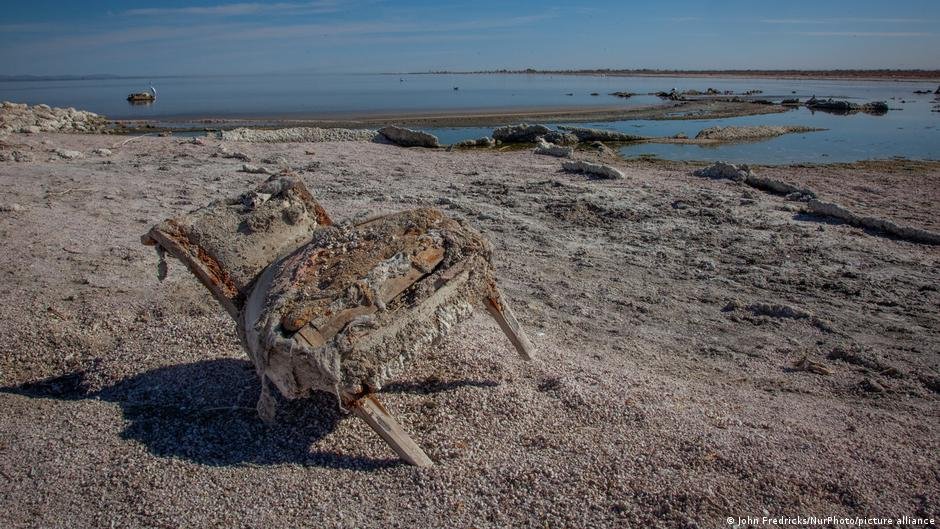
dusty air near an evaporating lake
Sandstorms are common in this region, which is home to about 500,000 people.
The main source of that dust is a huge lake that is steadily drying up. Spanning approximately 343 square miles (888 square kilometers), the Salton Sea is California’s largest lake. But it is rapidly shrinking. When wind blows across the exposed lake bed, it kicks up dry sediment, creating harmful sandstorms.
As water levels steadily fall, sand, dust and toxins linked to respiratory illnesses are revealed Image: Thomas De Wever/Zoonar/picture Alliance
Children living near lakes have been found to have a disproportionately high incidence of asthma. One study that followed more than 700 elementary school children over many years found that 24% reported having the condition, far more than the roughly 7% of boys and 5.5% of girls nationwide. More than 70% had allergies, more than three times the national average.
“Most families I know will have at least one child with a respiratory illness,” Dugan Delgado said. “It’s really heartbreaking.”
Her own 13-year-old daughter has asthma and her 11-year-old son has allergies.
From paradise to environmental crisis
The Salton Sea was formed by chance in 1905 when the Colorado River burst the gates of an irrigation canal and flooded the area. Since then, this water body has been maintained by continuous agricultural drainage/irrigation wastewater and local rivers.
It became a popular vacation spot in the 1950s, with trendy lakeside resorts attracting tourists and celebrities. But then, due in part to a warming climate and policies to divert water, water levels began to fall. Over the past 30 years, the lake has shrunk by about 20 percent, or 70 square miles.
But there’s more than just dust on the exposed lake bed. Pesticides and other toxic chemicals from farms are also stranded in the wind, only worsening local air quality.
Once a tourist destination, the Salton Sea is now drying up.Image: Olivier Hertel/ABACA/picture Alliance
Climate change caused by the continued burning of fossil fuels is causing higher temperatures and prolonged droughts, making desert regions around the world even drier. That makes it much harder for plants to grow and puts pressure on water resources, said Amato Evan, a professor of climate science at the Scripps Institution of Oceanography at the University of California, San Diego.
“Sandstorms are definitely becoming more frequent over time,” he says.
Globally, at least a quarter of the dust in the air comes from human activities such as off-road driving, deforestation, and unsustainable agricultural practices such as tillage and overgrazing.
From California’s Salton Sea to Iran’s Lake Urmia, drying lakes are also major sources of dust. For example, dust in Central Asia has increased by 7% over the past 30 years due to the shrinking Aral Sea.
have a negative impact on the economy and human health
More than half of the world’s dust emissions come from the Sahara Desert in North Africa. If the winds are strong enough, the dust can be thrown up to eight miles into the sky and travel long distances across the Atlantic Ocean toward the Americas or across the Mediterranean Sea toward Europe.
India’s worst air pollution crisis isn’t in big cities
To view this video, please enable JavaScript and consider upgrading to a web browser that supports HTML5 video.
The World Meteorological Organization says sandstorms and dust storms affect around 330 million people each year. They can engulf entire cities, ground planes, destroy crops, and cause deadly traffic accidents.
And there is also damage to human health.
“That’s the biggest negative impact: humans breathing in the dust,” Evan said.
Dust particulate matter can lodge deep in the lungs and can lead to serious respiratory and heart disease. Approximately 721,000 people die each year worldwide, with children, the elderly, and people with lung diseases most at risk.
live with dust
Dougan Delgado said his lung condition continues to deteriorate. Meanwhile, the Salton Sea is predicted to continue shrinking.
State and local governments have launched a series of projects as part of a plan to restore 30,000 acres of the lake’s dusty shoreline by 2028. Thousands of hay bales are lined along the lakeshore to keep dust down. They are also planting native plants to stabilize the soil and pumping water to create artificial wetlands for wildlife.
Nigeria: Fighting desertification in Yobe State
To view this video, please enable JavaScript and consider upgrading to a web browser that supports HTML5 video.
Evan says efforts such as planting native plants could work well in some places to combat desertification. But he points out that this requires significant investment, water and time.
“Those are all resources that are not in infinite supply,” he says. He and his team are currently developing an early warning system to alert communities when a sandstorm is approaching.
“Just like you should get a weather forecast, you should get a dust forecast,” he says.
Dougan Delgado says he welcomes the sandstorm warning system. She would also like to see further efforts to raise awareness about the risks of living with dust pollution and to let others know how to protect themselves and their children.
“I think we need to educate families more about respiratory diseases here in the Valley and how it affects their health,” she says. “One death is too many and we have to find a way to stop it.”
Editor: Tamsin Walker
This article was adapted from the DW Living Planet podcast. Click here to listen to the entire episode.
