


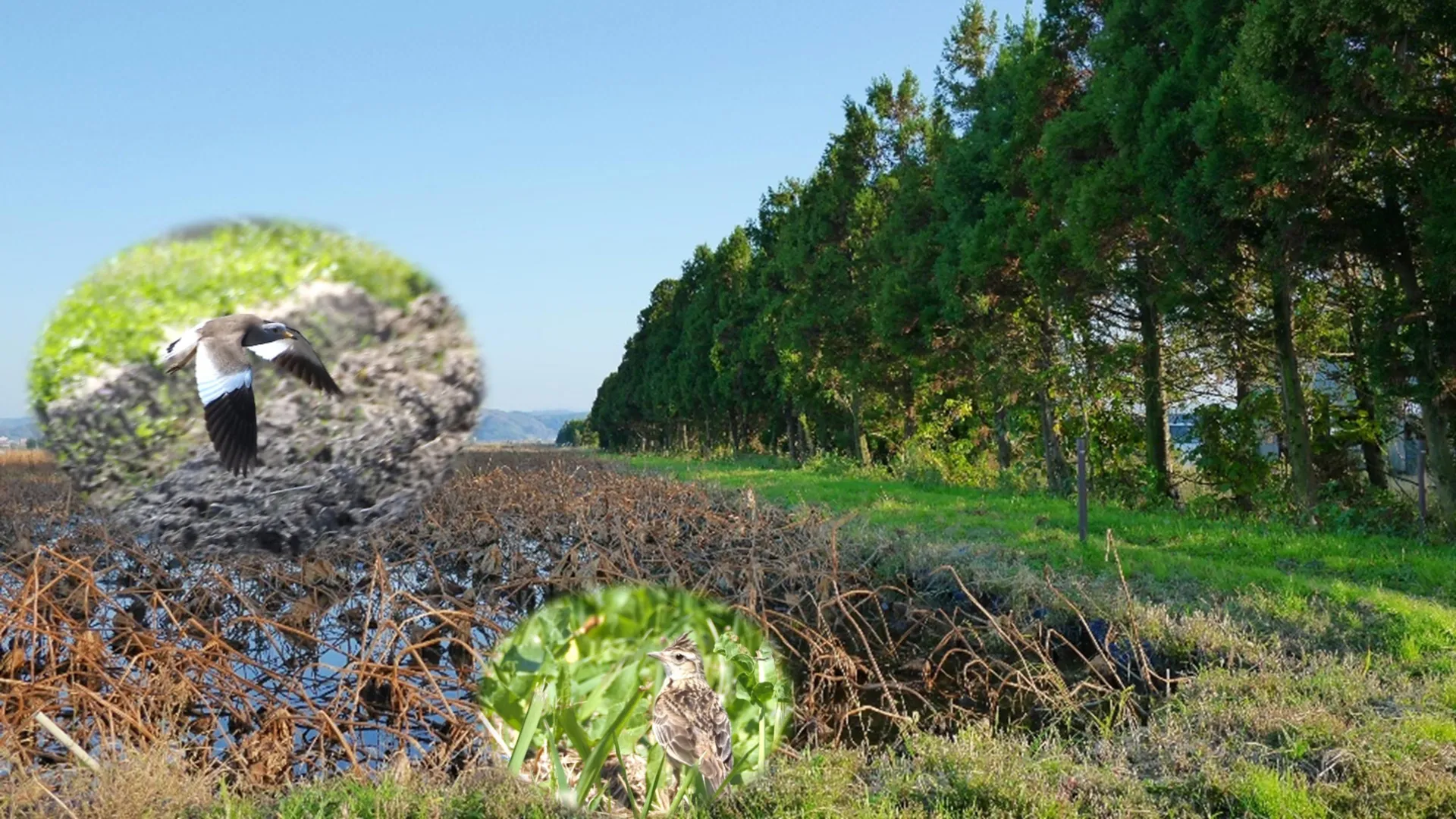
Trees planted along farmland to protect crops from strong winds are often seen as an easy way to support biodiversity. But new research suggests the situation is more complex, especially in agricultural wetlands where many bird species depend on open landscapes.
A team of researchers studying agricultural wetlands on the west coast of central Japan has found that windbreaks, rows of trees planted as windbreaks, do not benefit all birds equally. While they provide habitat for some species, they can also reduce the number and diversity of birds that rely on open grassland and wetland environments.
The survey results are environmental management journal.
Tree planting and bird protection
Many agricultural conservation programs encourage farmers to plant trees and hedgerows to increase biodiversity. These woody landscape features, known as windbreaks, are generally considered beneficial to wildlife.
However, much of the research supporting its value comes from cropland and grassland systems in Europe and North America. Little is known about their effects in wet agricultural landscapes such as rice fields. Rice fields are widespread throughout Asia and provide important habitat for wetland-dependent wildlife. These habitats are also decreasing around the world.
“The central question of our study is: ‘Do windbreaks and other linear woody features equally benefit all farmland birds in agricultural wetland landscapes, or do they create trade-offs that disadvantage species that rely on open habitats?'” said corresponding author Masumi Kuno, assistant professor at Hiroshima University’s Graduate School of Advanced Science and Engineering.
This issue is particularly important because agricultural wetlands have a dual role. In addition to food production, they serve as alternative wetlands for many bird species, including migratory birds that migrate along major flyways. Conservation efforts aimed at increasing biodiversity can have unintended consequences when windbreaks reduce the quality of grassland and wetland bird habitat.
Wild bird survey around Kahoku Lagoon
For their study, the researchers focused on farmland around Kahoku Lagoon in central Japan. The landscape includes extensive rice fields along with lotus fields, cultivated land, and pastures.
Because strong winter winds and storms occur regularly in this region, windbreaks are commonly used to protect farmland from wind damage.
Hebei Lagoon is also an important transit point along the East Asia-Australasian Flyway. Migratory birds use the area during different seasons, wintering species spend the cold season, and breeding species occupy the area during the summer. Nearly 300 bird species have been recorded in this area.
The research team conducted bird surveys in February and March 2021, and again in June 2023, using a point-count method to measure bird abundance and diversity.
Shelter belts create winners and losers
Research reveals clear ecological trade-offs.
Shelter belts supported birds associated with shrubs and habitat edges. At the same time, both the number of bird species in grasslands and the species diversity of wetlands that depend on large open areas have decreased significantly.
“We found that the number of grassland birds was more than 70 percent lower in areas adjacent to windbreaks than in open areas about 1 km away,” Kuno said.
The researchers say the results show that even relatively narrow tree lines can have a big impact on which bird species can occupy a landscape.
“A helpful way to think about this is that windbreaks act like an ecological wall,” Kuno says.
The researchers explained that while windbreaks create habitat opportunities for some species, they can reduce the space available for birds that nest and feed in open environments. It can also increase exposure to predators.
“Our study provides clear, quantitative evidence that small-scale landscape features can have large ecological impacts that are directly relevant to land-use planning and environmental management,” Professor Kuno said.
Why tree placement is important
The study highlights the importance of where and how trees are integrated into agricultural landscapes, rather than framing them as beneficial or harmful, the researchers said.
“Biodiversity-friendly agricultural land management needs to balance structural complexity with the ecological needs of open habitat species, especially in landscapes where wetlands have already been significantly modified by humans,” Kuno said.
The researchers argue that this message is particularly relevant because many agricultural conservation programs encourage tree planting without sufficient consideration of how the changes will affect bird communities as a whole.
Future research and conservation planning
The researchers say future studies should examine how specific windbreak characteristics, such as width, height, spacing, composition, and tree species composition, affect wildlife across different regions and seasons.
They also want to better understand indirect effects, such as how shelter belts change predator activity and habitat connectivity, which may further impact bird populations.
“Ultimately, our goal is to help design evidence-based agri-environmental policies that work in wetland croplands around the world. Rather than promoting a single solution, such as planting more trees everywhere, “We aim to support landscape-level planning that combines protected habitat and woody features so that agricultural wetlands can remain productive for people while continuing to serve as important habitat for wildlife in a rapidly changing world.”
The research team included Masumi Kuno from Hiroshima University, the University of Tokyo, and Kyoto University. Shota Deguchi and Fukui City Museum of Natural History. Wenhuan Xu University of British Columbia and Simon Fraser University. Xike Xiao Professor at Hiroshima University. Keinosuke Sanno, Nihonkai Eco Engineering Technologies, and Xinli Chen of Zhenjiang University of Technology. And Ken Motomura and Nakano City Hall.
This research was supported by the Kahoku Lagoon Research Institute and the Japan Society for the Promotion of Science Grant-in-Aid for Scientific Research.
