


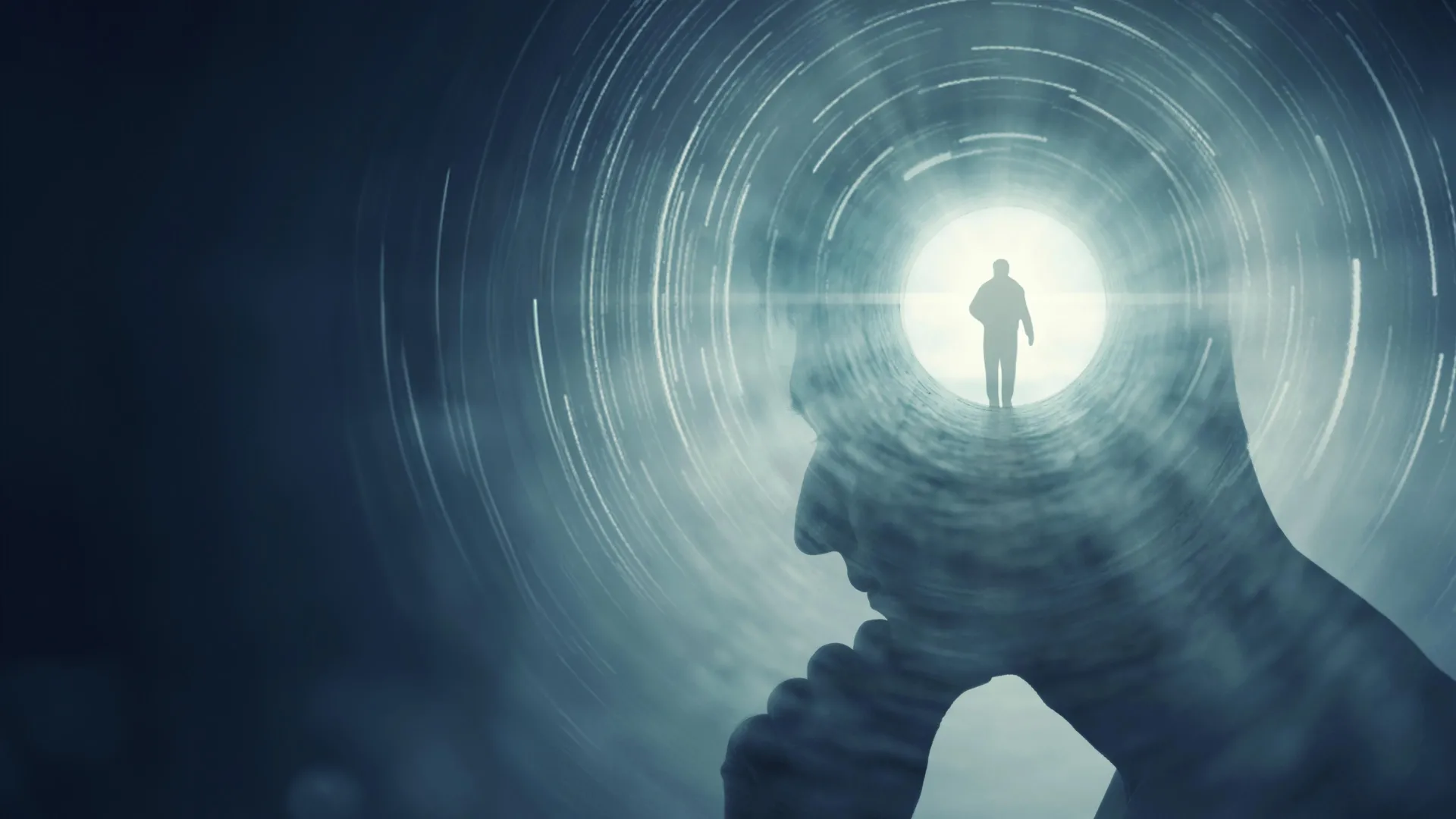
Does the brain create consciousness, or is consciousness a more fundamental feature of reality? Christoph Koch, one of the world’s most eminent neuroscientists, explored this question at the 15th Behind the Brain and Beyond Symposium.
The mystery goes far beyond understanding how neurons process information. Scientists can observe which parts of the brain activate when a person looks at an object, feels pain, recalls a memory, or makes a decision. But they still cannot explain why those physical processes involve inner experiences.
In other words, researchers can study what the brain does, but they still don’t know how that activity creates the feeling of being conscious.
The “hard problem” of consciousness
Koch’s presentation examined the limits of materialism, the dominant scientific view that everything that exists can ultimately be explained by matter, energy, and the laws of physics.
Neuroscience has made great strides in identifying brain regions and networks associated with consciousness. But what philosophers call the “hard problem” of consciousness remains unsolved. This term refers to the difficulty in explaining how electrical and chemical activity in the brain gives rise to subjective experiences such as sensations, emotions, thoughts, and a personal sense of being alive.
For example, brain scans may tell us what happens when we see red, but they cannot tell us why seeing red feels like something.
Science is still an experience that is difficult to explain.
Koch plans to focus on three key areas of uncertainty. The first is the challenge of reducing conscious experience entirely to physical processes in the brain. The second concerns the questions modern physics raises about what should be considered “reality.” The third concerns unusual human experiences that remain difficult to explain using traditional scientific models.
These include near-death experiences, mystical states, and episodes of terminal lucidity. End-of-life lucidity refers to the unexpected return of mental clarity just before death in a person with severe dementia or other conditions that have made normal communication impossible.
Such experiences do not necessarily prove that consciousness can exist independently of the brain. But Koch argues that it deserves serious investigation because of its potential to expose gaps in current scientific explanations.
Is consciousness a fundamental part of reality?
Koch believes researchers may need to reconsider philosophical ideas such as idealism and panpsychism while continuing to apply modern scientific methods.
Idealism broadly proposes that consciousness or mind is central to the nature of reality. Panpsychism suggests that consciousness is not limited to humans or animals, but may be a fundamental property found to varying degrees throughout nature.
Based on these perspectives, consciousness does not simply emerge once the brain becomes sufficiently complex. It can be an underlying feature of reality itself.
Integrated information theory offers radical possibilities
Koch is a major proponent of integrated information theory, which attempts to explain consciousness mathematically. This theory proposes that subjective experience occurs in systems that integrate large amounts of information and combine them into a whole.
According to this view, consciousness depends not only on the amount of information contained in a system, but also on how deeply interconnected the parts of the system are. Therefore, a system with highly integrated information can have some form of subjective experience.
This idea has been described as a scientific version of panpsychism, as it allows for the possibility that consciousness exists in systems other than the human brain.
Exploring the awareness of unresponsive patients
Koch is a researcher at the Allen Institute for Brain Science and previously served as a professor at the Massachusetts Institute of Technology and the California Institute of Technology. He has played an important role in the modern scientific study of consciousness.
His research includes developing new approaches to detect signs of subconscious consciousness in patients who appear unresponsive. Because conscious brain activity may remain in some people who are unable to move or communicate, reliable detection methods can be important in diagnosis, treatment, and medical decisions.
By examining the limits of materialism, unanswered questions in neuroscience, and experiences that remain difficult to categorize, Koch asks whether the brain really creates consciousness, or whether it is connected to something more fundamental.
