


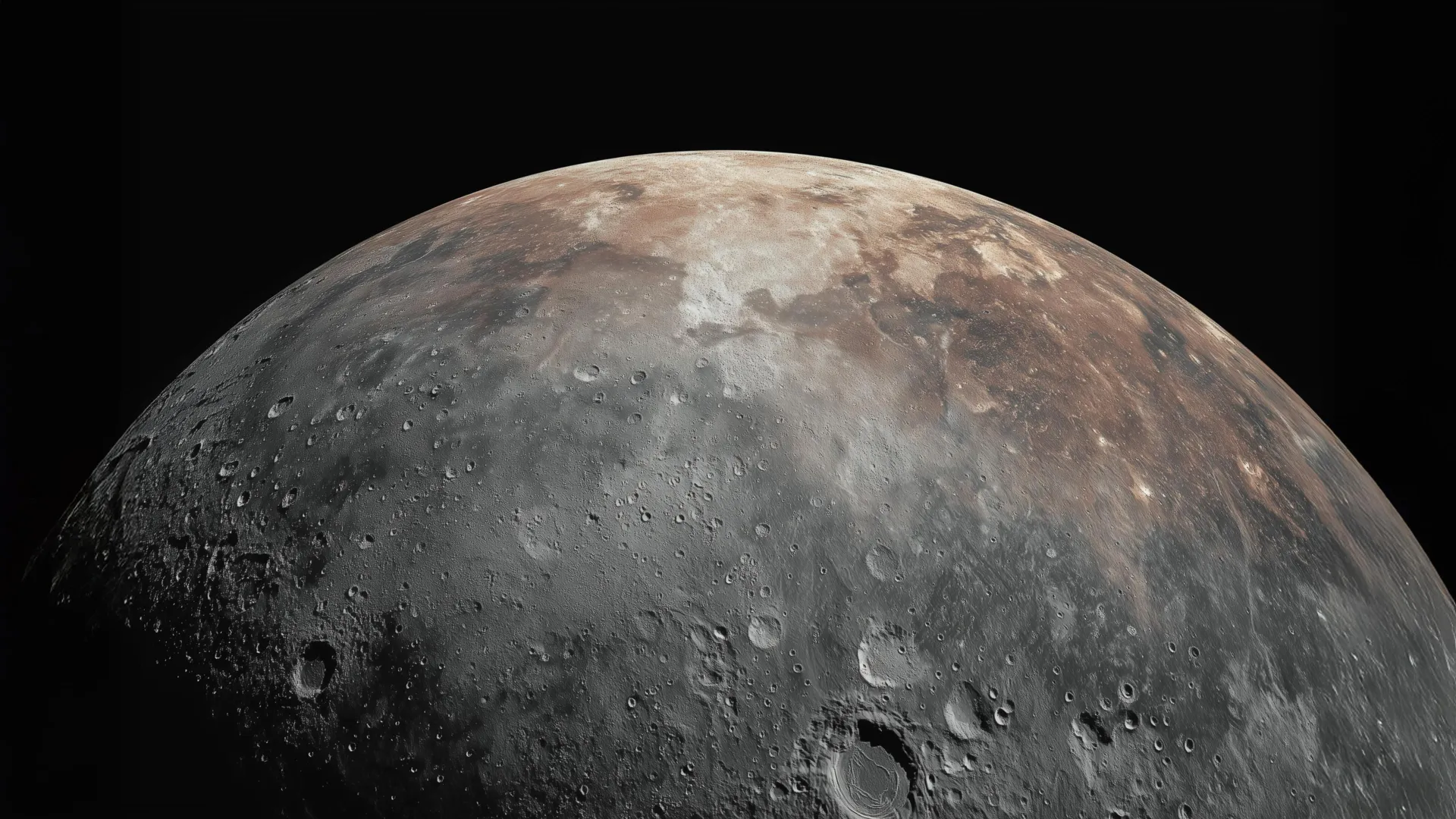
More than 4.5 billion years ago, a giant world potentially as large as the moon or Mars was traveling around a young sun before being shattered into pieces by a violent collision.
Scientists have now announced that they have discovered the first direct evidence that this long-lost planetary embryo, known as a protoplanet, once existed. Discoveries recorded in the diary Earth and Planetary Science Lettersindicating a different type of planetary evolution than previously recognized.
“It’s hard to believe that there was ever a world this big,” said Aaron Bell, an assistant professor in the Department of Earth Sciences at the University of Colorado Boulder. “We know it exists because some of its fragments happened to fall on Earth. These meteorites preserved evidence of a completely different path by which the early planets developed.”
A rare meteorite holds clues to a lost world
This breakthrough discovery was made possible by a meteorite named Northwest Africa (NWA) 12774, the Anglite meteorite, which was discovered in the Sahara Desert.
Angrite is one of the oldest known volcanic rocks in the solar system. It was formed just a few million years after the birth of our solar system, about 4.56 billion years ago. They are also very rare. Of the over 80,000 meteorites found on Earth, only 68 belong to the angrite group.
These meteorites have long puzzled scientists due to their unusual composition. Compared to Earth, Mars, and other rocky planets, angrilite contains very little silicon dioxide, or silica, a major component of nearly all known terrestrial planets.
Because of its chemical properties, researchers believed that angrilite originated as a small asteroid with a radius of less than 200 kilometers (124 miles).
Evidence of extreme pressure inside the planet
While investigating NWA 12774, Bell and his colleagues identified clinopyroxene, a mineral commonly found in Earth’s crust and mantle. The clinopyroxene in this meteorite contains exceptionally high levels of aluminum, an important clue that it formed under intense pressure deep within a large celestial body.
The team then calculated the conditions necessary for the mineral to form.
Their results were amazing. Pressures of at least 17.5 kilobar would have been required to form the aluminum-rich clinopyroxene. By comparison, the pressure at the bottom of the Mariana Trench, the deepest on Earth, reaches only about 1 kilobar.
Such extreme pressures cannot exist inside a small asteroid. Instead, the discovery showed that Angrit’s parent body must have had a radius of at least 1,000 kilometers (621 miles).
A world comparable to the moon
Additional evidence suggests an even larger source.
The crystals within NWA 12774 still retain their sharp edges and delicate chemical signatures. If they had formed deep within a giant world, their details would likely have been erased over time. Their preservation suggests that the crystals formed relatively close to the parent surface.
If that interpretation is correct, then the original world would have had to be much larger than the minimum estimate.
Researchers say the angry parent object may have had a radius of more than 1,800 kilometers (1,118 miles). That would put it within an area the size of Earth’s moon, and potentially approach the size of Mars, which has a radius of 3,300 kilometers (2,050 miles).
“There are a lot of understudied meteorites sitting in drawers, so there could be many more protoplanets that we don’t know about,” Bell said.
Different paths of planet formation
Scientists still don’t know exactly what happened in this ancient world. One possibility is that it was destroyed in a massive collision in the chaotic early solar system. Its debris may have later become part of other rocky planets, including Earth.
“The material that formed Angrite’s parent body is fundamentally different from the composition of Earth and Mars. This points to distinct and distinct evolutionary paths of planet formation in the early history of the solar system,” Bell said.
