


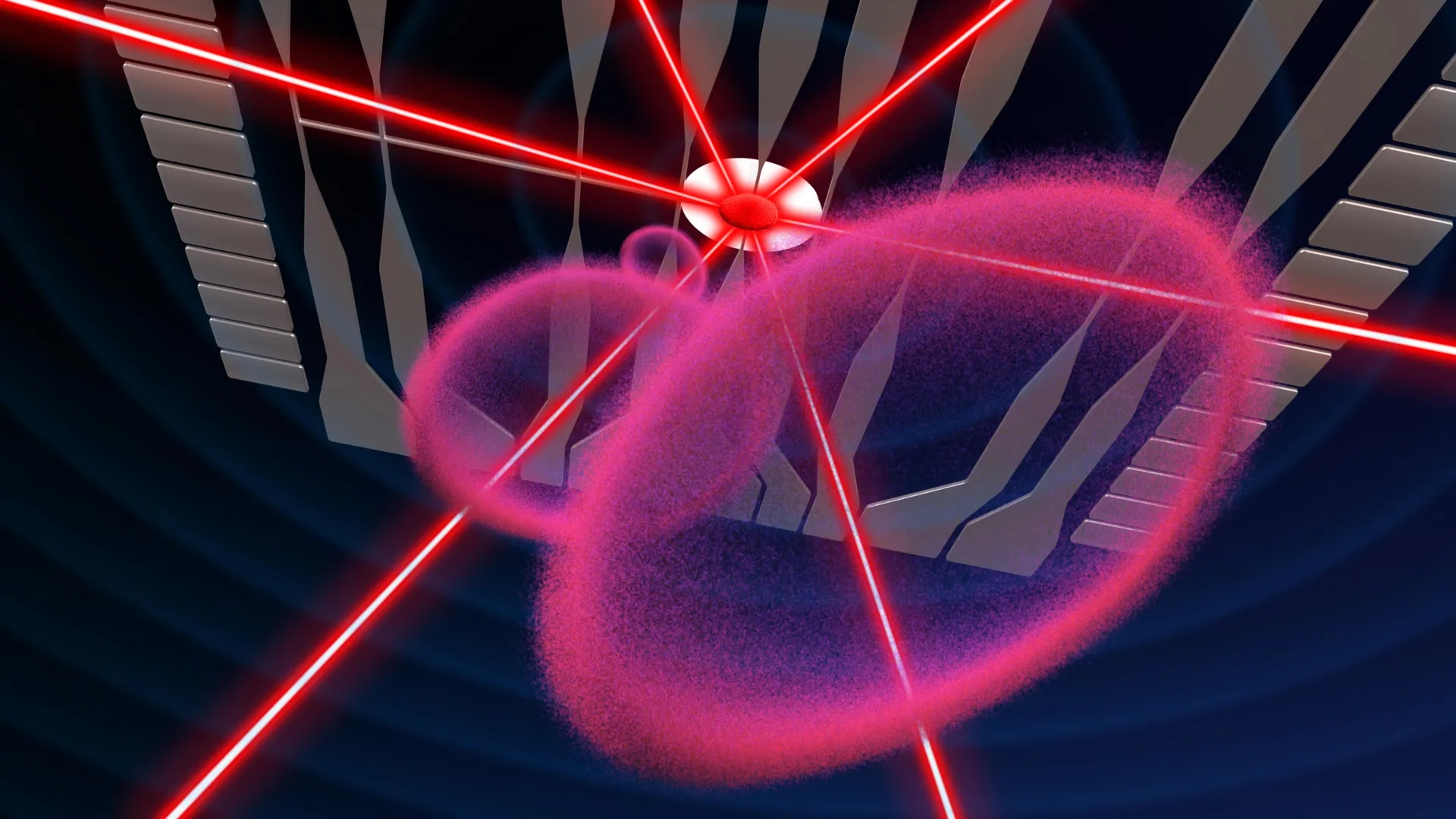
NASA’s upgraded Cold Atom Lab is back up and running on the International Space Station, giving researchers a powerful new way to probe the fundamental properties of matter and advance the development of future quantum technologies. This facility uses the station’s microgravity environment to conduct experiments that cannot be done on the ground.
Quantum science focuses on the behavior of matter and energy at very small scales, such as atoms, electrons, and particles of light. Atoms are often pictured as tiny spheres colliding with each other, but the quantum world is much stranger. Atoms behave like waves, appearing in multiple places at the same time and even passing through each other under certain conditions.
Research at NASA’s Cold Atomic Laboratory is important near absolute zero
About the size of a small refrigerator and remotely controlled from Earth, the Cold Atom Lab cools atoms to temperatures below minus 459 degrees Fahrenheit (minus 237 degrees Celsius). At temperatures just above absolute zero, atoms can combine into an unusual quantum state known as a Bose-Einstein condensate (BEC).
BEC consists of waves of matter and is considered the fifth state of matter in addition to solid, liquid, gas, and plasma. Although much larger than individual subatomic particles, they still obey the laws of quantum mechanics. The microgravity conditions of low Earth orbit make these waves of material even larger than on Earth.
“At the coldest temperatures, matter behaves very differently than we have experienced,” said Jason Williams, project scientist at NASA’s Cold Atom Lab at NASA’s Jet Propulsion Laboratory in Southern California, which built the facility. “The wave-like nature of matter predominates, and ultracold matter can behave in unexpected ways, as well as allowing very precise measurements of time, gravity, and motion. The lab has a wealth of tools that allow us to investigate the nature of the universe, especially with this latest upgrade.”
The facility currently supports five international research teams studying fundamental physics. It will also serve as a testing ground for quantum equipment that may one day support Earth science research and future exploration missions.
How the upgraded cold atom lab works
At the heart of the facility is a collection of sophisticated equipment known as the Science Module. A newly upgraded version of the module arrived at the space station on April 11 on a Commercial Supply Services mission, expanding the range of experiments scientists can perform.
During the experiment, a strip of rubidium or potassium metal is heated to temperatures as high as 750 °F (400 °C), creating a gas in the vacuum chamber. Researchers then use carefully tuned lasers to remove energy from the atoms. As atoms lose energy, they slow down and cool dramatically.
After the laser cooling step, a magnetic field traps the atoms and keeps them confined. Additional cooling techniques will further reduce the energy, bringing the cloud closer to a complete standstill, allowing scientists to maximize the time they can study it in microgravity.
Why quantum experiments benefit from space
Scientists can study ultracold gases in laboratories on Earth, but space has important advantages. In a microgravity environment, quantum gases can be observed for long periods of time and cooled to even lower temperatures.
In a low-gravity environment, larger quantum waves form and are also able to interact with gravity for longer periods of time. To make these experiments possible inside the station, engineers compressed a room-sized nuclear physics laboratory normally filled with lasers and optical equipment into a compact system that fits inside the station’s experiment rack.
“As the first project to produce a Bose-Einstein condensate in orbit, we are demonstrating that quantum technology can work reliably in space,” said Ethan Elliott, deputy project scientist in JPL’s Cold Atom Lab. “In the last century, we had a quantum revolution that led to lasers for medical imaging, mobile phones, and MRIs. We are now working on Quantum 2.0, the direct manipulation of large quantum states. And by advancing this science in orbit, we hope to see similar advances in quantum technology.”
New upgrade expands quantum research capabilities
This enhancement marks the fourth major upgrade to the Cold Atom Lab since it was installed on the International Space Station in 2018.
The most important improvement is a redesigned magnetic trap that can change the shape of the quantum gas cloud. This gives researchers new opportunities to study the properties and behavior of cryogenic atoms. Engineers also introduced a redesigned metal atomic source that produces the gas cloud used in the experiment.
“This is the closest we’ll get to controlling the boundaries of the quantum world,” Kamal Udrili, project manager at JPL’s Cold Atom Lab, said of these low temperatures. “This new upgrade pushes those boundaries even further.”
Oudrilli added that the new hardware “demonstrates NASA’s ability to maintain U.S. leadership in space-based quantum technologies while maturing future quantum instruments such as matter-wave interferometers for fundamental physics missions such as Earth and the Moon, positioning, navigation, timing, and gravity sensing.”
Advances in quantum technology in space
Cold Atom Lab is managed by the California Institute of Technology in Pasadena, and NASA’s Jet Propulsion Laboratory designed, built and operates the facility. The project is sponsored by the Biophysical Sciences Division within NASA’s Science Mission Directorate in Washington.
We support scientific discoveries by taking advantage of the special conditions of space to conduct experiments that cannot be done on Earth. By studying biological and physical processes in extreme environments, researchers gain knowledge that will allow humans to travel farther and stay in space longer, while also benefiting life on Earth.
