


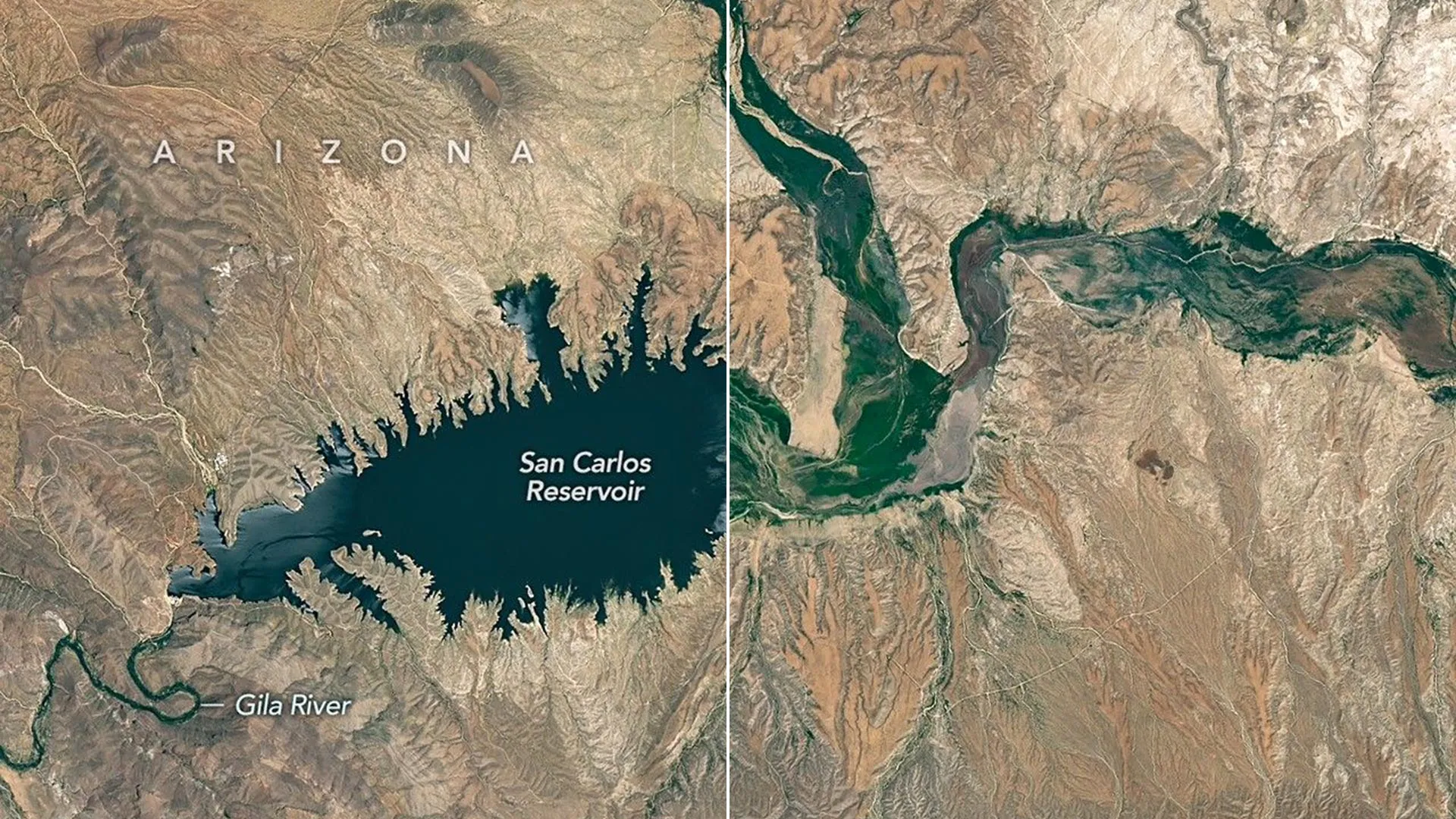
The Gila River is one of the Southwest’s most important waterways, providing water for communities, farms, and wildlife, and connecting the snow-covered mountains of southwestern New Mexico to the desert regions of southwestern Arizona.
In years with high precipitation, winter snow accumulation in the Mogollon and Black Mountains provides much of the river’s spring runoff. This water helps replenish the San Carlos Reservoir created by Coolidge Dam. When full, this reservoir ranks as the largest lake in Arizona.
The collapse of the snowpack drains the reservoir
The situation in 2026 was dramatically different. Snowfall in the Gila River Basin has been exceptionally low, with mountain snowpack only 2% of the median March value from 1991 to 2020. As a result, river flows remained at 39 percent of normal levels during April.
By June, supplies were further reduced by the release of water needed for downstream agricultural uses. The reservoir had less than 400 acre-feet of water.
Comparing Landsat satellite images highlights dramatic changes. The image above (right) was taken on May 22, 2026 and shows that San Carlos Reservoir only has 389 acre-feet of water, less than 1% of its full capacity. In contrast, the image on the left taken in June 2023 shows the reservoir at about 60% capacity. Vegetation found along the reservoir’s shorelines and river channels includes tamarisk, willow, cottonwood, sedge, and various grasses.
A large number of fish stores are forced to close.
As the water level continued to fall, oxygen levels within the reservoir plummeted. The resulting hypoxia killed nearly all the fish that lived there.
In response, authorities closed the reservoir indefinitely on June 5, 2026. Affected fish species included stocked species such as largemouth bass, black crappie, bluegill, channel catfish, flathead catfish, brown trout and rainbow trout.
The San Carlos Recreation and Wildlife Department also warned that rotting fish could pose a health risk to people trying to fish or boat in the area.
A long history of extremely low water levels
Although the current situation is difficult, it is not without precedent. According to news reports, the San Carlos Reservoir has completely dried up at least 20 times since it was first filled in 1930.
Even when the dam and reservoir were first completed, conditions were so dry that grass could grow on the exposed lakebed. Humorist Will Rogers famously joked to President Calvin Coolidge, “If that was my lake, I’d cut the grass.”
Large-scale fish die-offs have occurred in the past, including in 1976 and 2018. The 1976 fish die-off killed more than 5 million fish, and it took five years for the reservoir’s ecosystem to recover, according to the Gila Herald.
Drought continues, but rain could bring relief
The region remains in a multi-year drought. Much of New Mexico’s Gila River headwaters is currently in severe drought, according to data from the U.S. Drought Monitor.
Still, river flows can vary significantly from year to year. Heavy rains in the coming rainy season could replenish the reservoir.
NOAA’s seasonal monsoon outlook, released in May 2026, estimates the chance of above-average rainfall across the region in the summer to be between 33 and 50 percent. At the same time, El Niño conditions will strengthen in the central and eastern equatorial Pacific Ocean into late spring 2026, a pattern that could increase the likelihood of heavy rainfall across the southwestern United States.
