


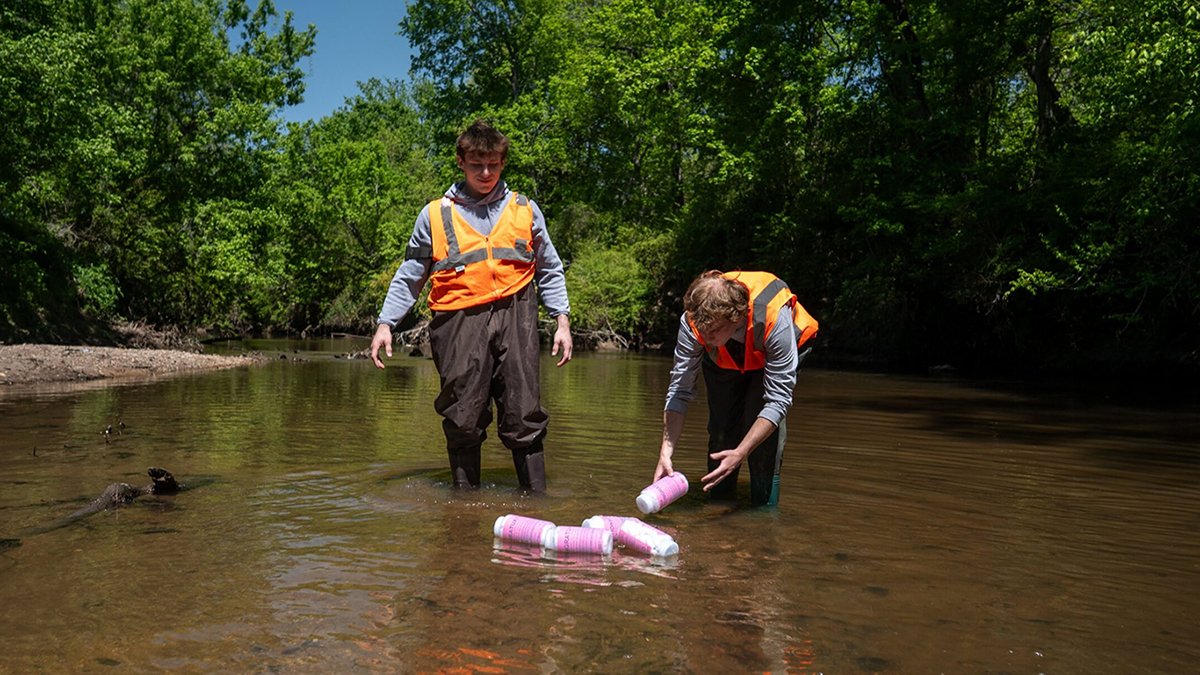
 Researchers working in freshwater streams may or may not deploy traceable bottles that travel to the Neuse River, Pamlico Sound, and ultimately the Atlantic Ocean. Photo: North Carolina Sea Grant
Tatiana the Trash was carried by water about 110 miles downstream from where Tatiana the Trash and dozens of other reusable bottles were released into a northeast Raleigh creek more than a year ago.
It looks like Dan the Debris won’t be far from where it was placed in Marsh Creek in the spring of 2025.
There are now 60 cheekily named bottles that can be traced from the freshwater of streams and the Neuse River to the brackish waters of Pamlico Sound.
These are part of ongoing research investigating how rainwater washes trash into local streams, how far that trash travels downstream, and the direct link between municipal trash and plastic pollution in waterways.
 Christy Perrin
“Even though we’re here in Wake County, the Neuse River carries a lot of pollutants all the way to the coast. Unfortunately, our coastal neighbors have a cumulative impact of the river on upstream watersheds,” said Christy Perrin, Sustainable Water and Communities Coordinator at the Waters Resources Institute and North Carolina Sea Grant, and co-principal investigator on the study.
To understand how trash enters waterways and moves downstream, researchers are digging deep to identify trash hotspots and determining correlations between storms and the amount of trash that enters individual rivers during storms.
Researchers plan to use the results to guide site-specific interventions to prevent trash from reaching waterways.
The research was funded in 2024 through the National Oceanic and Atmospheric Administration’s Office of National Ocean Grants.
As part of the study, researchers placed three trash traps in Marsh Creek, a small watershed that flows into Crabtree Creek and the Neuse River near Interstate 440. Each time it rains, the team removes the trash caught in the traps, counts each trash, and documents the different types of trash they collect.
“Every time it rains, rainwater washes trash and pollutants from sidewalks and roads into local streams,” says Madison Haley, a doctoral student in North Carolina State University’s Department of Bioagricultural Engineering. “Here we can understand how much trash is entering and moving through a watershed from a given storm. What we’re finding is that the higher that peak of flow is, the more trash we’re seeing.”
 Madison Haley
The researchers found a clear relationship between the amount of trash caught by trash traps and neighborhood population size.
“The smaller the population of a watershed, the less trash you typically see. And the more urbanized a watershed, the more trash you typically see,” Haley said.
Researchers worked with volunteers from the Great Raleigh Cleanup, a nonprofit organization founded in 2020 that has removed more than 45,000 pounds of trash from the city’s landscape, to measure the amount of trash along roads in the Marsh Creek watershed and identify hot spots.
“We’ve noticed that roads with more traffic have more trash,” Haley said. “Roads with less traffic have less trash. Roads with advanced industrialization tend to have more trash. Roads in residential areas tend to have less trash.”
While there is no perfect formula for determining exactly what creates trash hotspots, researchers have found a clear pattern, she said.
And they’re trying to find patterns in how trash is transported by downstream waterways, how long it takes for trash to flow from its headwaters into the river and into Pamlico Sound.
That’s where the bottle comes in, with the help of citizen scientists, especially those recreating waters close to the coast.
Each 1-liter Nalgene bottle contains a GPS tracker and a brightly colored note with a QR code linking to the project website.
Eventually, your GPS tracker’s battery will die.
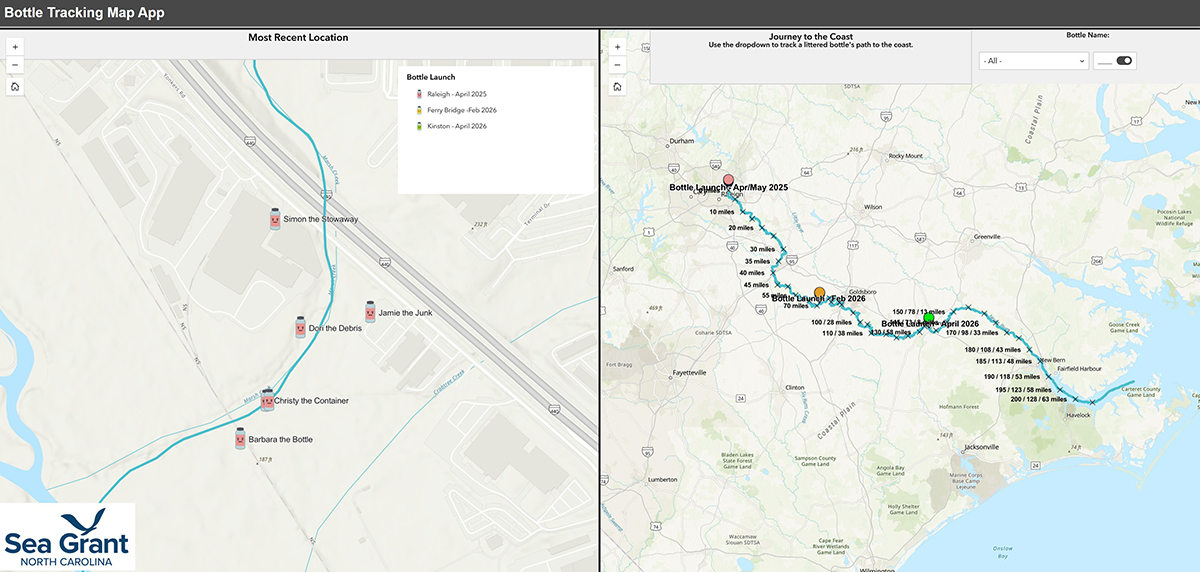 Adjacent panes in the North Carolina Sea Grant Bottle Tracking Map app display the location and name of bottles being tracked for research.
“If you see a bottle, it could be our bottle,” Haley said of the tracker that lost power.
She’s asking anyone who finds a bottle while playing in the Neuse River or Pamlico Sound to check to see if it’s theirs. Once you find their research bottle, scan the QR code to record its location and return it to the water.
Noting that this month is Plastic Free July, Ms Haley said: “It’s a good time for people to be more mindful and do some recreation and see if they can find a bottle, but it’s also a good time to pick up some trash in the process.” “The important thing is that people can connect more than what we’re doing here in Raleigh. And what we do in these urban areas can impact our neighbors downstream, and everything we do here doesn’t necessarily stay in our own communities. Plastic lingers for a very long time and travels through waterways and the environment.”
Researchers initially released 40 bottles into Marsh Creek in April and May 2025.
Haley explained that the bottles were moving slower than the researchers had expected, and they wanted to understand how they moved in different areas of the Neuse River. So last February, they dumped 10 more bottles into the Neuse River just upstream from Goldsboro. In April, 10 more bottles were released into Kinston’s river.
“We found that the River Neuse is not only a flow of water from Raleigh to the sea, but also a place to store a lot of rubbish,” Mr Haley said. “Litter can be left in the River Neusé for a long time, so this study allows us to see if bottles are left in a certain location for a long time. We can see where in the river itself the garbage is stored.”
She said she understands that it’s easy to feel discouraged when it comes to trash issues.
“We all see it everywhere,” she said. “But it’s incredible to see how many people are interested in our work and how many people are interested in supporting us. It’s exciting and hopeful at the same time. There’s a lot of work to be done.”
