


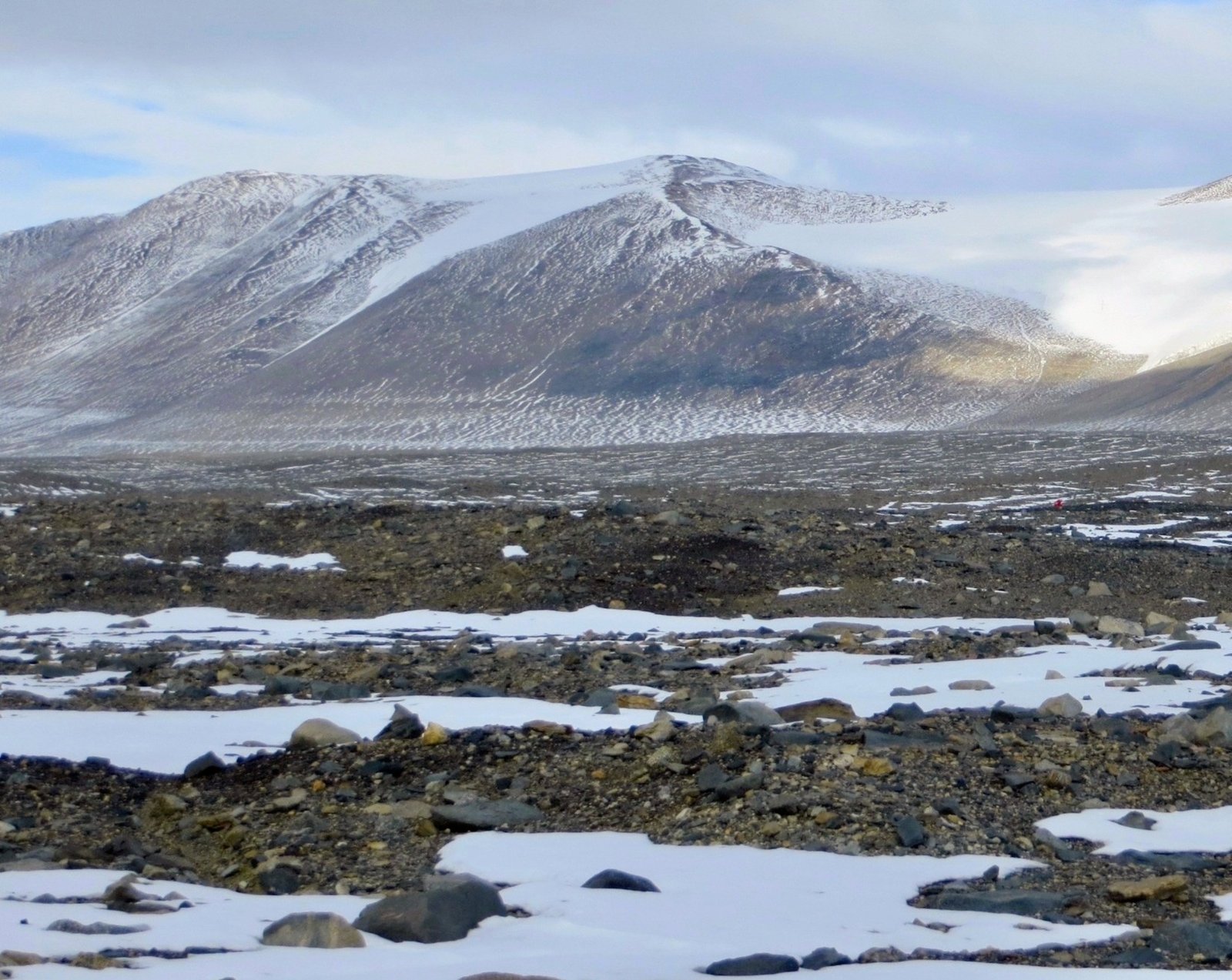
The McMurdo Arid Valleys in Antarctica are one of the most remote and pristine environments on Earth, but even the soil is not free of plastic.
Researchers found both microplastics and nanoplastics, including particles buried beneath the surface, in soil collected across the Antarctic region.

The findings show how widespread plastic pollution is reaching some of the most isolated areas on Earth.
The discovery raises new concerns about what it means for fragile polar ecosystems.
The research was carried out by an international team of scientists led by Lancaster University.
Samples collected in January 2023 revealed the presence of a wide range of plastics in Dry Valley soil.
Researchers detected polypropylene, polyethylene, PET, polystyrene, polyvinyl chloride, and even tire wear particles.
Antarctica’s overlooked plastic problem
Plastic pollution has been a well-documented global problem for years, and scientists had already discovered both large and microplastics in the waters around Antarctica.
What received less attention was the ground itself. Soil remained something of a blind spot in research.
That left a huge gap in understanding how widespread plastic pollution is not just in the surrounding oceans, but across the continent’s landmass.
This gap was more important than I expected.
The soil in Antarctica is as close as possible to an environment that has not been directly affected by human activities.
This will be the real test of whether there are truly no limits left to plastic pollution, or whether it still persists in some parts of the planet.
Tiny plastics appear everywhere
Plastics were detected in the topsoil of 13 separate sample sites, and nanoplastics were specifically detected in 54 percent of those topsoil samples.
Digging deeper, the researchers also found nanoplastics in the underlying soil layers at half of the sites they studied, but in smaller amounts than what was found closer to the surface.
None of this would have been detectable without fairly recent upgrades to laboratory technology.
The research team used a newly developed method called temperature-programmed desorption proton transfer reaction mass spectrometry.
This technology can detect plastic particles so small that they completely elude previous detection tools.
How did plastic reach Antarctica?
No one is yet completely sure how these plastics actually got there. Researchers believe that the contamination likely comes from a combination of sources.
Some of the contamination may have come from Antarctica’s own research stations. Other particles may have traveled long distances through the atmosphere before finally being deposited in soil.
More research will be needed to understand exactly how much each source contributes, and what that actually means for ecosystems that have traditionally had near-zero exposure to plastic.
Nu Huang, the study’s lead author, conducted the research as a Ph.D. Student at Lancaster University.
“This evidence shows that soil, one of the most natural environments on earth, is not immune to plastic pollution,” Huang said.
:These findings highlight the urgent need to study the fate, transport and ecological impact of plastics in polar regions. ”
Risks of living in polar regions
Researchers are genuinely concerned about what this means for the Antarctic ecosystem.
In fact, polar environments may be more vulnerable to plastic pollution than warmer regions. The invertebrates that live there tend to have slow metabolisms and slow growth.
These characteristics generally make animals less adaptable and more susceptible to new chemical stressors that they have not previously had to deal with.
Co-author Crispin Halsall from Lancaster University said: “Our findings raise concerns about the global reach of plastic pollution.”
“It is unclear whether the ultra-fine nanoplastic particles were produced by direct long-distance atmospheric transport from far away, or by weathering of larger plastic debris found in waters along the Antarctic coastline.”
If most of the plastic is locally sourced, cleaning up the continent’s research stations and tightening waste practices could be a real help.
However, if it is carried by the wind from all over the world, no amount of local purification will be enough.
Fixes need to happen on a much larger scale, everywhere plastic comes from in the first place.
Plastic pollution knows no borders
Researchers claim their findings demonstrate the urgent need for increased international cooperation to reduce plastic emissions around the world.
They are also calling for stronger waste management in Antarctica itself.
Given what they discovered, this two-way call makes sense. These discoveries of plastic pollution aren’t limited to remote Antarctic valleys.
This is a warning sign of how thoroughly plastic has entered the Earth’s systems. We have reached places where most people never set foot.
The findings show that plastic pollution is no longer a local problem.
It has become almost a permanent feature of the modern world, and even the most isolated and ice-bound corners of the planet can no longer escape it.
The research will be published in a journal Nature Scientific Report.
—-
Like what you read? Subscribe to our newsletter for fascinating articles, exclusive content and the latest updates.
Check us out on EarthSnap, the free app from Eric Ralls and Earth.com.
—-
