


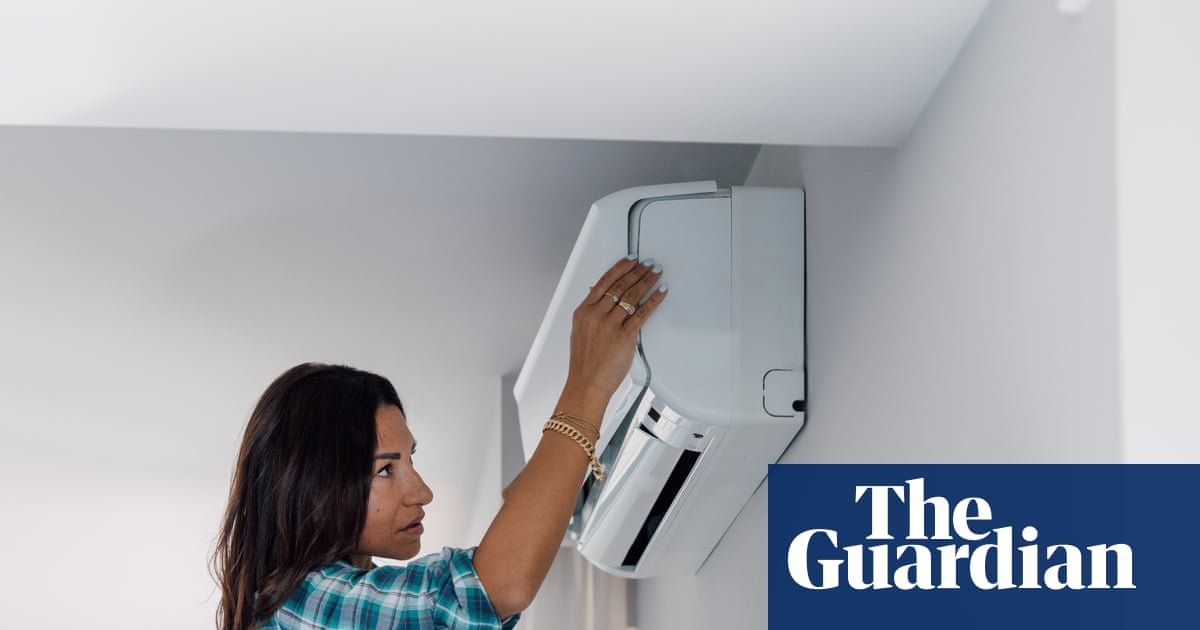
When a heatwave hit the UK this week, software developer John Connaughton started monitoring temperatures inside his East Hampshire terraced house. The temperature in some rooms can reach close to 40 degrees Celsius, so it’s time to install an air conditioner. “We only respond to emergencies on an emergency basis,” he said. “We were having trouble sleeping.”
Connaughton and his wife have a portable air conditioner. These plug-in devices cool indoor air by removing heat from the air and blowing it outside, usually through large hoses hanging from windows and doors.
Connaughton only runs the unit from time to time if the solar panels on his roof can cover his electricity needs. But he still questions the use of technology. “It feels like a luxury and bad for the environment,” he said.
Do I need air conditioning in the UK?
Most homes in the UK are not built to withstand extreme heat. Photo: DeMarre/Getty
British homeowners are rapidly installing air conditioning as the climate crisis heats up summers. An estimated 4 million households now have air conditioning, double the number from three years ago.
Portable units with a power rating of around 1kW are fairly common, and more and more people are installing air-to-air heat pumps, but they can be much less than 1kW for cooling private rooms. However, some large centralized systems, such as those that use ductwork to cool multiple rooms, can use much more power than an electric oven, perhaps 2.7kW.
The government’s climate advisers said in a report last week that around 22% of UK homes will require active cooling, such as air conditioning, when global heating reaches 2C. However, this comes with risks. Air conditioners use so much energy that some researchers say they could threaten progress towards net zero.
Nicole Miranda, sustainable cooling researcher and carbon reduction manager at the University of Oxford, agrees. But she said Mr Connaughton’s approach of combining air conditioning with solar power was “a good idea”, adding: “It’s really considerate.”
Can air conditioners be green?
Green roofs can help keep buildings cool and can even use sunlight to power air conditioners. Photo: Pat Tuson/Alamy
According to the Energy Saving Trust, air conditioners use more energy than other cooling devices, resulting in higher carbon emissions. Using a portable unit for an average of 8 hours a day in the summer produces approximately 4.87 kg of CO2 emissions, which is equivalent to approximately 18 miles of driving.
If you don’t have solar panels but feel that air conditioning is essential, one approach might be to only run your air conditioner when there is high levels of renewable energy on the grid, such as during the sunniest hours of the day.
Rooms can also be pre-cooled before evening electricity demand peaks. Alternatively, you can power your air conditioner with a household battery that charges when you have surplus renewable energy, allowing you to make the most of your renewable energy without owning it yourself.
Andrew Sissons, director of sustainable futures at charity Nesta, said people should not feel guilty about using air conditioning. Even inefficient portable devices were probably used only as a “last resort” by many people. Miranda pointed out that air conditioning can help keep people safe, especially children, the elderly and vulnerable people, during periods of deadly heat.
Natalie Massey, energy expert at Uswitch, said: “Until the entire grid runs on renewable energy, air conditioners that run purely on grid power won’t be truly ‘green.’ Heat pumps move heat rather than create it, and can produce about three units of cooling output for every unit of electricity they use.”
What kind of air conditioner can I install?
Approximately 22% of UK homes will require active cooling with 2C of global heating. Photo: David Taljat/Getty
It is important to note that not all air conditioners are the same. Richard Laws, global head of heat and buildings at the Regulatory Support Project, an energy think tank, said portable versions were relatively inefficient. Blowing out air lowers the air pressure in the room, so some of the warm air is inevitably drawn into the room through windows and doors that are slightly opened for the exhaust hose.
If you’re investing in a built-in air conditioner, make sure you buy the right size unit for the room you’re cooling (think of it like a radiator). According to Checkatrade, a wall-mounted unit powerful enough to cool the average UK bedroom (12,000 BTU) costs around £750, with a further £1,150 to install. A comparable portable unit costs £350.
Air conditioners work on the same principle as heat pumps, moving heat from one place to another with the help of a refrigerant fluid. However, devices commonly referred to as “air-to-air heat pumps” are reversible and can provide heating as well as cooling.
Air-to-air heat pumps, where the outdoor and internal units are connected by sealed pipes through the exterior walls of the property, are probably the best option for the environment.
Sissons added that homeowners who switch from oil or gas heating to electric air-to-air heat pumps and use them for winter heating and summer cooling are decarbonizing their homes. “This is a huge victory against climate change, and it should never be held back.”
The Government will offer homeowners in England and Wales a £2,500 grant to replace their fossil fuel-based heating systems with air-to-air heat pumps, which are currently rarely installed.
What about other ways to stay cool?
Shutters that block sunlight are also an option. Photo: Kevin Britland/Alamy
Also consider passive cooling steps, such as shading your windows, naturally ventilating your home when temperatures drop at night, adding greenery to your roof, and adding insulation to reduce heat intrusion. Such measures may be sufficient on their own and will lower the energy demand for air conditioning.
“I get wet towels and use a fan to spread them out like curtains,” Miranda said. There is a risk that people who own air conditioners will use them more often than necessary, increasing the impact on energy consumption, she added.
How is a fan different from an air conditioner?
Electric fans are cheaper than air conditioners and have a minimal carbon footprint. Photo: MementoJpeg/Getty
According to , the typical cost to run a fan 24 hours a day in the UK is between 15p and 31p*. Energy Saving Trust. Fans use less energy, minimizing your carbon footprint.
Using a portable air conditioning unit for 24 hours will cost £5 on the same basis. They have a higher purchase price than most electric fans, costing more than 20 times more than a typical freestanding fan when used continuously for 24 hours.
A 2021 study found that on hot days from 2007 to 2019, using a fan alone was as effective as an air conditioner in preventing heat stress.
Connaughton anticipates that he and his wife will rely on air conditioning more often, so they are considering purchasing a more efficient air conditioner. “Everyone is aware of how the UK’s climate is changing and how summers are changing,” he said. “That’s worrying.”
* UK Energy Saving Trust figures are accurate as of May 2026. Based on electricity prices of 24.7p/kWh and gas prices of 5.7p/kWh, calculated from a weighted average of forecast, current and recent energy price caps.
