


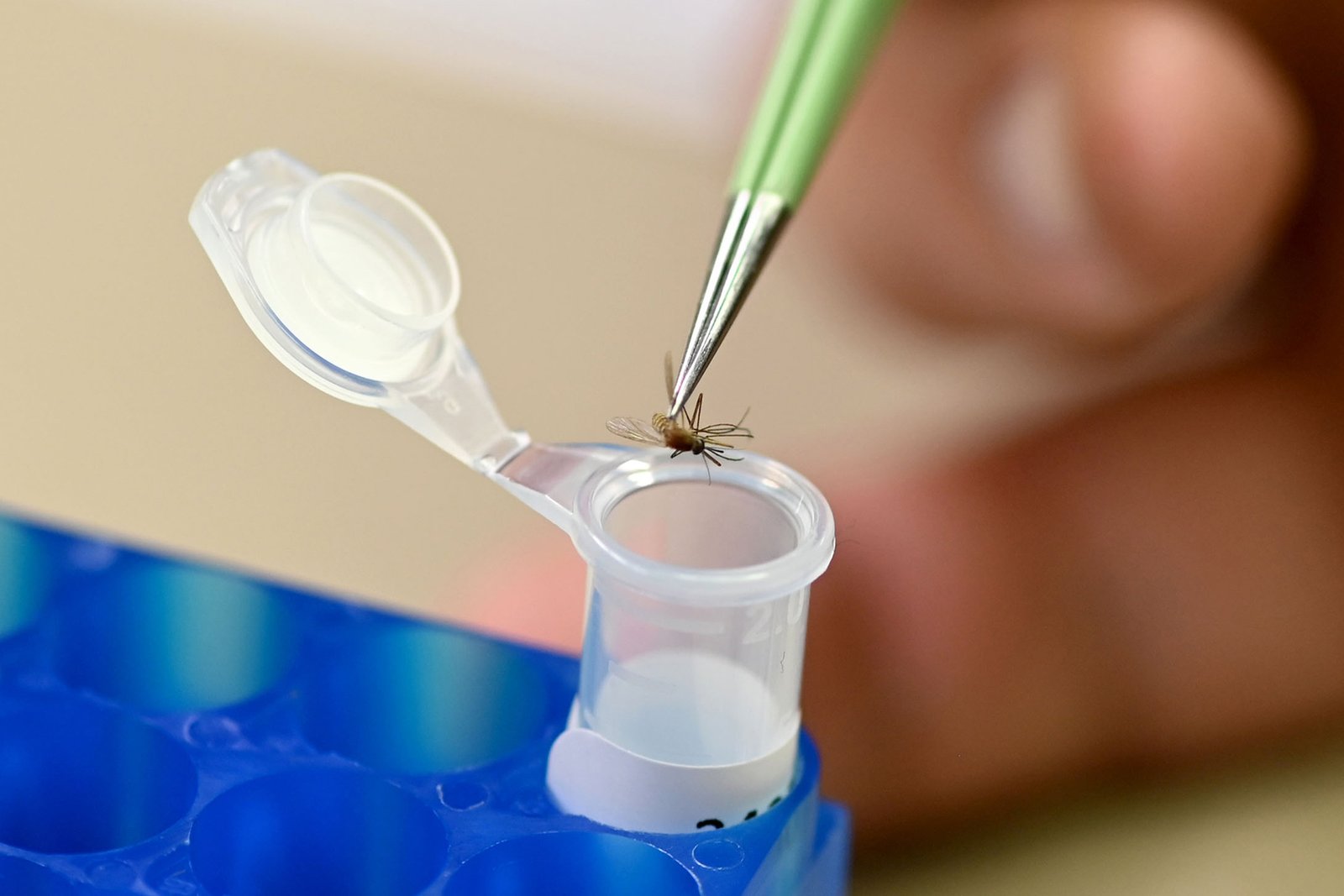
With the heat of summer comes pool parties, beach days, backyard barbecues, and, of course, swarms of bloodthirsty mosquitoes.
But while insect bites have always been a side effect of spending time outdoors, the species that cause insect bites are changing in historically temperate regions like New England. As climate change makes these regions warmer and wetter, their ranges are expanding, along with all the diseases they carry.
For example, in Connecticut, a statewide mosquito surveillance program detected 54 different species, including invasive species such as the Asian tiger mosquito, which transmits potentially serious diseases such as dengue and Zika. This mosquito’s historical territory was further south in hot, humid climates, but it is moving north.
“Many new species are creeping into our region,” said Philip Armstrong, chief scientist at the Connecticut Agricultural Experiment Station, which coordinates the state’s mosquito trapping and testing program.
Such programs are key to preventing mosquito-borne diseases, especially as risks change due to climate change. “We need to actually test mosquitoes to find out where these virus hotspots are,” Armstrong said. “By the time we learn about human cases, there’s usually nothing we can do.”
In most parts of the country, statewide surveillance programs do not exist. Instead, a patchwork quilt of more than 1,000 mosquito control agencies is trying to stay ahead of the evolving problem. Most operate at a regional level and employ a wide range of organizational structures and monitoring practices.
Dan Murkowski of the American Mosquito Control Association, a nonprofit that works to reduce mosquitoes and vector-borne diseases, said the U.S. should have a national surveillance database that collects and shares information from all surveillance programs. But “everything obviously comes back to money,” he added.
“There are cycles of increased viral activity that we haven’t seen historically. This has the characteristics of something that is being affected by climate change.”
—Philip Armstrong, Connecticut Agricultural Experiment Station
Last week, the state of Connecticut announced that mosquitoes in the state had tested positive for West Nile virus this season already. The virus occurs every summer and is the main cause of mosquito-borne disease in the Northeast. Although most infections are asymptomatic, it can cause flu-like symptoms and has killed more than 3,300 people since it first emerged in the United States in 1999.
Two years earlier, Connecticut established a surveillance program to monitor for another virus. Eastern equine encephalitis is a rare but serious mosquito-borne disease that can cause neurological problems and has a mortality rate of about 30 percent. Although still rare, outbreaks are becoming more frequent in New England.
“There are cycles of increased viral activity that we haven’t seen historically,” Armstrong said. “It has the characteristics of something that is affected by climate change.”
In temperate regions like the Northeast, global warming could change the risk of mosquito-borne diseases by not only expanding the range of virus-carrying insects, but also by extending the transmission season, reducing the number of predatory mosquitoes, and changing habitat. Researchers predict that tropical mosquito-borne diseases such as Zika, dengue, chikungunya and malaria are likely to take hold in temperate regions as a result of climate change.
“Warmer temperatures actually accelerate mosquito outbreaks, so new areas can potentially have multiple mosquito outbreaks each year,” said Brian Reidet, who studies mosquito and tick-borne diseases at the State University of New York’s School of Environmental Sciences and Forestry.
This story is funded by readers like you.
Our nonprofit newsroom provides free advertising for our award-winning climate coverage. We rely on donations from readers like you to continue our work. Donate now to support our work.
donate now
Reide said environmental changes can affect not only mosquitoes but also viruses and their original hosts such as birds and deer, causing complex ecological changes that are difficult to study.
Reidet helped establish a monitoring program in St. Lawrence County, New York in 2024 following an outbreak of eastern equine encephalitis. Unlike Connecticut, New York does not have a statewide program, and many counties “lack the infrastructure and funding to regularly monitor mosquitoes,” according to the project’s announcement.
Surveillance programs are typically labor-intensive and expensive, requiring the collaboration of teams to set and check traps and experts to identify, classify, and test samples. Some traps attract female mosquitoes with “stinky water” rich in decaying organic matter, while others require dry ice to emit carbon dioxide, which mosquitoes smell when hunting mammals. However, dry ice can be difficult to obtain in rural New York, and the team had to make their own ice.
In addition to logistics and resource issues, communication, coordination, and data sharing for mosquito surveillance can also be a challenge.
“One of the problems with states that don’t comprehensively implement these monitoring programs is that the monitoring can be hit or miss,” Reidet said. “A lot of these monitoring programs are run by counties, but the counties don’t really talk to each other.”
Reide’s lab found that this patchwork system means that some non-native mosquito species fly under the radar.
Another challenge to strengthening oversight is funding. “If the county doesn’t have the funding and resources, these programs will disappear,” Reidet said. “Without these monitoring programs, all we’re doing is responding to problems when they’re already a problem, and prevention never works.”
That situation could change with a bill introduced in the New York State Assembly this session. The bill would lay the groundwork for a comprehensive mosquito surveillance program that would allow public health officials to respond before an outbreak occurs, instead of what the bill calls the current “sparse and broken” system.
Pre-emptive measures include clearing standing water, applying targeted larvicides to breeding habitats, and warning the public to use insect repellents and cover bare skin when outdoors, but more widespread insecticide applications may be needed in the event of an outbreak.
Greater centralization is a start, but widespread coordination can be difficult in a large state like New York, Reidet said. “There’s a lot of public interest in these programs, but when you start looking at how much they cost, you’re like, ‘Maybe we’re not that interested.'”
Still, he said, “any help is better than nothing.”
About this story
As you may have noticed, this article, like all news we publish, is free to read. That’s because Inside Climate News is a 501c3 nonprofit organization. We don’t charge subscription fees, keep our news behind paywalls, or fill our website with ads. We provide climate and environmental news free to you and anyone who wants it.
That’s not all. We also share our news for free with dozens of other news organizations across the country. Many of them cannot afford to do their own environmental journalism. We’ve established bureaus across the country to report on local news, partner with local newsrooms and co-publish stories to ensure this important work is shared as widely as possible.
The two of us started ICN in 2007. Six years later, we won the Pulitzer Prize for national reporting and now run the nation’s oldest and largest dedicated climate newsroom. We tell the story in its entirety. We hold polluters accountable. We expose environmental injustice. We debunk misinformation. We explore solutions and inspire action.
Donations from readers like you fund all aspects of our work. If you haven’t already, will you support our ongoing work, our coverage of the biggest crises facing our planet, and help us reach more readers in more places?
Please make a tax-deductible donation. Each one makes a difference.
thank you,

Madeline Shaw
fellow
Madeline Shaw is an Outrider Fellow at Inside Climate News and a journalist with New York University’s Science, Health, and Environmental Reporting Program. She has reported on issues related to conservation, poaching and biodiversity. Her work has appeared in the New York Times and Scienceline.
