


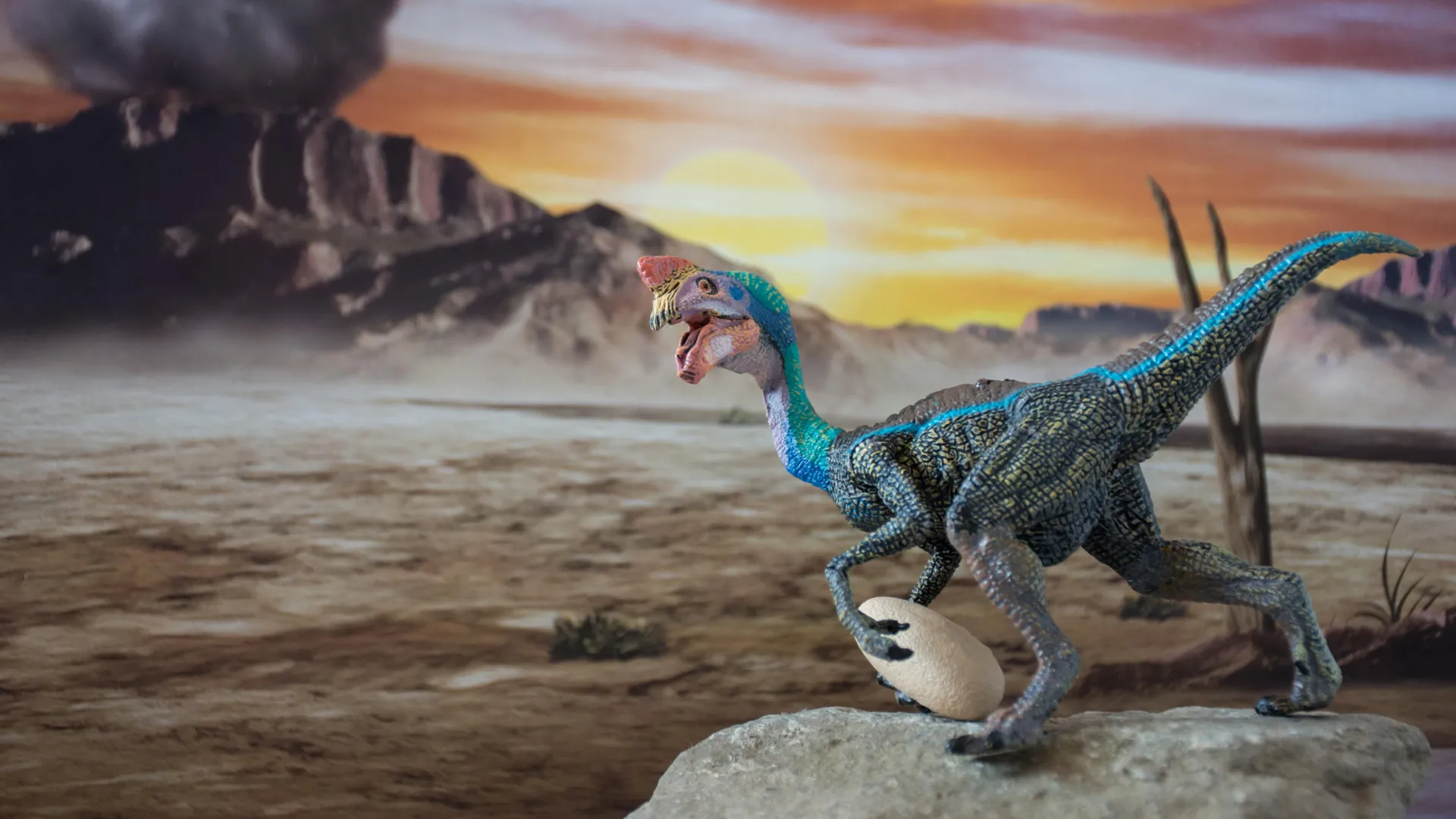
How did oviraptors bring their young into the world? These feathered, bird-like dinosaurs couldn’t fly, but scientists have long wondered whether they hatched eggs like modern birds, or whether they relied more on the heat of their environment like crocodiles and turtles.
New research published in Frontiers of ecology and evolution I will review the question again. Researchers in Taiwan used a combination of physical experiments and computer simulations to investigate how oviraptor eggs are warmed and how efficiently they hatch. To do so, they created a life-size model of an oviraptor and recreated its nest using artificial eggs.
This result suggests that the position of the incubating adult relative to the egg played an important role in egg development.
“We showed that differences in oviraptor hatching patterns were caused by the relative positions of the adults and eggs during hatching,” said lead author Dr. Tzu-Ruei Yang, associate curator of vertebrate paleontology at the National Museum of Natural Science, Taiwan.
The study also found that Oviraptor’s hatching efficiency was lower than that of modern birds.
“We also obtained an estimate of the hatching efficiency of Oviraptor, which is much lower than that of modern birds,” added lead author Chun Yu-Su, who was attending Washington High School in Taichung at the time the study was conducted.
oviraptor
Oviraptors are a group of feathered, bird-like dinosaurs that lived during the Late Cretaceous Period, approximately 100 million to 66 million years ago. Despite their name, which means “egg thief,” scientists currently believe they do not steal eggs. The first oviraptor fossils were found near nests, leading researchers to mistakenly assume that the oviraptors were raiding the nests. Subsequent discoveries revealed that the dinosaur was probably caring for its own eggs.
These relatively small to medium-sized dinosaurs had beak-like jaws and long necks, and often had crests on their heads. Most species were probably omnivorous, eating a variety of foods, including plants, seeds, eggs, shellfish, and small animals. Fossils discovered in Asia, particularly Mongolia and China, provide remarkable evidence of nesting behavior, including adults preserved in a brooding position on the nest.
Oviraptor is of particular interest to scientists because it helps reveal the evolutionary transition from non-avian dinosaurs to modern birds. Their plumage, nesting habits, and parental care behaviors indicate that many traits associated with birds evolved long before the first true birds appeared.
Recreating an ancient dinosaur nest
Based on the reconstruction, the researchers Huangyuanniaa type of oviraptor that lived in what is now China between 70 and 66 million years ago. The dinosaur, which was about 1.5 meters long and weighed about 20 kilograms, built a semi-open nest containing several egg rings.
To recreate this animal, the team used a wooden skeleton and polystyrene foam to construct the torso. Cotton, cloth, and bubble paper were added to represent soft tissue. The eggs were cast from resin and placed in a double ring that matched the arrangement seen in fossilized oviraptor nests.
Creating a realistic model was not easy.
“Part of the difficulty lies in realistically reconstructing oviraptor hatching,” Hsu said. “For example, oviraptor eggs are different from eggs of modern species, so we invented resin eggs to get as close as possible to real oviraptor eggs.”
Sunlight may play a big role
The researchers tested how different environmental conditions and the presence of an adult in the nest affected the temperature of the eggs.
Under cool conditions, eggs in the outer ring of the nest with adults showed a temperature difference of up to 6°C. Such fluctuations could have caused asynchronous hatching. This means that some eggs hatch earlier than others within the same clutch.
In warm conditions, the temperature difference between eggs within the outer ring decreased to only 0.6 °C. This finding suggests that oviraptors that lived in warmer environments may have experienced different hatching patterns because sunlight provided an additional heat source.
“It is unlikely that large dinosaurs were sitting on clutches. Like turtles, they would have used heat from the sun or the soil to incubate their eggs. Oviraptor’s clutches are open to the air, so heat from the sun was likely much more important than heat from the soil,” Yang explained.
Comparison of Oviraptor and modern birds
The researchers also looked at how oviraptor hatching overlaps with that of modern birds.
Most birds use thermoregulated contact incubation (TCI), where the adult sits on the egg and transfers body heat directly to the egg. This strategy depends on three conditions. The parents must touch all eggs, serve as the primary heat source, and keep all eggs within a relatively narrow temperature range.
Oviraptor probably could not meet these requirements. Their unique nest design prevented the adults from having direct contact with all the eggs at once.
“Oviraptor may not have been able to perform TCI like modern birds,” Hsu said. Rather, these dinosaurs and the sun may have been co-incubators, a behavior that is less efficient at hatching than modern birds. However, the combination of adult incubation and an ambient heat source (perhaps a behavioral adaptation associated with the evolution of buried to semi-open nests) is not necessarily bad.
Yang says the comparison should not be seen as a competition between dinosaurs and birds.
“Modern birds are not ‘good’ at incubating their eggs. On the contrary, modern birds and oviraptors have very different methods of incubation, and more specifically, incubation,” Yang pointed out. “There’s no good or bad. It depends on the environment.”
New insights into dinosaur parenting
The researchers emphasize that their conclusions are tied to the reconstructed nests used in the study. They also point out that Earth’s climate today is very different from conditions in the Late Cretaceous, which may have influenced the results. Oviraptor is also thought to have had a longer incubation period than modern birds.
Still, this study provides an innovative new approach to studying dinosaur reproduction. By combining physical reconstruction and heat transfer modeling, researchers were able to investigate questions that were traditionally difficult to investigate using fossils alone.
“This is really encouraging for all students, especially in Taiwan,” Yang concluded. “There are no dinosaur fossils in Taiwan, but that doesn’t mean we can’t study dinosaurs.”
