


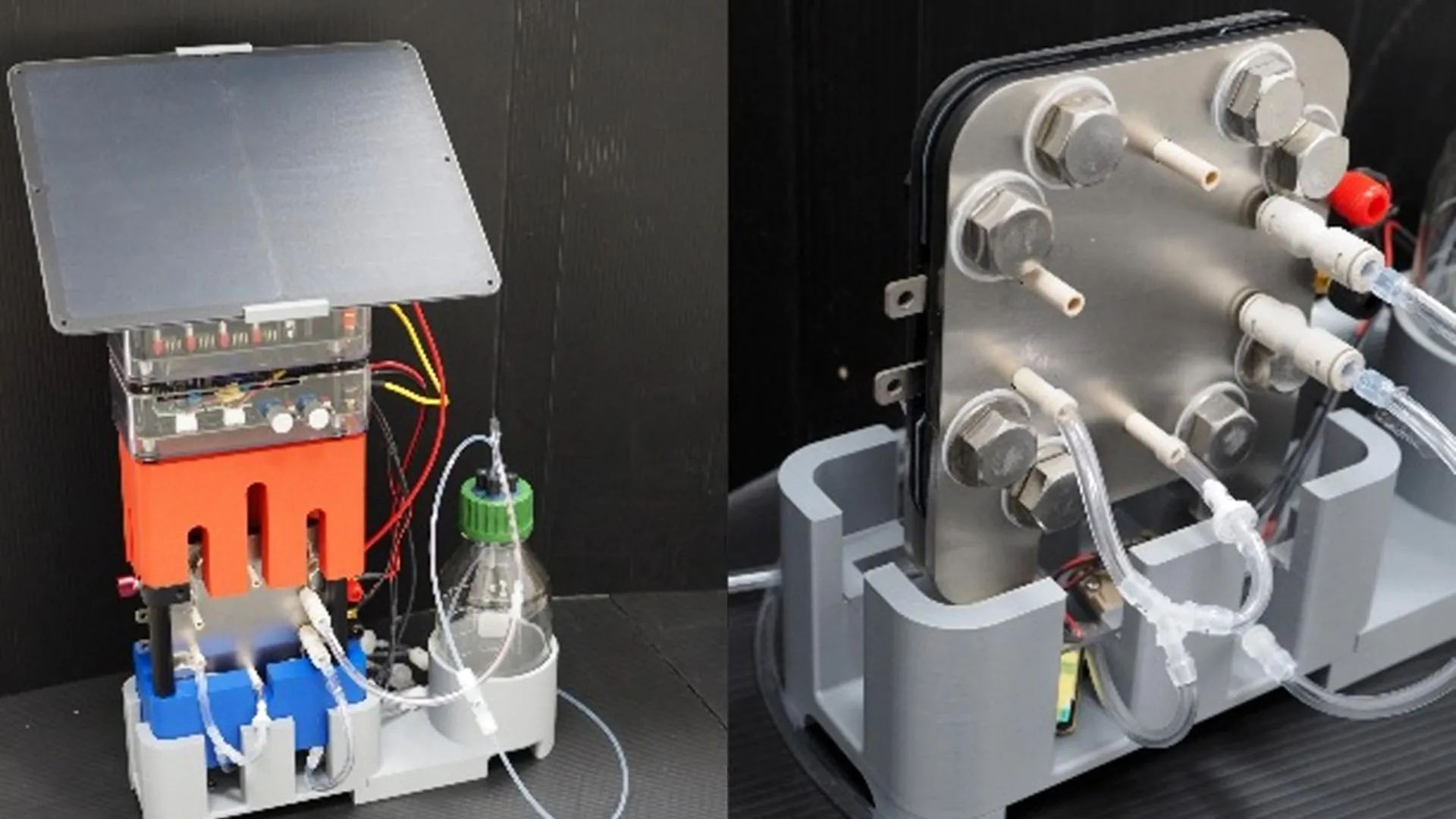
Researchers at Osaka Metropolitan University have developed a new artificial photosynthesis system that can more consistently produce solar fuel while eliminating the need for battery-based controllers. This advancement is achieved by integrating self-regulating chemical components directly into the electrolyzer, reducing both system complexity and cost.
Similar to natural photosynthesis in plants, artificial photosynthesis uses sunlight to convert water and carbon dioxide into energy-rich compounds. One such product is formic acid. This is a chemical that acts as a fuel and energy storage device.
How artificial photosynthesis produces solar fuel
At the heart of these systems is an electrolyzer that converts electricity from solar cells into chemical energy. That energy is stored in the form of a fuel such as formic acid.
The main challenge is maintaining efficient operation when sunlight changes throughout the day. To address this, many artificial photosynthesis systems use maximum power point tracking (MPPT), a method of continuously adjusting voltage and current so that the solar cell provides the highest possible power output.
However, traditional MPPT setups typically rely on batteries and additional electronic components to smooth the flow of energy. Although effective, these additions increase both cost and system complexity.
Self-regulating electrolyzer eliminates the need for batteries
To overcome this limitation, a team led by Associate Professor Yasuo Matsubara and Professor Yutaka Amao from the Osaka Capital University Artificial Photosynthesis Research Center, in collaboration with Iida Group Holdings, Inc., redesigned the electrolyzer itself.
Their approach uses a specially designed solid electrolyte that is integrated directly into the device. As a result, the electrolyzer can automatically perform MPPT functions on its own, eliminating the need for a battery-based control system.
Rather than relying on external electronics, converters, or batteries, electrolysers adjust their electrical properties through their own thermal and impedance characteristics.
“When sunlight increases, the electrolyzer heats up naturally. The system is designed so that this temperature increase lowers the electrical resistance, allowing electricity to flow more smoothly,” explains Professor Amao. “This allows the system to automatically adjust its electrical behavior.”
“This self-regulating behavior allows us to keep fuel production more stable throughout the day and automate the system while reducing dependence on batteries and expensive external components,” he added.
Stable formic acid production under real sunlight
When the researchers tested the technology under real-world outdoor conditions, the system consistently produced formic acid from water and CO2, even as sunlight levels fluctuated.
“This research was also exhibited at the “Joint Pavilion Iida Group x Osaka Capital University” exhibition held as part of the 2025 Osaka-Kansai Expo, so I was confident that it would be a success,” Professor Matsubara said. “We successfully produced enough formic acid to power the miniature dioramas inside the pavilion, demonstrating its potential as an efficient artificial photosynthesis system that can be used to power domestic applications.”
The survey results are EES solar.
