


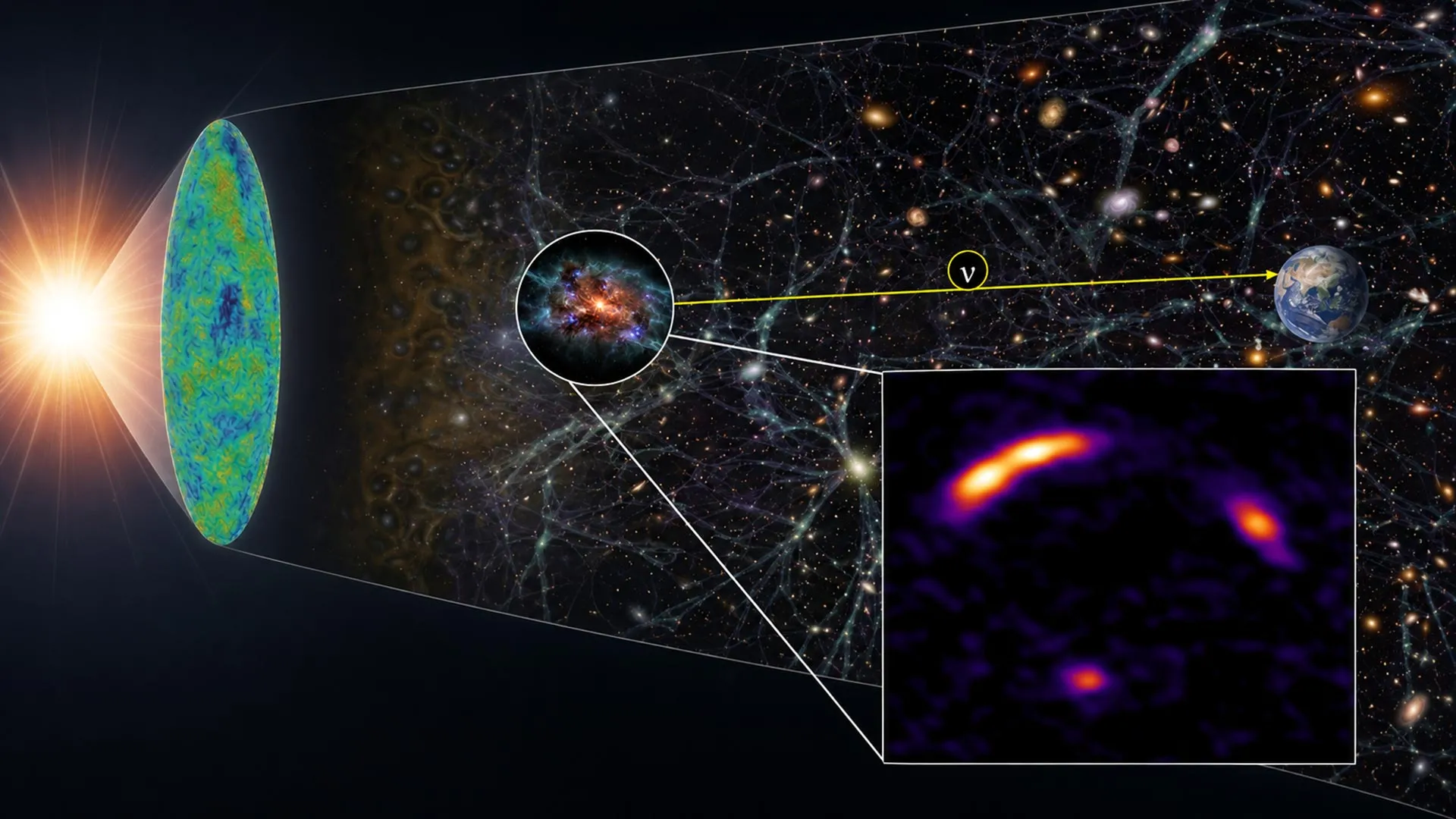
Astronomers using the Atacama Large Millimeter/Submillimeter Array (ALMA) have located the source of a powerful neutrino burst with the help of a surprising cosmic phenomenon that acts like a natural telescope. What they discovered defied expectations.
Researchers initially suspected that supermassive black holes were powering unusually bright distant galaxies associated with neutrino signals. Instead, observations reveal that the galaxy’s energy comes from intense star formation. The discovery provides important evidence that could help explain where many of the universe’s mysterious high-energy neutrinos originate.
Tracking one of the most elusive particles in the universe
Neutrinos are one of the most mysterious particles known to science. A huge number of them pass through space and even through the Earth, with little interaction with matter. Although astronomers have identified a small number of galaxies that can produce neutrinos, these known sources are not sufficient to explain the large populations of high-energy neutrinos detected so far.
To investigate the origins of such particles, an international research team from Mythos Science Corporation, National Chuo University, Nakahara University, Tohoku University, Fukui Institute of Technology, and the National Astronomical Observatory of Japan conducted follow-up observations using ALMA and several other telescopes.
Their target was the high-energy neutrino event IC 210922A, detected by the IceCube Neutrino Observatory in Antarctica. Their search led them to an extremely bright galaxy known as JCMT0402−0424, about 11 billion light years from Earth.
The mystery of the shadow blaster
The neutrino-producing galaxies identified so far are typically powered by supermassive black holes. However, when researchers examined JCMT0402-0424, they found no evidence of the high-energy radiation typically associated with such black holes.
This galaxy is difficult to see in visible light because it is covered in dust. However, it shines strongly at submillimeter waves. Because of its hidden nature and extreme brightness at these wavelengths, the team gave it the nickname “Shadow Blaster.”
Natural telescope reveals galaxy’s core
Astronomers were able to take a deep look inside the Shadow Blaster thanks to a lucky alignment with another galaxy located between it and Earth. The gravity of the foreground galaxy bent and amplified the radio waves from the Shadow Blaster, effectively forming a natural telescope.
This gravitational lensing effect produced brighter, magnified images, allowing ALMA to examine distant galaxies in greater detail.
Radio observations also showed no signs of a powerful black hole. Instead, the data pointed to another energy source. Gas and dust throughout the galaxy appears to be heated primarily by active star formation.
The researchers also identified a dense “compact core” at the center of Shadowblaster. It is just about 1,500 light-years in diameter and is filled with tons of gas and dust. Neutrinos can be produced in such extreme environments.
New explanation for high-energy neutrinos
This result suggests that powerful star-forming galaxies may be important sources of high-energy neutrinos, which have been previously underestimated.
Compact, dust-rich starburst galaxies undergoing rapid star formation may contribute a significant portion of the high-energy neutrino background, the researchers say. Their analysis shows that these galaxies may account for 20% of the total number of high-energy neutrinos observed throughout the universe.
If confirmed in future studies, this discovery could revolutionize scientists’ understanding of how the universe’s most elusive particles are created.
