


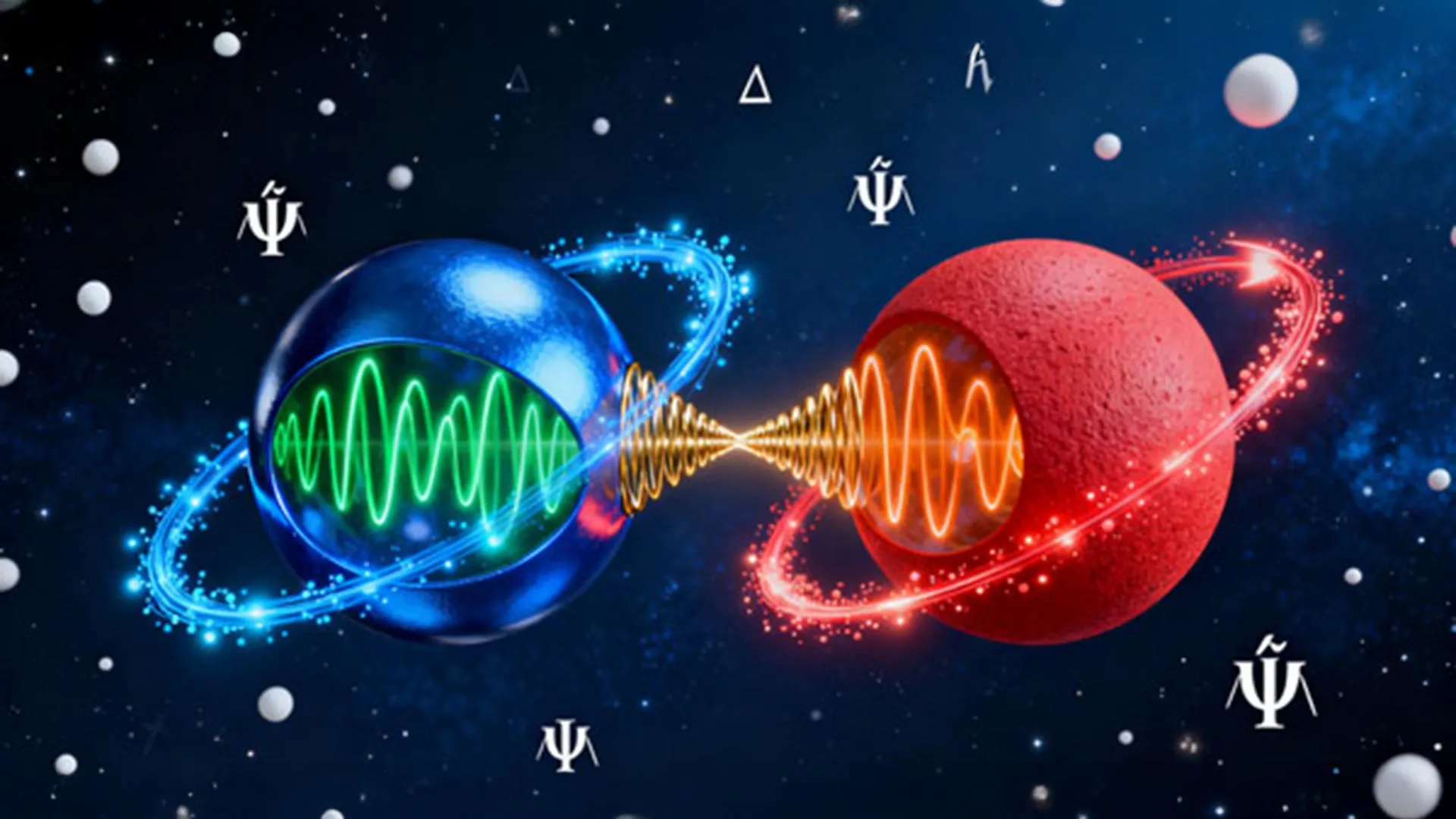
A team of theoretical physicists at RIKEN has proposed a new way to achieve one-way quantum synchronization of phonons, particles associated with sound. This approach stands out because it remains highly effective in the face of real-world challenges such as manufacturing defects and environmental noise.
Many modern technologies rely on components that behave like one-way traffic. These devices allow particles or signals to move freely in one direction, but severely restrict movement in the opposite direction. Known as non-reciprocal components, these are widely used in microwave and optical systems to direct signals and reduce unwanted reflections.
Franco Nori of the RIKEN Quantum Computing Research Center (RQC) points out, “The non-reciprocal component allows the signal to travel along the desired path, but it is greatly attenuated in the opposite direction.” “This ability has applications in a wide range of applications, from signal processing to invisible cloaking.”
One-way quantum synchronization
Researchers have long sought to create a related phenomenon known as non-reciprocal quantum synchronization. In this process, two quantum systems synchronize when information flows in one direction, but no synchronization occurs in the opposite direction.
Despite considerable interest, developing practical methods to achieve this effect has proven difficult. Previous proposals have generally been vulnerable to various limitations that make real-world implementation difficult.
“Practical quantum technologies face significant challenges from random manufacturing defects and environmental noise,” said Adam Milanowitz, also of RQC. “These factors severely constrain or even completely destroy quantum resources under conventional approaches.”
Overcoming noise and defects in new ways
In new theoretical work, Nori, Miranowicz, and Deng-Gao Lai have developed a technique that enables nonreciprocal quantum synchronization of phonons while avoiding many of the obstacles that have hampered previous approaches.
“This development establishes a new foundation for producing fragile to robust irreversible quantum resources that will enable future practical applications,” Nori said.
Their strategy combines two separate quantum effects into one framework. Using this approach, phonons synchronize when light or a magnetic field is applied from one direction, but not when the same influence comes from the opposite direction.
The amazing robustness of quantum technology
The researchers were particularly surprised by the system’s proven resilience.
“We were excited to discover that quantum synchronization persists even in the presence of significant imperfections and noise,” says Lai. “Previously, this was thought to be impossible without employing complex protection schemes.”
The research team believes this discovery could help accelerate the development of practical quantum technologies and plans to continue exploring this concept.
“By enabling robust non-reciprocal quantum synchronization, our work paves the way for more reliable quantum processors and protected quantum resources,” commented Lai. “We are now planning to explore applications in quantum networking and error-tolerant quantum information processing.”
