


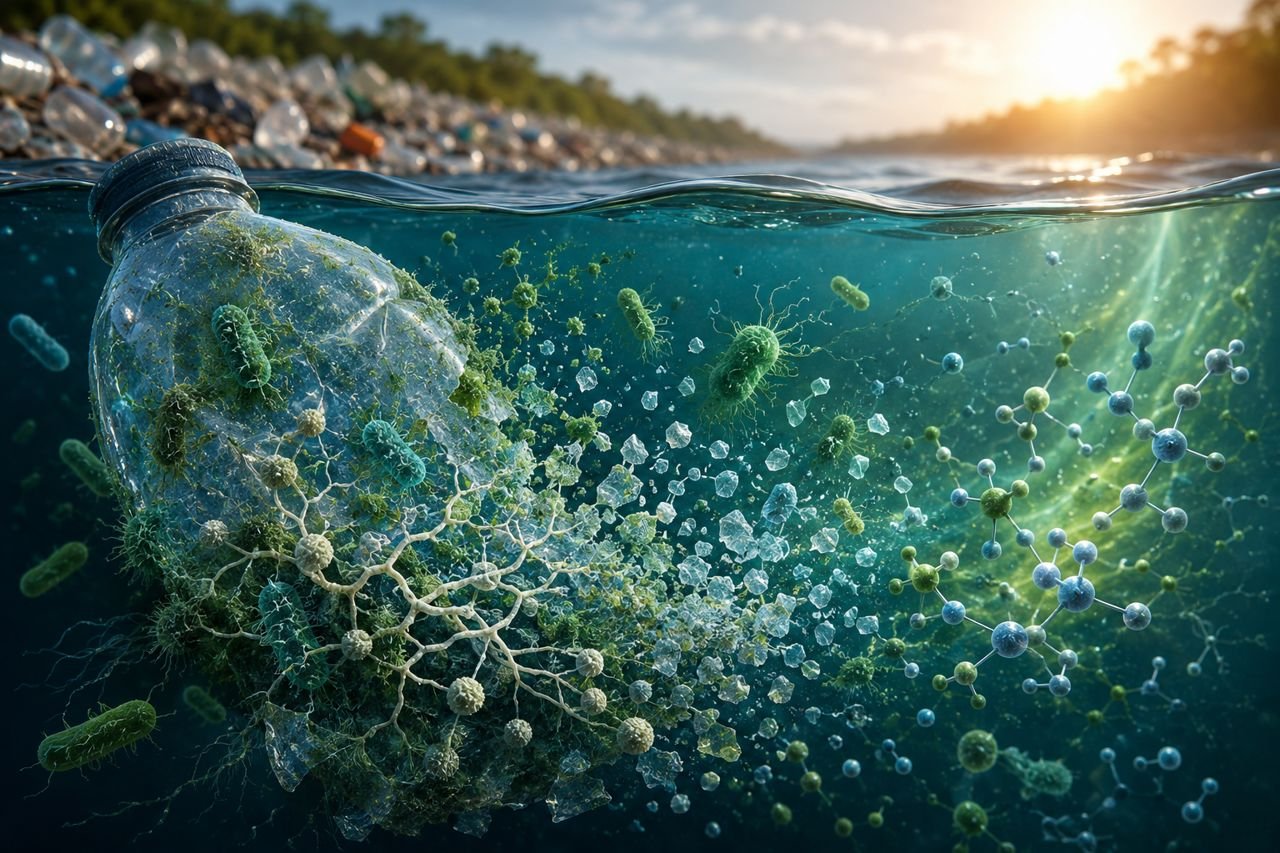
Microplastic pollution has become a global cleanup problem with no clear end point. Filtration can capture some particles, dredging removes contaminated sediment, and chemical treatments can change certain polymers, but these interventions are expensive, incomplete, and often move plastic from one place to another rather than destroying it.
A new scientific review claims the most promising alternative may come from organisms too small to see. “Microbial bioremediation of microplastic pollution for sustainable ecosystems and a greener future: A review” Published in applied microbiologyinvestigates how bacteria, fungi, microbial communities, and plastic-degrading enzymes can potentially break down synthetic polymers and convert their carbon into useful products. This paper summarizes developments in microbial ecology, enzyme engineering, CRISPR, synthetic biology, multi-omics, nanobiocatalysts, and bioreactor design.
Microorganisms can colonize plastics, weakening polymer chains and metabolizing some degradation products. Scientists can increasingly engineer these processes to be faster and more targeted. However, these techniques are still far from being a universal environmental treatment. The hardest plastics are resistant to biological attack, often underperforming in the laboratory under real-world conditions, and engineered organisms pose significant biological safety and regulatory issues.
So a breakthrough won’t come from discovering one mythical bacteria that “eats plastic.” It comes by creating a controlled biological system where microorganisms, enzymes, reactors and waste infrastructure work together.
Microplastic removal still treats the symptom, not the substance
Microplastics are generally defined as particles smaller than 5 millimeters. These occur as intentionally manufactured particles or through the fragmentation of larger products such as packaging, synthetic fibers, tires, fishing gear, and agricultural plastics. The problem is not just scale. The same chemical properties that make plastics useful—durability, high molecular weight, hydrophobicity, resistance to heat and water—also make them difficult to remove once they enter an ecosystem. Microplastics currently circulate in water, land, and atmospheric environments and can carry other pollutants across food chains and geographic regions.
Traditional restorations are still poorly suited for their sustainability. Mechanical separation and filtration may work where particles are concentrated, such as wastewater treatment plants, but they become impractical after the pollution has spread to rivers, oceans, and soil. Advanced oxidation and chemical processes require large amounts of energy and can generate secondary waste. Very small particles, especially nanoplastics, remain difficult to capture.
The review’s main criticism is that many existing approaches reposition plastic rather than eliminate it. Filters can remove particles from water, but the collected waste must be treated or stored. Removing sediment can clean up one area while transferring contaminants to another.
Microbial bioremediation offers a fundamentally different model. Rather than simply collecting particles, it attempts to break down polymer chains into smaller chemical units. Under favorable conditions, microorganisms absorb some of these units and channel them into metabolic pathways to produce energy, biomass, or end products such as carbon dioxide or water.
However, “biodegradation” is often used too loosely. Surface damage, weight loss, or fragmentation does not necessarily mean complete destruction. The process of turning microplastics into even smaller particles can exacerbate environmental problems. Therefore, a reliable technology must demonstrate that it produces identifiable chemical intermediates and ideally completes mineralization or controlled transformation into recoverable products.
Microorganisms work as a team, and their enzymes perform the cutting.
Plastic biodegradation is not a single biological reaction. It is a series of chained processes starting with the attachment of microorganisms. When bacteria and other organisms colonize plastic surfaces, they form biofilms, which are structured communities held together by secreted substances. These biofilms create a zone of concentration of cells, enzymes, and metabolites at the interface between the organism and the polymer.
Within this environment, different enzymes perform different jobs. Oxidizing enzymes such as laccases and peroxidases can alter resistant polymer surfaces, making them less crystalline and more chemically accessible. Hydrolytic enzymes such as esterases, cutinases, lipases, PETases, and MHETases cleave sensitive bonds and release smaller molecules. Oxidative “priming” modifies the polymer before hydrolytic enzymes cleave it into oligomers and monomers that can be assimilated by microorganisms.
Some polymers are much more fragile than others. Polyethylene terephthalate (PET) contains ester bonds that can be attacked by enzymes. Polyurethanes and some polyamides also provide chemically accessible targets. Polyethylene, polypropylene, and polystyrene are very hard because their stable carbon-carbon backbones resist enzymatic cleavage.
This uneven performance explains why dramatic test results should be interpreted with caution. This review mentions a genetically engineered leaf-and-branch compost cutinase that can achieve approximately 90% PET depolymerization in 10 h at 72 °C under optimized conditions. While this is a major technological achievement, it also presents challenges. The high temperatures, carefully prepared materials, and controlled conditions are very different from rivers, landfills, and farmland.
The study also highlights that individual microbial species are rarely sufficient on their own. Mixed plastic waste requires different enzymes and metabolic functions, making microbial consortia more promising than single microbial solutions.
In such a consortium, one species could chemically prime the polymer, another cleave its chains, and a third species could consume or detoxify the resulting intermediate. This division of labor reduces metabolic stress, increases stability, and has the potential to process multiple types of polymers at once.
CRISPR could build better plastic degraders, but also increased risks
Natural microorganisms evolved long before synthetic plastics became widespread. Therefore, their ability to degrade modern polymers is often slow, incomplete, or haphazard.
CRISPR and synthetic biology give researchers the ability to redesign that biology. Plastic-degrading genes can be inserted into microbial hosts to increase enzyme production, eliminate competing metabolic pathways, and use regulatory switches to activate the degrading function only when a specific polymer is present.
This review describes how CRISPR can be used to introduce PETase and related enzymes to optimize promoters and eliminate pathways that waste cellular resources. The proposed results are more enzyme secretion, faster depolymerization, and less accumulation of toxic intermediates.
Multi-omics technology makes this engineering more systematic. Metagenomics can identify genes that degrade plastic in complex environmental communities without first culturing all the organisms. Transcriptomics reveals which genes are activated when microbes encounter plastic. Proteomics determines whether the corresponding enzyme is produced, and metabolomics tracks the chemical intermediates formed during degradation.
Together, these tools can reveal bottlenecks that remain hidden. Even if microorganisms have the necessary genes, they may not be able to produce enough enzymes. It may cleave the polymer, but the resulting compound cannot be metabolized. Although it performs well at laboratory temperatures, it loses activity under environmental stress.
Protein engineering, enzyme immobilization, and nanobiocatalysis can address some of these weaknesses. Immobilized enzymes can be attached to reusable supports, increasing stability and allowing recovery after multiple treatment cycles. This could reduce costs and make continued treatment more viable.
The danger is that more capable organisms may cause more serious failures. Genetically engineered microorganisms released into the environment can persist unexpectedly and transfer genetic material to other organisms or disrupt existing ecological communities. This review discusses safeguards such as kill switches, nutrient dependence, and self-limiting genetic circuits. They also suggest using closed bioreactors to prevent modified organisms from directly entering natural ecosystems.
Although these protections are necessary, they cannot be treated as automatic guarantees. Biocontainment systems can fail, mutate, or behave differently outside of a laboratory environment. Therefore, independent ecological risk assessments, long-term monitoring, and transparent regulatory reviews need to develop in parallel with the science.
Public acceptance is also important. Local communities may support biological treatment within wastewater treatment plants while opposing the release of genetically modified organisms into rivers, coastal areas, and agricultural land. The path to implementation depends not only on technical efficiency, but also on whether the technology is manageable and reliable.
The winning model may be biorefineries rather than environmental releases
The most powerful application in the near term could be in containment systems where microplastics are already concentrated. Wastewater treatment plants are obvious targets because they receive fibers and particles from domestic, industrial, and municipal wastewater. Recycling plants and industrial facilities can also integrate microbial or enzyme-based treatments into existing waste streams. Contaminated soil may eventually be treated through controlled ex-situ processes rather than open release into the environment.
Bioreactors represent the most practical bridge between laboratory discovery and industrial applications. These allow operators to control temperature, pH, oxygen, mixing and holding times, variables that have a significant impact on enzyme and microbial performance.
But microplastics present unusual engineering challenges. They are insoluble, buoyant, and chemically heterogeneous. Traditional stirred tanks may not be able to maintain effective contact with biological catalysts. This review focuses on airlift, packed bed, fluidized bed, and biofilm reactors as alternatives that can improve the contact between particles and enzymes.
The commercial case may ultimately depend on whether degradation creates value. The circular bioeconomic model in this review assumes that microorganisms and enzymes can break down plastics into smaller compounds that can be converted into biomass, bioenergy, or biochemicals. That would take the technology beyond pollution prevention to resource recovery. This is strategically important. Cleanup processes that consume energy and incur disposal costs will be difficult to scale up, especially in developing countries with limited waste management budgets. Processes that also recover monomers, chemicals, or energy-rich products could attract private investment and be easier to integrate into industrial systems.
However, the economic situation remains uncertain. Mixed waste may contain dyes, plasticizers, fillers, and several types of polymers, each requiring different treatment. Enzyme activity may be lost. The microbial community may become unstable. Transferring and mixing oxygen can be expensive at large scale. Techniques that work well with pure PET in the lab can struggle with dirty, weathered, and chemically complex waste.
Therefore, this review is best read as a map of technological possibilities rather than evidence of commercialization readiness. Although it synthesizes advances across multiple areas, it does not systematically compare costs, degradation rates, and life cycle impacts. This is a narrative review and does not present a new experimental data set.
Microbial bioremediation should complement, rather than replace, upstream activities. Plastic reduction, product redesign, reuse, recovery and traditional recycling remain essential. No biological system can efficiently capture all the particles already dispersed in the ocean, soil, and atmosphere.
First release date: Developer talk
