


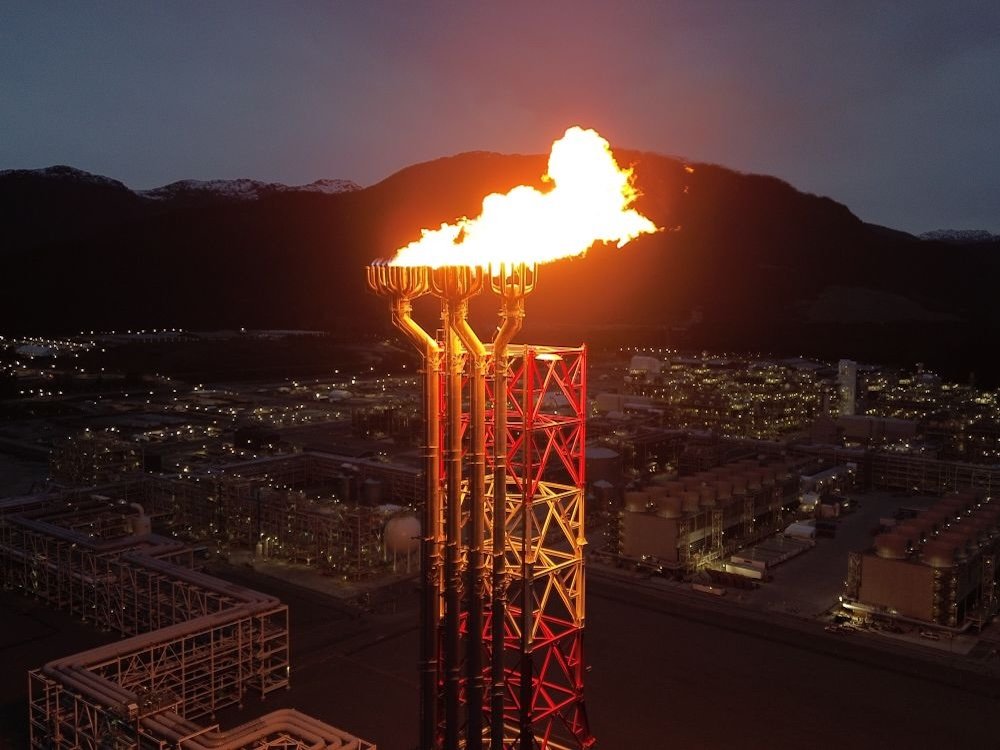
A key tool for destroying potentially dangerous gas at the LNG Canada facility in Kitimat has been out of service for more days than it was in operation between September and April.
Announcements, events, and more from Tyee and select partners
Hollyhock invites you to the “art of entanglement”

A five-day journey through spirit, art, and science that reveals the interconnectedness of all things.
Before operations began, LNG Canada predicted that the shutdown of its two acid gas incinerators could result in one of its “worst-case flare scenarios.” However, the ministry assured that such cases are rare, occurring “approximately once a year and lasting between four and six hours.”
But the incinerator in one of the plant’s two production units was shut down for 139 days in the eight months starting in April, including one outage for two consecutive months, according to monthly air emissions reports obtained by researchers through a Freedom of Information request and later shared with the media.
LNG Canada’s sour gas incinerators are closed burners that destroy hazardous gases such as hydrogen sulfide and benzene under tightly controlled high temperature conditions. This level of control ensures that no harmful gases escape or form other dangerous compounds during the combustion process.
LNG Canada sent those gases to one of its flare stacks when the incinerator was shut down, increasing the flare temperature with additional gas. According to the company and the BC Energy Regulator, this approach “ensures the same combustion process occurs and the acid gases are safely destroyed.”
But Faisal Khan, chair of chemical engineering at Texas A&M University, disagrees.
“That doesn’t work,” he said. “If that’s the analogy you offer, it’s scientifically incorrect.”
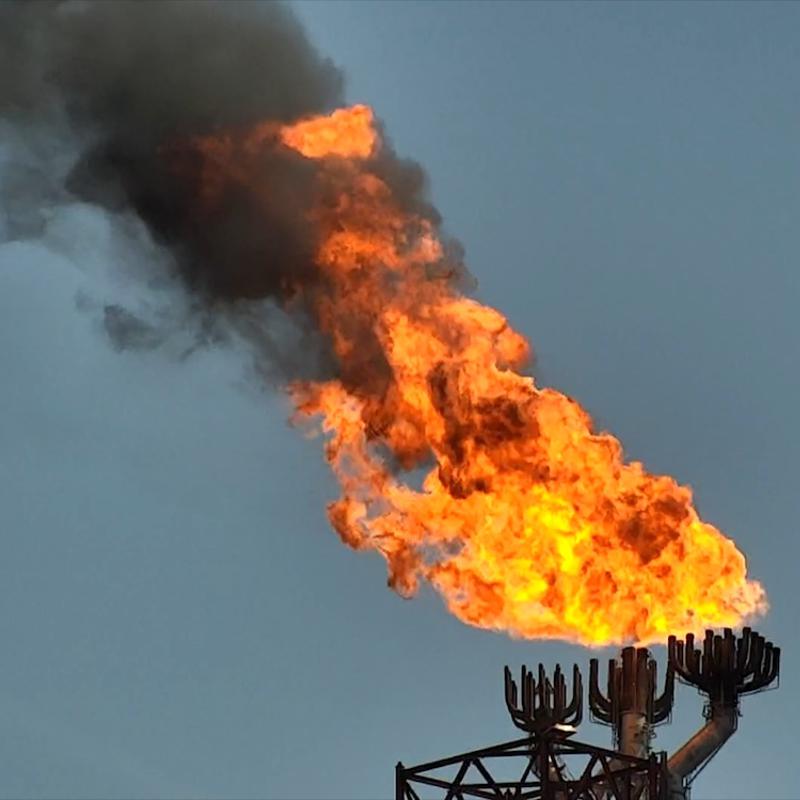
Khan said flare stacks are not a replacement for incinerators. Even if the extra gas contributes to the temperature increase, changes in the gas composition or environment can change how the gas burns, leaving some or most of the gas unburned. The black smoke rising from the flare tip of LNG Canada provides a visual example of gas particles that the flame was unable to burn completely.
In a pre-operation pollution modeling document obtained by The Tyee, LNG Canada promised the province that it would take steps “to minimize the amount of acid gases sent to the flare” if the incinerator is shut down for an extended period of time.
The company said it would reduce production to “minimal” levels until the incinerators are back in operation.
In response to a question from The Tyee about whether it had reduced production as promised during the incinerator outage, a spokesperson wrote, “LNG Canada has various operational controls in place to manage and minimize the amount of gas sent to the flare when the sour gas incinerator is unavailable. Specific operational conditions will vary depending on the nature of the event.”
LNG Canada’s pollution modeling estimates that incinerator shutdowns will release high levels of volatile organic compounds into the wind field, including benzene, a strong carcinogen.
The acid gas incinerator for the company’s first production unit, or “train,” was out of service for all of October and November and March last year. In September and December, incinerators broke down or shut down for about half of the months. The second train’s incinerator malfunctioned when it was restarted last November, but it was shut down for most of December and nine days this year.
acid gas incineration
Acid gas incinerators help address one of LNG producers’ biggest challenges: the natural gas they receive contains compounds that prevent proper liquefaction.
B.C. town requests study into health effects of LNG
read more
To remove these impurities, LNG operators like LNG Canada use a series of processes that involve solvents, heat, and pressure. But once the compounds are removed from the soon-to-be liquefied gas, it has to go somewhere.
Some LNG facilities turn the compounds into commercial byproducts and sell them for use in other industrial processes. But in regions where gas contains low amounts of valuable compounds, lower costs and financial returns may make companies less inclined to spend money on recovery equipment, Kahn said. LNG Canada did not invest in recovery systems for acid gases or other compounds such as benzene.
However, some of these acid gases and compounds can be harmful to humans and the environment, so LNG Canada designed an incineration system to better control the combustion process. The incinerator allows the company to adjust the temperature and exhaust based on the composition of the gases present. When burned at the right temperature, highly toxic and corrosive gases such as hydrogen sulfide are converted to sulfur dioxide, a less harmful pollutant.
But these carefully controlled conditions are key, Khan said.
By sending gas to a flare rather than an incinerator, facility operators lose that degree of control, he said. Also, if the heat of the flare is not high enough, or if there are other chemicals such as volatile organic compounds that interact with the sulfur in the combustion process, a long list of different compounds can be created.
Kitimat LNG plant requests significant increase in flaring permit
read more
“We don’t want other potentially dangerous complexes to form during combustion,” he said. “Incineration helps control that.”
Matthew Johnson, director of Carleton University’s Energy and Emissions Laboratory, said flares “tend to burn fairly completely” if combustion temperatures are high enough but within limits.
Johnson said that while they are not perfect and some perform poorly, studies have found that combustion levels in the low 90s are “common.”
In an email to The Tyee, B.C.’s energy regulator said it was satisfied with the performance of LNG Canada’s flare system, noting that a report requested by the company “demonstrated that the flare system is operating within design specifications to efficiently destroy hydrocarbons, even during smoke production.”
LNG Canada did not respond to The Tyee’s questions about why its sour gas incinerator repeatedly failed. 
