


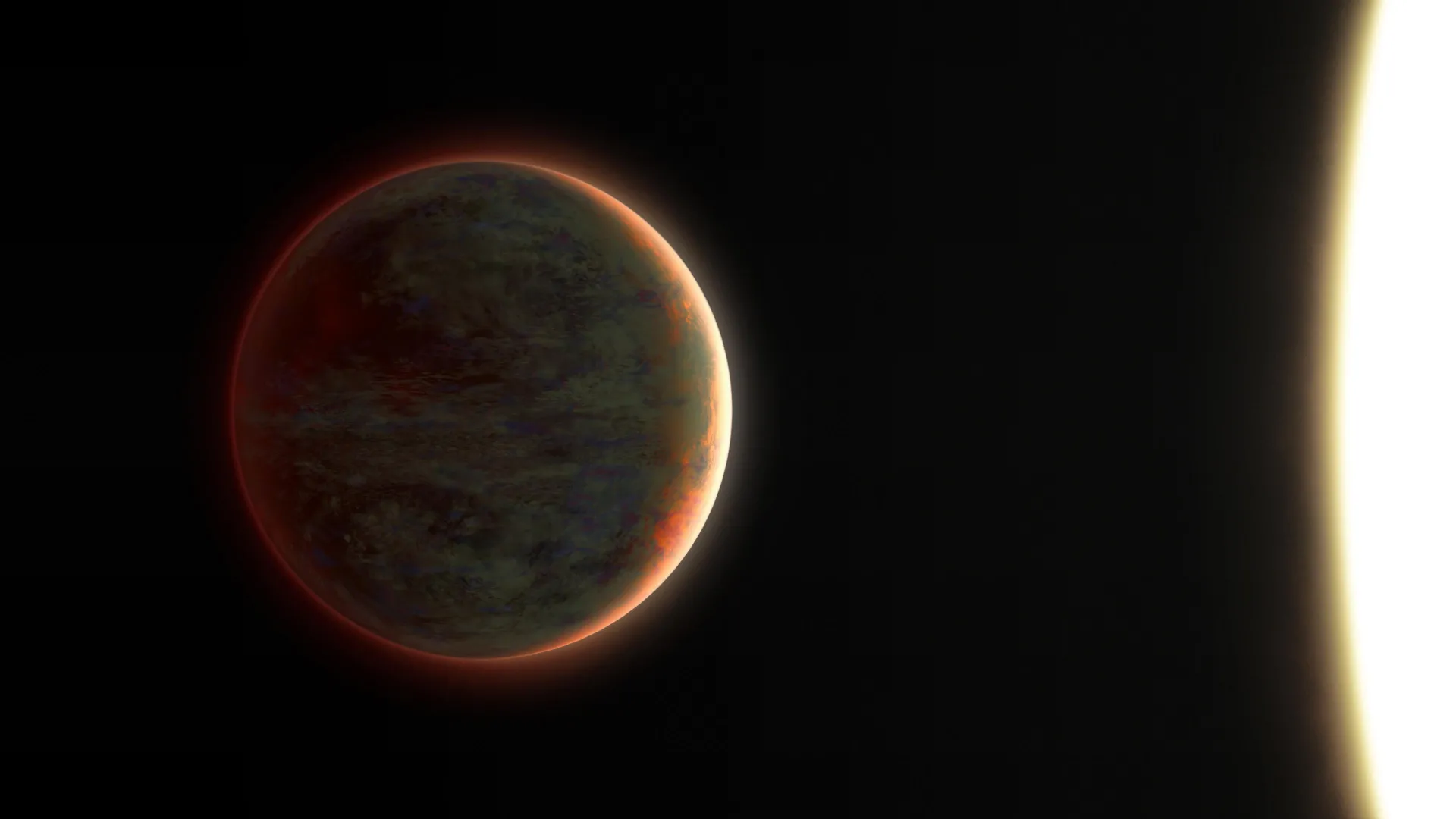
Astronomers using the James Webb Space Telescope (JWST) have discovered a striking difference between the dawn and dusk regions of the superhot exoplanet WASP-121 b. These boundary zones, known as terminators, mark the transition between the planet’s permanent day side and permanent night side. The discovery provided the clearest evidence yet that the two regions have different temperatures and atmospheric compositions, confirming predictions that had previously existed only in theoretical models.
The discovery comes from measurements of infrared starlight passing through the planet’s atmosphere as WASP-121 b passes in front of its host star. The researchers discovered the uneven absorption pattern by looking at how the atmosphere filtered that light during its passage.
The researchers say this asymmetry is best explained by differences in temperature and chemistry between the morning and evening sides of the planet.
“JWST’s unprecedented observational quality provides us with the most detailed glimpse yet of a distant planet. By measuring how the absorption of starlight changes as WASP-121 b rotates, we probe its atmosphere from longitude to longitude,” said MPIA’s Cyril Gapp.
Observations show that evening terminators absorb more light than morning terminators. This is consistent with current thinking about strong atmospheric winds transporting heat from the hotter dayside to the cooler nightside. These winds head east in the direction of the planet’s rotation, heating the region more strongly in the evening.
As temperature increases, the atmosphere expands. The larger the atmosphere, the larger the cross-section of incoming starlight and the more radiation it can absorb.
Data collected with JWST’s NIRSpec (Near Infrared Spectrometer) instrument also revealed a stronger carbon monoxide (CO) signal towards the end of the pass. The researchers believe that this change is caused by temperature effects rather than an actual increase in carbon monoxide levels.
Water (H2O) tells a different story. This observation suggests that regions of the atmosphere with higher temperatures have fewer water molecules. Scientists interpret this as a true depletion of water because temperatures in the upper atmosphere are high enough to break water molecules into their component parts. This discovery provides further evidence that hot air is warming the terminator in the evening.
A planet where day and night last forever
To detect these subtle atmospheric differences, scientists needed to take advantage of common features of nearby orbiting gas giants.
Over time, tidal forces synchronize the planet’s rotation with its orbit, so that one rotation takes the same amount of time as one orbit around the star. As a result, one hemisphere is always facing the stars, and the other is in eternal darkness.
“WASP-121b is particularly extreme, with an average temperature in the day hemisphere of about 2,770 degrees Kelvin, but an average temperature in the night hemisphere closer to around 1,000 degrees Kelvin,” explains co-author Tom Evans-Soma of the University of Newcastle in Australia. He has previously determined the temperature range of planets and is also affiliated with MPIA.
These temperatures correspond to approximately 2,500 degrees Celsius (4,525 degrees Fahrenheit) on the day side and approximately 725 degrees Celsius (1,340 degrees Fahrenheit) on the night side.
When a planet passes by its star, it rotates slightly between the start and end of the event. This small rotation allows astronomers to observe different parts of the atmosphere. Although the night side remains mostly visible, scientists can glimpse parts of the dawn and dusk regions, and, depending on the phase of passage, even a small region closer to the glowing dayside.
The leading side of the orbit corresponds to the morning terminator, and the trailing side corresponds to the evening terminator.
Convert transit time to atmospheric map
To study the atmosphere, researchers analyzed how the planet’s brightness changed during its passage. They also looked at the spectrum produced when light is separated into its constituent wavelengths, much like a prism creates a rainbow.
Scientists can identify chemicals present in the atmosphere because different gases absorb specific wavelengths of light.
As the planet rotates as it moves across the star’s surface, changes in the signal over time correspond to different longitudes on the planet. During a complete pass, WASP-121 b rotates approximately 30 degrees. This is enough to distinguish between morning (dawn) and evening (dusk) terminators with amazing accuracy.
Astronomers often combine all transit measurements into a single average signal to improve clarity. But in this study, Gapp and his colleagues allowed the signal to change over time as the planet rotates. Statistical analysis showed that this approach agreed reasonably well with observations, providing strong evidence that atmospheric differences do indeed exist.
Current model may be missing clouds
To understand their observations, the researchers ran computer simulations of heat transport in the gas giant’s upper atmosphere. Although the model successfully reproduced the general asymmetry caused by temperature differences, the observed effects were stronger than predicted.
This discrepancy suggests that additional processes may be influencing the atmosphere.
One possibility is that the morning terminator experiences additional cooling that current models cannot capture. Previous research suggests that clouds may exist in these regions. Unlike Earth’s clouds, clouds may be composed of minerals such as silicates rather than water droplets.
Such clouds can block infrared radiation from the hot layers below, making the atmosphere appear cooler than it actually is.
Modeling cloud formation, condensation, and evaporation in rapidly changing environments remains extremely difficult. As a result, many exoplanet atmospheric models, including the one used in this study, do not fully incorporate cloud physics.
When the team modified the simulation to approximate the effect of clouds, the results more closely matched observations. Still, more advanced modeling will be needed before researchers can confidently confirm the presence of clouds over WASP-121.
A new way to study extreme exoplanets
Future improvements in atmospheric models could make this technique even more powerful.
Researchers have already identified other superhot gas giants with temperatures and rotational speeds suitable for similar studies. By applying the same technique to a larger sample of planets, astronomers hope to compare how atmospheric conditions change on different worlds and gain a better understanding of their three-dimensional structure.
Additional Information
The MPIA astronomers involved in this study were Cyril Gapp (also from the University of Heidelberg), Thomas M. Evans-Soma (also from the University of Newcastle, Australia), and Eva-Maria Ahrer.
Other researchers are Aurélien Falco (Sorbonne University, Paris, France), David K. Sing (Johns Hopkins University, Baltimore, USA), Shashank Dholakia (University of Queensland, St. Lucia, Australia), Vivien Parmentier (University of the Côte d’Azur, Nice, France), Jérémy Leconte (University of Bordeaux, France), and Guangwei Fu (Johns Hopkins University).
The JWST observations used in this study were conducted as part of GO Program #1729 (PI: Thomas Evans-Soma, Co-Principal Investigator: Tiffany Kataria) entitled “NIRSpec Phase Curve of Ultrahot Jupiter WASP-121b” and GTO Program #1201 (PI: David Lafreniere) entitled “NIRISS Exploration of Atmospheric Diversity of Transiting Exoplanets (NEAT)”.
NIRSpec (Near Infrared Spectrometer) was built by European industry to European Space Agency (ESA) specifications and is managed by the ESA JWST project at ESTEC (European Space Research and Technology Center) in the Netherlands. The prime contractor was Airbus Defense and Space, Ottobrunn, Germany. MPIA contributed to the development and manufacturing of NIRSpec’s filters and grating wheels. The NIRSpec detector and micro-shutter array subsystem were provided by NASA’s Goddard Space Flight Center (GSFC).
The James Webb Space Telescope is the world’s premier observatory for space research. This is an international program led by NASA and its partners ESA and CSA (Canadian Space Agency).
