


The Jiangmen Underground Neutrino Observatory (JUNO) has achieved its first major scientific milestone. June 10th, nature The debut physics results of this experiment were published as a cover article.
The international JUNO collaboration, led by the Institute of High Energy Physics of the Chinese Academy of Sciences, made high-precision measurements of two fundamental neutrino oscillation parameters using 59 days of validated data collected from August 26 to November 2, 2025. This analysis reduced the uncertainty in these measurements by a factor of 1.6 compared to the combined results of previous experiments conducted over several decades.
Why are neutrinos important?
Neutrinos are one of the most mysterious particles in the universe. They have no electric charge, have very low mass, and interact weakly with matter. As a result, a huge number of neutrinos pass through the Earth and even through our bodies without leaving a trace.
Neutrinos remain the least understood of all known elementary particles because they are extremely difficult to detect.
JUNO began data collection in August 2025. One of its main scientific goals is to determine the mass order of neutrinos. The experiment also measures three of the six neutrino mixing parameters with better than 1% accuracy and is designed to study neutrinos produced by supernovae, the Earth’s interior, the sun, the atmosphere, and other sources.
Breakthrough results in neutrino research
This study received high praise during peer review.
The reviewers wrote, “These results not only validate the detector performance and analytical methods, but also establish JUNO as a key player in a new high-precision era of neutrino oscillation physics, with direct implications for testing the three-flavor paradigm, global oscillation fits, and future determinations of neutrino mass order.”
nature We also highlighted the works of news and views The article states:
“Understanding the behavior of neutrinos is paramount to developing a complete description of matter and forces at the smallest scales. This first analysis builds confidence that the detector can determine mass order. This first result from JUNO marks the dawn of the next era of precise neutrino oscillation measurements and provides insight into the properties of these mysterious fundamental particles.”
Early this year, in April, Chinese Physics C JUNO’s detector performance is featured on the cover.
Professor Arthur McDonald, who won the 2015 Nobel Prize in Physics for the discovery of solar neutrino oscillations, commented on the publication:
“JUNO has achieved its design goals, achieving exceptional radiation purity, energy resolution, and detector stability. The experiment is fully operational and ready to pursue ambitious physics goals, including determining neutrino mass order (NMO), studying neutrino oscillation parameters, detecting neutrinos from a variety of sources, and exploring physics beyond the Standard Model of elementary particles.”
Inside a giant underground detector
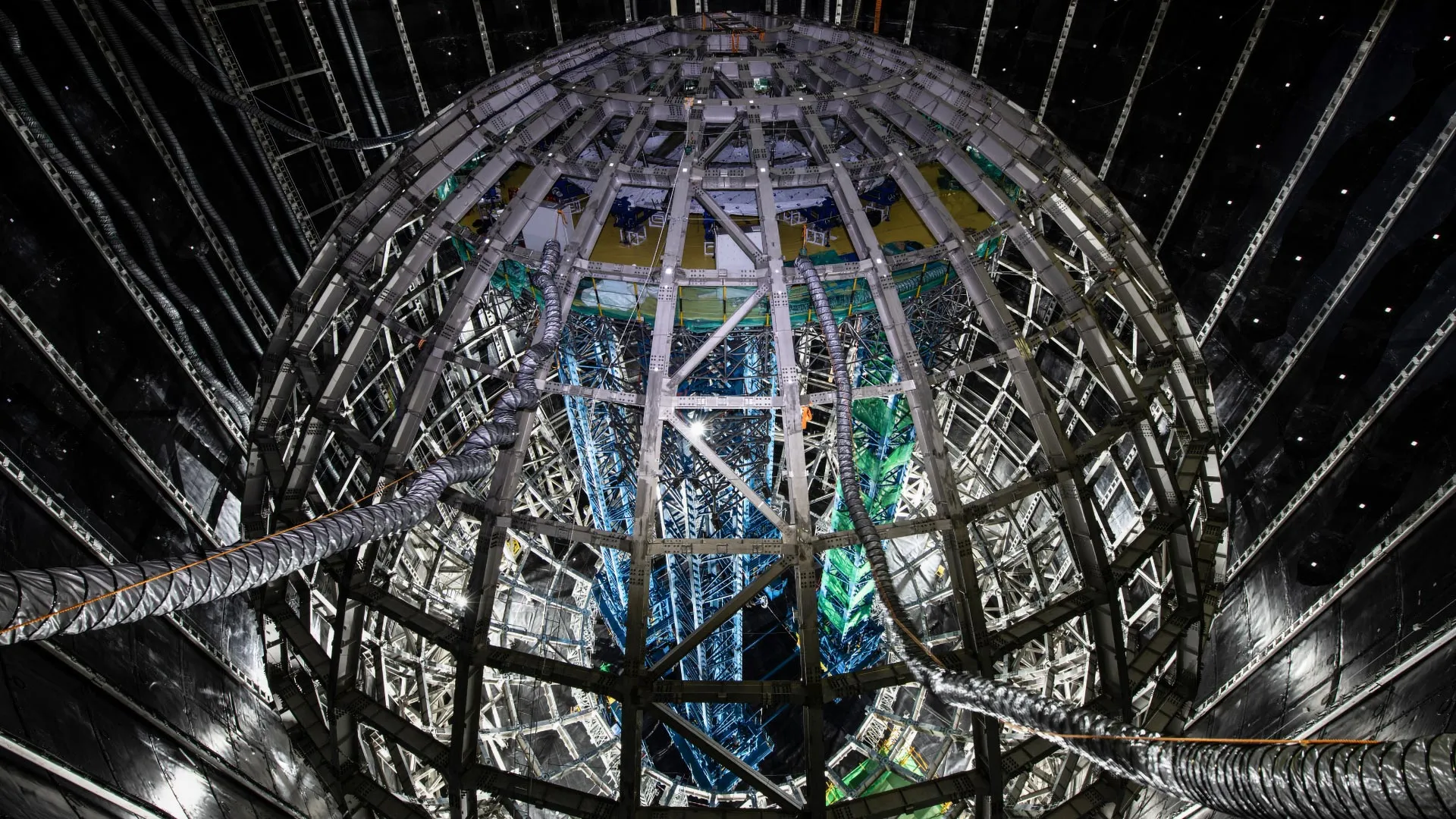
At the heart of the JUNO experiment, located 700 meters underground, is a giant liquid scintillator detector with an effective mass of 20,000 tons. The detector is installed in a water pool at a depth of 44 meters.
The 41.1 meter diameter stainless steel support structure holds a 35.4 meter acrylic sphere along with a liquid scintillator, 20,000 20-inch photomultiplier tubes (PMTs), 25,600 3-inch PMTs, front-end electronics, wiring, antimagnetic compensation coils, and optical panels.
How JUNO detects neutrinos
The detector’s PMTs operate simultaneously to capture the small flashes of scintillation light produced when neutrinos interact within the detector. These optical signals are converted into electrical signals that researchers can analyze.
By precisely measuring the energy of neutrinos during these interactions, JUNO will be able to determine important vibrational parameters and investigate fundamental properties of these elusive particles.
Further discoveries are expected
JUNO has been running successfully for nine months.
As the experiment continues to collect data, researchers expect a series of new scientific results to be published starting this summer. These future discoveries could provide further insight into the nature of neutrinos and help answer some of the most important questions in particle physics.
