


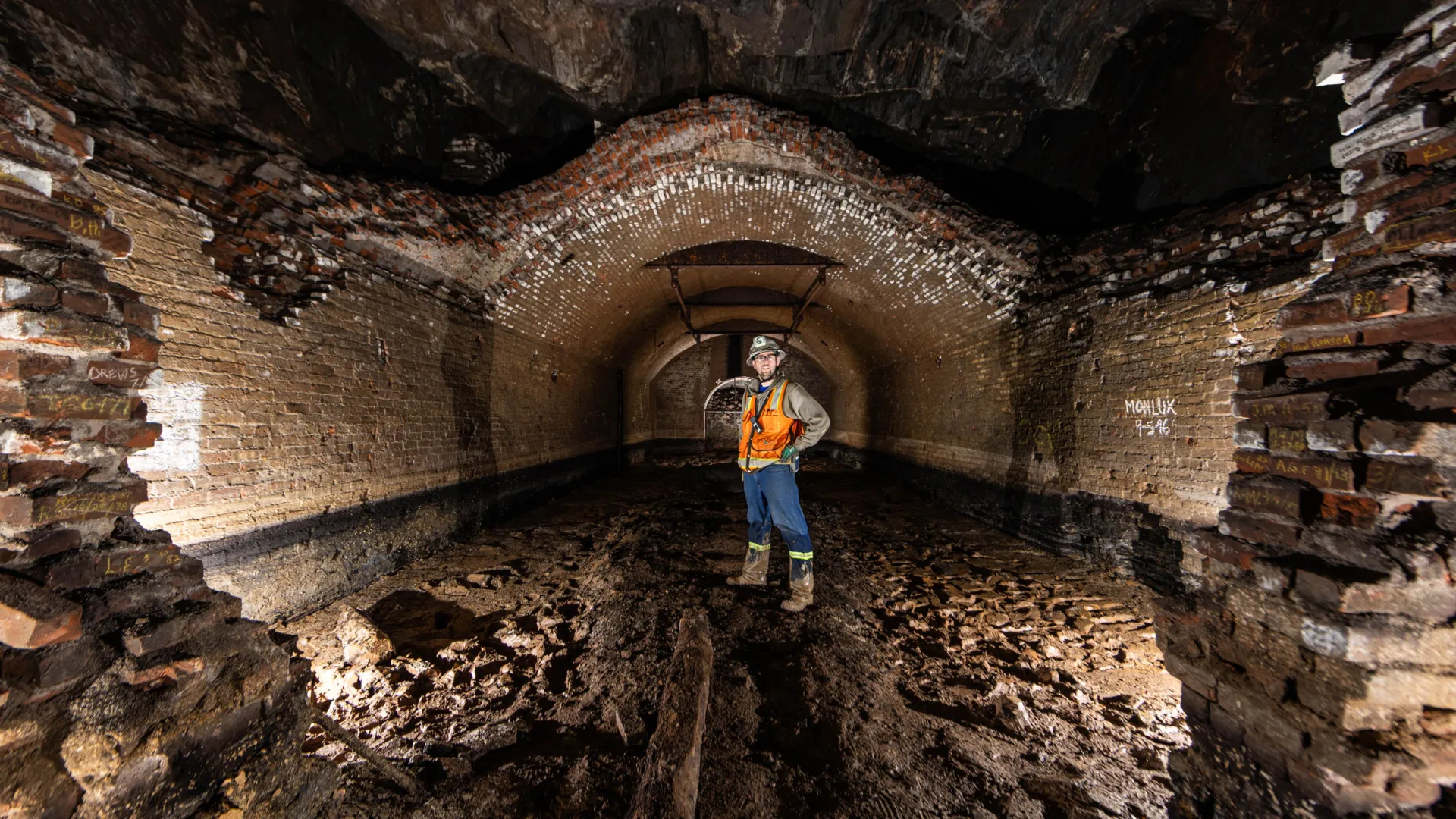
Operating a facility deep below the earth’s surface requires continuous control of two critical elements: air and water.
Workers in underground tunnels and shafts rely on reliable ventilation to survive and work safely. At the same time, groundwater and rainwater that seeps underground must be collected and pumped back to the surface.
This challenge is common in large mine operations where ventilation and water systems are managed by specialized teams. It also plays a key role in operating the Sanford Underground Research Facility (SURF), a large underground science laboratory in South Dakota. Although mining no longer takes place there, mining engineers are still responsible for safely maintaining the extensive network of tunnels and shafts.
Unexpected changes in airflow due to heavy rain
Since joining SURF in 2019, mining engineer Jason Connot has overseen the facility’s ventilation system. During periods of heavy rain, he and his colleagues began noticing something unusual. Subsurface airflow patterns sometimes weakened or reversed direction.
“We have noticed fan failures on the five shafts. In some areas, airflow can be reduced or reversed when there is heavy rain,” Connot said.
Under normal conditions, fresh air enters the facility through two main shafts and exits through two separate shafts. One of those exhaust routes is the 5-shaft. However, during heavy rains, excess water is channeled through Shaft No. 5 into a deep underground pool and then pumped out.
“At first, we didn’t know what was happening to the airflow when it rained heavily,” Connott said. “We were all seeing these airflow changes happening all over the underground, and we wondered why this was happening.”
Sensors reveal clues
To find the answer, we needed data.
This breakthrough came after the Maestro Airflow Sensor was installed at the 2000 level as part of the automatic ventilation control system. These measurements gave engineers a clearer picture of how air was moving through the facility.
Previous evidence had already suggested a link. During testing of the shaft deluge system, the airflow sensor at the 4850 level recorded an unexpected increase in air movement.
These sensors were built and installed by Spearfish High School science teacher Steve Gabriel and his students. Gabriel later joined SURF as a full-time ventilation technician.
“During that test, we felt an increase in airflow at the 4850 level, and that’s what created the correlation and caused everything,” Connot said.
Amazing effects of falling water
During major storms, the incoming water can exceed the capacity of underground pumping systems. To handle the extra volume, engineers channeled the excess water into a deep pool beneath the 5-shaft, much like an overflow spillway relieves pressure in a full reservoir.
The research team suspected that the falling water itself might be affecting the air flow.
Their theory was that the descending water column would act like a syringe, forcing air into the shaft as it fell.
The idea was interesting, but needed scientific validation.
Connot searched the scientific literature and found reports describing similar phenomena in large urban sewer systems. These studies included fluid dynamics equations that describe how the movement of water affects the movement of air within a confined space.
Working with colleagues at South Dakota Mining, Connott tailored those equations to SURF conditions. The results closely matched what engineers observed underground.
“Once we added numbers and parameters to the model, everything came out exactly right,” says Connot. “You wouldn’t expect the weight of a water droplet to move so much air.”
Impact on mine ventilation and safety
This discovery extends beyond heavy rains and could have an impact on underground activities around the world.
“In the event of a fire, mining engineers may turn a valve at the top to allow water to flow down the shaft. It’s important information for everyone to know that this can change the airflow. We’ve tested this and seen it happen,” Connot said.
Because SURF functions as a research facility, engineers had the opportunity to investigate the phenomenon in detail.
“This is not the kind of research that you always have time for in an operating mine,” Connot said.
Bryce Pieczyk, SURF’s director of underground operations, said the effort reflects Connot’s commitment to understanding the facility’s complex systems.
“One of the things I really like about working with Jason is that he’s willing to dig deep into the details necessary to understand such a complex operational system. No one has taken the time to understand this problem before, but this is absolutely important and that’s why the whole team supported this research,” Pieczyk said. “Thanks to this work, we can stay far ahead of airflow issues, predict what will happen, and set ventilation controls in an appropriate manner.”
Research results were published in Mining Journal
Connot’s paper, Impact of water inflow on mine ventilation systems: a case studyPublished in mining, metallurgy, exploration.
Dr. Andrea Brickey, Connott’s advisor and professor in the Department of Mine Engineering and Management at South Dakota Mines, praised both the research and the tenacity behind it.
“I couldn’t ask for a better graduate student than Jason as an advisor,” Brickey said. “He wanted to identify phenomena that affect ventilation systems and determine how curiosity could predict their behavior. He succeeded, and his work contributes to SURF and the industry as a whole.”
Pietzyk also emphasized the effort required to complete research while balancing professional and personal responsibilities.
“Jason is an engineer who goes above and beyond,” Pieczyk said. “The work he has done to complete this study shows that he truly cares about this facility. He worked a full-time engineering job, commuted from Rapid City, earned a master’s degree, and raised a family while continuing to put everything together. This is a credit to him. It’s truly a remarkable effort.”
