


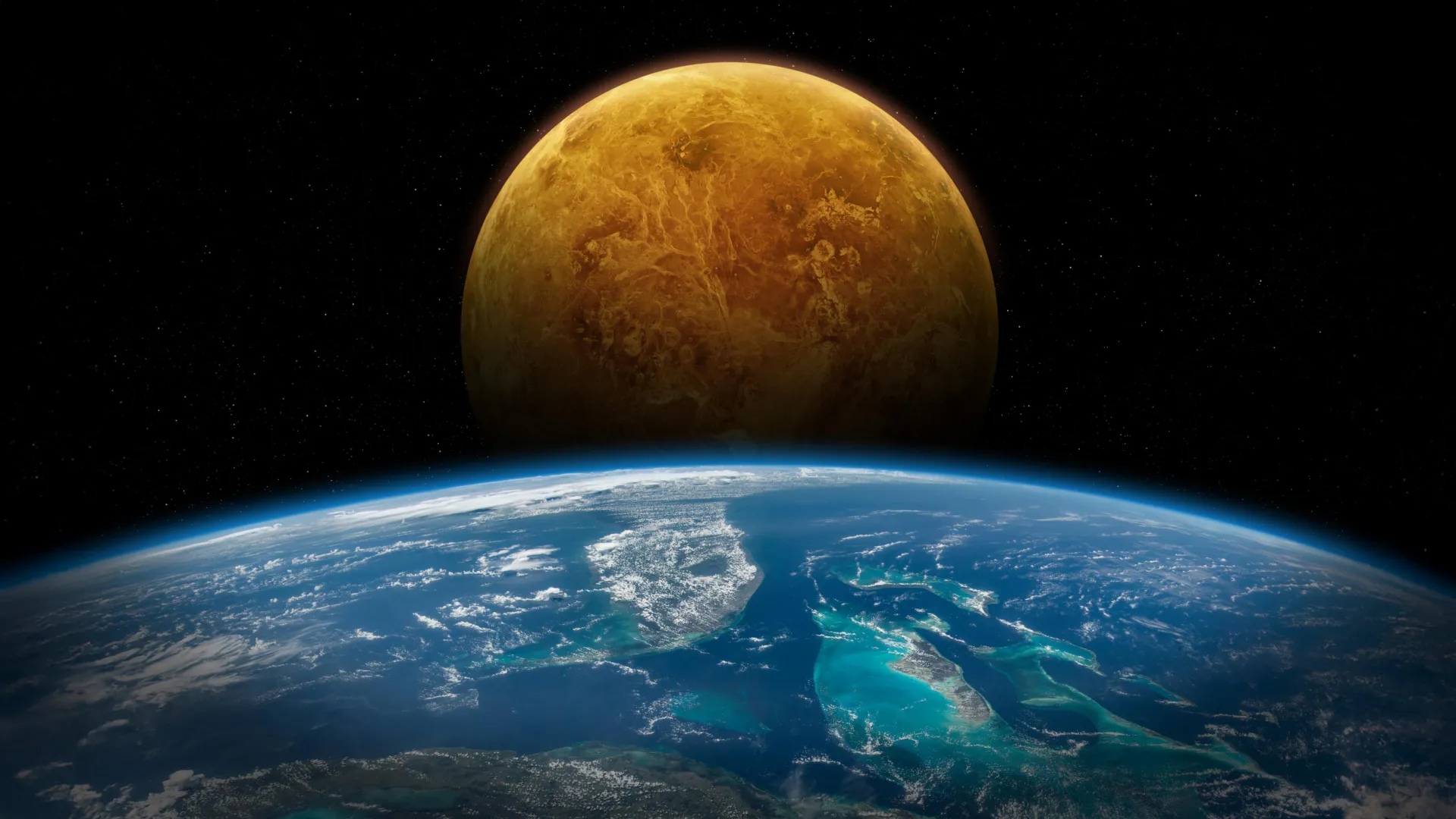
Panspermia theory proposes that life, or the ingredients necessary for life, could spread throughout the universe on asteroids, comets, and other rocks. When life develops on a planet, powerful impacts can blow material off the surface and into space, transporting microorganisms and organic compounds to other worlds. Scientists have long debated whether this type of migration could have occurred between Earth and Mars (in both directions). Recently, there has been renewed interest in the possibility that microorganisms exist in Venus’ thick cloud layers, and the discussion has extended to Earth, Venus, and Mars.
A recent study presented at the 2026 Lunar and Planetary Science Conference (LPSC) takes a closer look at that possibility. Researchers from the Johns Hopkins University Applied Physics Laboratory (JHUAPL) and Sandia National Laboratories used the Venus Life Equation (VLE), a framework developed by Norm Eisenberg and colleagues. In 2021, it will estimate how material from Earth could introduce life into Venus’ atmosphere. Their model suggests that life transported from Earth could survive in Venus’ clouds for at least a few days a century.
Venus life equation
Similar to the famous Drake equation, the VLE combines several contributing factors to estimate the probability of life. Each component is multiplied to produce an overall estimate of the likelihood that life exists.
*### L = O x R x C*
In this equation, L represents the probability of extant life (0 to 1, with 0 being no chance and 1 being certain). O stands for origin (life happened to begin and settle on Venus), R stands for robustness (the ability of the biosphere to survive and adapt to changing conditions), and C stands for continuity (the probability that habitable conditions have persisted to this day). Before applying this framework, the researchers first investigated whether organic materials could survive the journey from one planet to another, regardless of where they were first formed.
Survive the trip to Venus
Material thrown into space by an impact must endure great hardships. In addition to the intense shock upon release, they are exposed to intense heat, the vacuum of space, radiation, and extreme temperature changes. Previous computer simulations and analyzes of meteorites found on Earth have shown that organic material can survive both ejection from the planet and travel through interplanetary space. But once it reaches Venus, that material must also remain suspended within or above the planet’s cloud layer to survive.
To investigate this, the researchers modeled how a bolide meteorite (bolide) behaves as it enters Venus’ atmosphere, including its ablation, explosion, and fragmentation into smaller pieces that can remain in clouds. They relied on the “pancake model,” a widely used semi-analytical approach that explains how a fireball fragments as it passes through the atmosphere. After the fireball explodes in the atmosphere (an “airburst”), aerodynamic drag causes the debris to spread outward, forming flat “pancake”-like materials that researchers call “cells.”
Possibility of transferring billions
The researchers used the pancake model along with values from previous studies to estimate how many fireballs from Earth or Mars could have reached Venus’ clouds. According to their calculations, hundreds of billions of cells could be transported from Earth to Venus, with hundreds of billions potentially remaining viable. Their favorable estimates indicate that on Earth, about 100 cells are dispersed throughout Venus’ clouds each year. Approximately 20 billion cells may have been imported from Earth over the past billion years.
The researchers stress that their model does not capture every aspect of how the bolide interacts with Venus’ atmosphere. They also note that all parameters of the VLE are subject to significant uncertainties, similar to the Drake equation. Still, their findings support the possibility that panspermia can occur between Earth and Venus. If future astrobiology missions discover life in Venus’ clouds, one possible explanation is that it originally came from Earth.
