


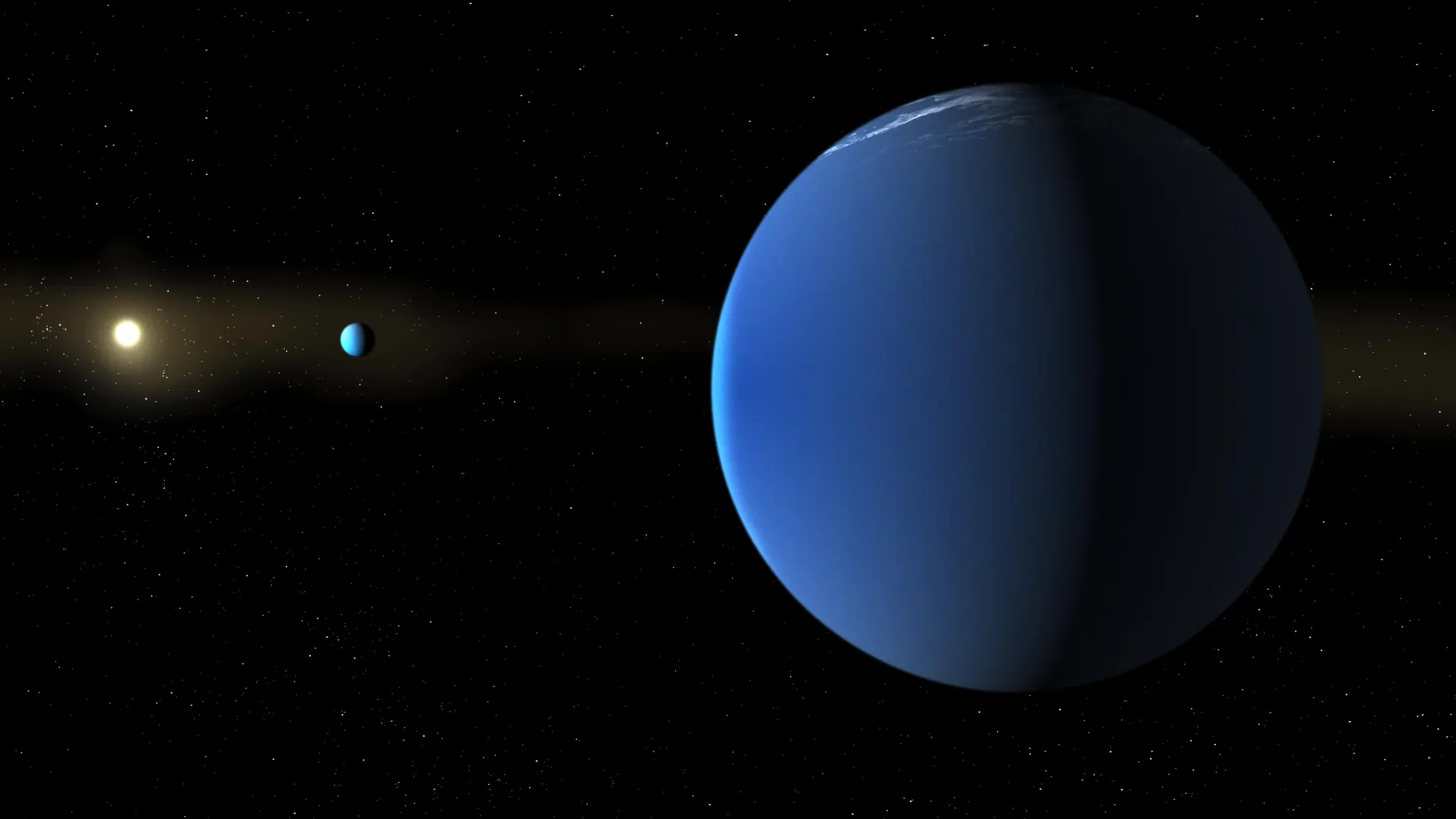
Astronomers have identified two of the fluffiest giant planets ever discovered, with densities so low that they are actually less dense than cotton candy. This unusual pair of “superpuff” planets was discovered by an international team led by the University of Oxford, in collaboration with the University of the Cote d’Azur/Observatoire de la Cote d’Azur and the University of Birmingham. The survey results are Royal Astronomical Society Monthly Notices.
The newly identified planets, TOI-791 b and TOI-791 c, orbit an F7 dwarf star in the southern constellation Urae, about 1,110 light-years from Earth. Each planet is about the same size as Jupiter, but both are surprisingly light compared to their size.
TOI-791 b has a density of only 0.038 grams per cubic centimeter, while TOI-791 c has a density of 0.047 grams per cubic centimeter. By comparison, Jupiter’s average density is 1.33 grams per cubic centimeter, making it approximately 28 to 35 times denser than these newly discovered worlds.
This comparison becomes even more striking when compared to cotton candy, which has a typical density of about 0.05 grams per cubic centimeter. Earth’s density is even higher, averaging 5.5 grams per cubic centimeter.
Unusual planetary twins trapped in a dance of gravity
Scientists believe that the two planets formed together from the same disk of gas and dust surrounding a young star, making them planetary “brothers.”
They are also coupled by an unusual orbital arrangement called a 5:3 mean-motion resonance. For every five orbits completed by the inner planets, the outer planets complete almost exactly three. As they orbit the star, their gravity repeatedly pulls against each other, causing small but measurable changes in the timing of each planet’s transit.
Only four other planetary systems are known to contain multiple superpuff planets, making TOI-791 an invaluable opportunity to investigate how these anomalous worlds arise and evolve.
Lead author Dr George Dransfield (she/her), Department of Physics, University of Oxford and presenter on BBC Sky at Night, said:
“Only a handful of these extremely plump planets are known, and finding two in the same star system is even rarer. Their extremely low density makes them fascinating targets for understanding how planetary systems form and evolve.”
Citizen scientists help discover planets
Volunteers participating in the Planet Hunters TESS citizen science project first reported TOI-791 b in 2019 and TOI-791 c in 2023 as potential planets. The project searches observations collected by NASA’s Transiting Exoplanet Survey Satellite (TESS) for signs of previously unknown worlds.
Researchers then combined measurements from telescopes around the world to determine the planet’s size and mass, allowing them to calculate its exceptionally low density.
When a planet passes in front of a star during a “transit,” it blocks a small amount of the star’s light. This decrease in brightness reveals the planet’s size. In the TOI-791 system, astronomers also detected small changes in the timing of the transit caused by the planet’s gravitational interactions. By analyzing these timing variations, the team was able to estimate each planet’s mass.
Antarctica played an important role
The discovery built on eight years of observations, including data from the ASTEP (Antarctic Transiting Exoplanet Search) telescope at Concordia Station in Antarctica. The telescope is jointly operated by researchers from the University of the Cote d’Azur/Observatory of the Cote d’Azur and international collaborators.
The long nights of winter in Antarctica have given astronomers a huge advantage. Months of uninterrupted darkness allowed each planet’s unusually long transit (each lasting more than 11 hours) to be observed without interruption. Researchers say this is the longest continuous planetary transit ever observed completely from the ground.
How do superpuff planets form?
Scientists are still trying to understand how super-inflated planets develop.
One of the main explanations is that these worlds have huge atmospheres rich in hydrogen and helium, which make up most of their total mass. The researchers suspect that these thick gaseous envelopes may have formed when the planets were much farther away from the star, in cooler regions of the protoplanetary disk where gas could quickly accumulate around the solid planetary core.
Future observations are planned to better understand the origins of these unusual planets and test competing theories.
Professor Amaury Tryaud (University of Birmingham), UK ASTEP principal investigator and co-author of the study, said:
“This system provides a unique laboratory for understanding how super-bulging planets form and evolve. We propose to use the James Webb Space Telescope to perform space-based observations to assess whether the bulging atmospheres contain species containing carbon, nitrogen, and oxygen, and to uncover new insights into how these unusual planets form.”
Professor Tristan Guyot (University of the Cote d’Azur), principal investigator of ASTEP and co-author of the study, added:
“These multiplanetary systems are complex, and the gravitational interactions between the planets evolve over very long periods of time, over decades. This discovery highlights the importance of continued international collaboration in astronomy. Integrating observations from Antarctica, space telescopes, and observatories across multiple continents was essential to uncovering the true nature of these unusual planets.”
