


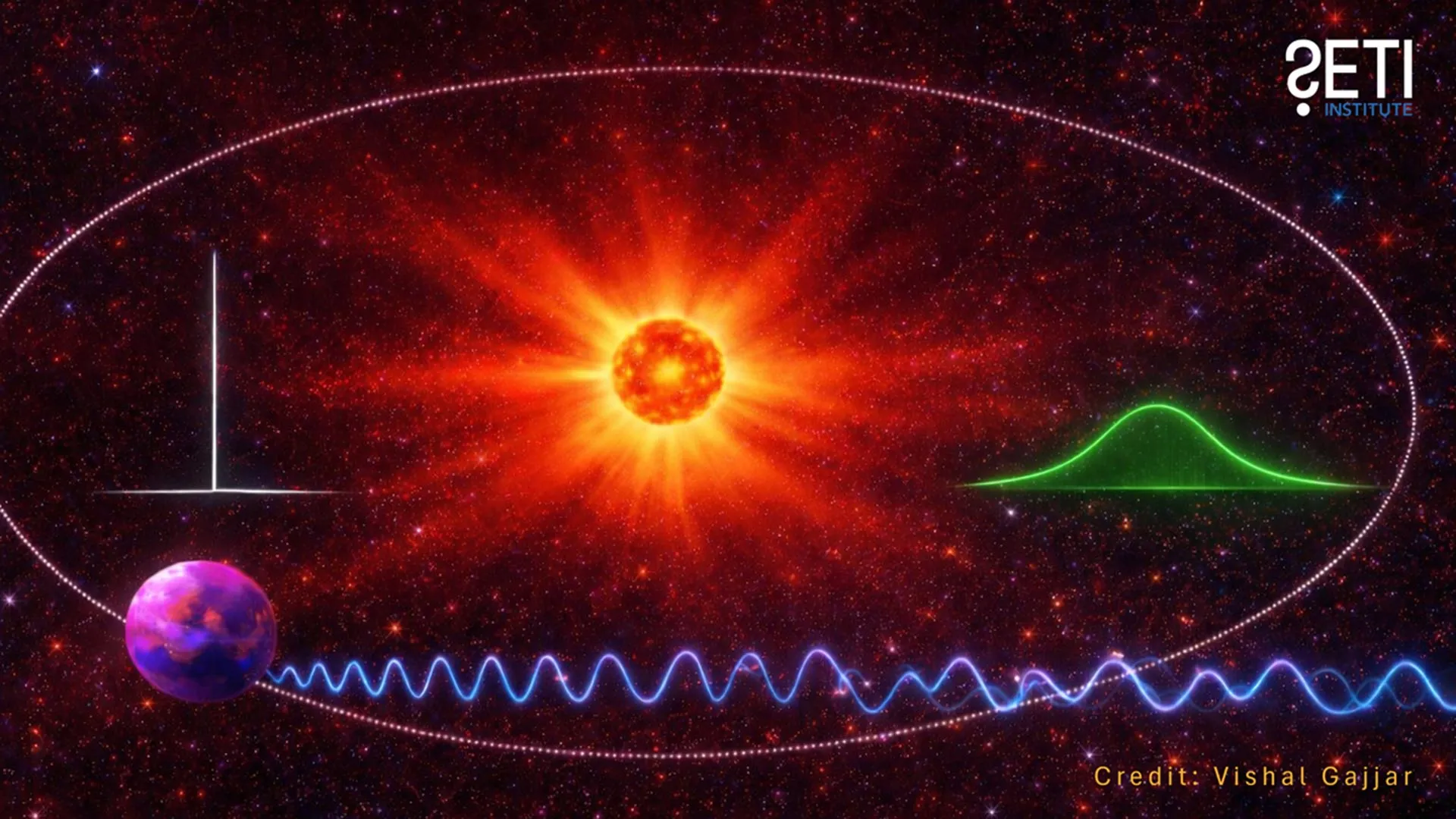
New research from the SETI Institute suggests that the search for extraterrestrial intelligence may be facing unexpected challenges. The same stellar activity that shapes the environment around distant planets could also make it much more difficult to detect alien radio signals.
Many of SETI’s efforts are looking for very narrow radio signals because they are unlikely to be produced by natural cosmic processes. However, researchers have discovered that these signals can become distorted before leaving their home star system.
How stellar activity distorts radio signals
For decades, SETI scientists have been looking for narrow spikes in radio frequencies that could indicate the presence of advanced technology. Extraterrestrial transmitters have been hypothesized to produce highly concentrated signals that stand out from natural background noise.
New research points to potential problems with that approach. Even if a civilization were transmitting a perfectly narrow radio signal, it might no longer appear that way after passing through the environment around its star.
Scientists have already explained many of the effects that occur when radio waves cross interstellar space. This study instead looked at what was happening much closer to the signal source. Fluctuations in plasma density within a stellar wind, along with explosive phenomena such as coronal mass ejections, can alter radio waves near their origin. These effects can spread the energy of the signal over a wider range of frequencies, weakening the sharp peaks that many search methods rely on.
“Searching for SETI is often optimized for very narrow signals. If the signal is broadened by its stellar environment, it may fall below the detection threshold, if one exists, and may help explain some of the radio silence seen so far in searches for technosignatures,” said Dr. Vishal Gajjar, an astronomer at the SETI Institute and lead author of the paper.
Study of effects using spacecraft signals
To gauge how significant this spread is, the researchers turned to a more familiar data source: radio transmissions from spacecraft operating within our solar system.
The researchers used observations from solar system probes to calibrate how turbulent plasma affects narrowband radio signals. They then applied those measurements to different stellar environments and estimated how the same processes affect signals occurring around other stars.
The result is a practical framework that allows scientists to estimate how much signal spread occurs around different types of stars and at different observation frequencies, especially in the active “space weather” environments found around some stars.
Impact on extraterrestrial intelligence exploration
This finding may have implications for both SETI target selection and exploration strategies. According to the study, M dwarfs, which make up about 75% of all stars in the Milky Way, are particularly likely to spread narrowband radio signals before escaping the system.
For this reason, the researchers suggest that future searches should remain sensitive to broader signals than the ultra-narrow signatures traditionally targeted by the SETI program.
“By quantifying how stellar activity reshapes narrowband signals, we can design searches that better match what actually reaches Earth, not just what might be transmitted,” said Grace C. Brown, co-author of the study and research assistant at the SETI Institute.
This project focuses on high-risk, high-impact research supported by the SETI Institute’s STRIDE program (Supporting Technology, Research, Innovation, Development, and Education). This effort helps researchers investigate new scientific questions and develop new tools and techniques to address them. STRIDE is funded through the Franklin Antonio Bequest, which was established to advance groundbreaking science and education efforts at the SETI Institute.
