


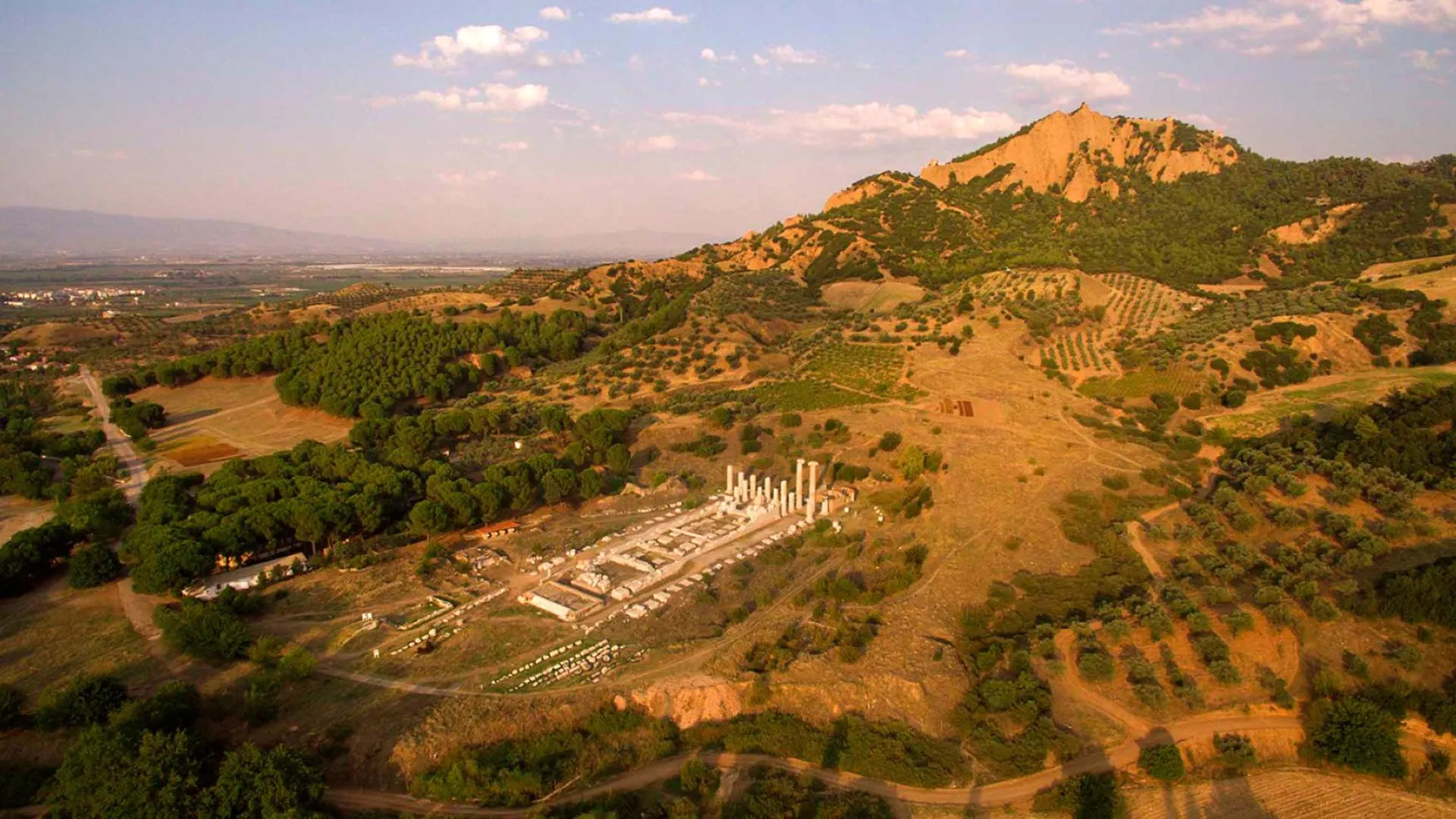
For thousands of years, the ancient city of Sardis in western Turkey changed hands as the Greeks, Romans, Byzantines, and Ottomans rose and fell. But one thing remains surprisingly stable, even as the city’s rulers change repeatedly. Since 1958, archaeologists have returned annually as part of the Harvard University Cornell Ancient Sardis Expedition, making it one of the longest-running organized excavation projects in the world.
“It’s really important that there’s institutional continuity,” says Benjamin Anderson, associate professor of art history and visual studies in the College of Arts and Sciences. “Many of us know and have been mentored by our excavator colleagues from previous generations. As a result, this is one of the few long-term archaeological projects in the region that has generated a significant amount of data.”
In recent years, Anderson has focused on the records of the walls and buildings of the Acropolis of Sardis, which became an important center during the post-Roman Byzantine period.
“This is a city that appears in many ancient historical sources,” he said. “But over the last 75 years or so, the possibility of telling that story through the archaeological discoveries of this project has also emerged.”
This summer marked a new milestone. Thanks to decades of excavations and support from the local community, Sardis has been added to UNESCO’s World Heritage List.
“The opportunity to truly begin to understand a culture through archaeological materials is very rare, and it requires such a long-term commitment,” Anderson said. “It is also something that is being celebrated by its World Heritage designation by UNESCO. This project has always been marked by a desire to communicate its results and make the work legible to tourists and local residents, as well as audiences of all kinds, from its inception.”
Sardis preserves thousands of years of history
Once the capital of the Iron Age kingdom of Lydia, Sardis occupied a strategic location between the Mediterranean Sea and the Anatolian Plateau. According to Annetta Alexandridis, associate professor of art history and classical history at A&S, it served as a “place of cultural encounter between East and West.”
The Lydian period is of particular significance to archaeologists and historians. The Lydians are widely known for inventing coinage, and their ruler, King Croesus, became legendary for his vast wealth. Later, Alexander the Great conquered Lydia, after which Sardis became part of the Roman Empire, followed by the Byzantine Empire and then the Ottoman Empire.
“Because it wasn’t overbuilt by a modern city, Sardis is just a small village and you can see a very long history from the Bronze Age, the third millennium BC, to basically today,” Alexandridis said. “All of these layers are present, and they’re not clearly layered, which makes excavation sometimes difficult. They interfere with each other, but in a sense it’s an ongoing history, and that’s what makes it so interesting to us.”
Mr. Alexandridis, who researches Roman funerary culture as deputy head of excavations, is currently leading research into Mr. Sardis’ cemetery, much of which has received far less attention than the nearby Bin Tepe cemetery, about 10 kilometers north of the city. Bin Tepe is home to some of the largest burial mounds ever recorded.
Ruins that shaped archeology
Sardis also occupies an important place in the history of American archaeology. The first modern excavations, led by the American Sardis Excavation Society in the early 20th century, “were really big digs,” Alexandridis said. Excavators discovered a temple of Artemis and a tomb, but many artifacts were damaged, lost, or taken to the United States by questionable means. Among them was a huge column that is still on display at the Metropolitan Museum of Art.
This project ended with the Greco-Turkish War in the early 1920s. Over the following decades, some crafts gradually returned to Türkiye.
“This is one of the first cases where we can see the entire discussion regarding the return of some illegally exported antiquities until they are returned to Turkey,” Alexandridis said. “It encompasses all broader issues, not only from a conservation and academic point of view, but also how to deal with cultural heritage from a political and legal point of view, as well as issues of stewardship and responsibility for the culture of the past.”
The modern Harvard-Cornell University partnership began in 1958 under George M.A. Hanfman, an archaeologist at Harvard University, and Henry Detwiler, an architect at Cornell University in the School of Architecture, Arts and Planning, who specialized in documenting historic buildings.
“I went to Sardis in 1950 and there were some things that looked like they were sticking out of the ground, but there wasn’t anything particularly interesting about them,” Anderson said. “The architects were the first generation of Cornelians to be there, and this project was really about taking what they had responsibly excavated, supplementing it with new work, and presenting a holistic experience of the structure, rather than just making drawings and publishing them.”
During the 1950s and 1960s, the team rebuilt a monumental bath-gymnasium complex and the largest synagogue in the ancient world. These restoration efforts became an influential model for similar work at archaeological sites elsewhere.
Since then, excavations have uncovered an adobe city wall, an acropolis, a Persian garbage dump, a gold smelting workshop, an ancient shopping street and, most recently, a sanctuary plaza that took 15 years to excavate.
Training the next generation of archaeologists
The project is currently based at the Harvard Art Museums and includes researchers from Turkish institutions as well as American universities such as the University of Wisconsin-Madison and the University of California, Berkeley. Cornell primarily supports graduate students, and a growing number of undergraduate students also work at the site for 10 weeks each summer.
The students catalog the salvaged items, mostly pottery or “broken pots,” in Anderson’s words, and supervise the excavation trenches.
Sardis is located on an alluvial plain, so some ditches extend up to 12 meters underground.
“(They) are pretty scary in and of themselves,” Anderson said.
“Already trained local workers are gradually removing dirt, and the students are there observing, recording, taking notes, asking questions, deciding when to stop and call in the superintendent or assistant superintendent to see what’s going on, deciding when to take photos, when to call in the architect to create a state diagram at a particular moment,” Anderson said.
Sardis is one of only three excavation projects in the world that “most people pursuing a career in classical archeology in the United States have experienced,” Anderson said.
More than half of the researchers currently participating are Turkish professionals and students, and local participation continues to be central to the project’s success.
“The conversation that always accompanies what we’re doing is how we’re doing it and how we bring in local expertise,” Alexandridis said.
Currently, women from the Sardis region are working alongside men in excavation and restoration efforts.
Local connections with ancient cities
Leila Uhler, currently a doctoral student majoring in art history and archeology, grew up near Sardis. She first studied English and literature at Istanbul University, and then decided to pursue classical archeology.
“To study archaeology, you also have to work in the field,” she says.
Starting in 2022, she investigated rock tombs from the Lydian to Roman times around Sardis. She continued that work for three summers, and this year she oversaw the excavation of a late Roman site.
Her experience at Sardis inspired her to pursue a Ph.D. At Cornell University, Alexandridis became an advisor. They both share an interest in funerary art, which provides insight into beliefs about beauty, the afterlife, and everyday life.
The city is on “one of the most important trade routes in the ancient world,” where the first coins were minted and where Alexander the Great visited, Ugler said. “You grew up there, so the same culture continues in you and around you. As a child, I remember watching archaeologists and being impressed. Being familiar with ongoing archaeological research also helps you better understand its archaeological significance.”
She believes that UNESCO’s recognition will bring important benefits to the region.
“As a local resident, I can tell you this is very important,” she says. “First of all, now this place is known worldwide and thanks to UNESCO, there could be more funding for excavations, more people, more tourists, more research. People will know more about this area and more protection will take place.”
Protecting Sardis for the future
Stronger protection is desperately needed. The Sardis landscape is susceptible to natural erosion, and many of the burial mounds have already been damaged by agriculture. Looting is also a serious problem.
Alexandridis said treasure hunters now operate on an “industrial scale” scale, targeting ancient tombs using explosives, bulldozers and often weapons.
Despite nearly 70 years of continuous excavation, researchers say there is still much to uncover at Sardis.
“This is why a long-term commitment is so important,” Anderson said. “You can learn how to do it in one season of work, but you don’t necessarily find something particularly important to the history of the site until maybe 10 years later, a little further away, you find something else and the pieces start to add up.”
