


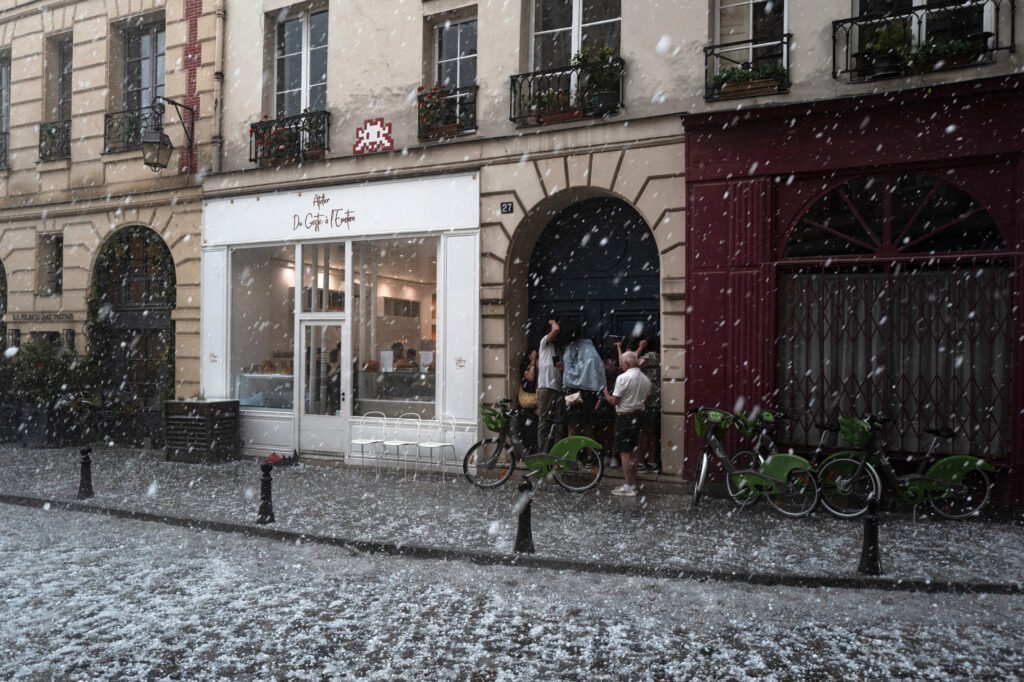
Areas frequently hit by severe storms also could face a more extreme hail threat, such as the Midwest, which was hit by powerful thunderstorms and deadly tornadoes last weekend.
A new study published Monday in Atmospheric Science Letters is the first to link anthropogenic warming to hail size in a single thunderstorm. The study examined the May 3 storm that dumped hailstones ranging in size from marbles to golf balls across Paris and other parts of France, destroying or damaging property worth more than $350 million. The researchers compared real-time data from May 3 to similar weather patterns from previous decades to determine how the warmer atmosphere changed the composition of the storm.
According to the analysis, the probability of hail in France and Germany increased by up to 30% under similar atmospheric conditions. And as the climate warms, hailstones grow from nuisance sizes to chunks of ice large enough to tear up crops and damage cars and buildings.
Paris storms form in weather patterns similar to those that cause severe weather in the Midwest and South, where warm, humid air pushes northward and meets cooler air masses under strong winds aloft. The combination of these components creates powerful updrafts in thunderstorms that cause hail to repeatedly bounce off the frozen layer of clouds and grow larger before falling to the ground.
In a warmer, wetter world, the seasonal collisions of air masses that cause intense storms are becoming more unstable. And this winter’s extreme weather, with frigid snow in parts of the East and renewed drought and heat in the West, helped prepare North America’s atmosphere for the March 5-7 storm that killed at least eight people and left climate scars ranging from unseasonably powerful tornadoes in Michigan to softball-sized hail in south Texas.
For weather and climate researchers who already know that warming temperatures lead to more severe weather, the unusual hail outbreak is one of the things that keeps them up at night.
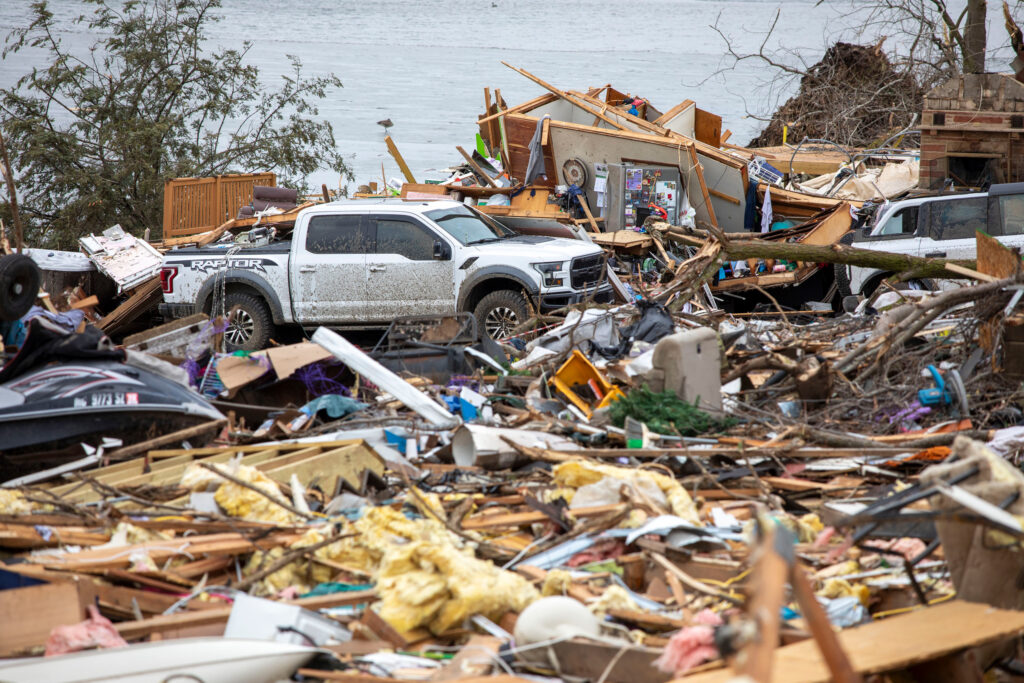 Damage and debris in Union City, Michigan, on March 7 after a tornado struck several cities in rural southwest Michigan. Credit: Bill Pugliano/Getty Images
But hailstorms are notoriously difficult to study because they form inside thunderstorms just a few miles in diameter, much smaller than the grid cells used in most climate models. Physics explains why more intense storms produce larger hailstones, and new research has pinpointed a link between global warming and the French storm.
Lead author Davide Faranda, research director at France’s National Center for Scientific Research, wrote in an email that, like other recent studies, the new findings show that hail is not a fringe or localized hazard. He pointed out that with global warming, hailstorms are becoming more damaging, affecting a wide range of areas, including major cities.
“Understanding how climate change amplifies these risks is essential to predicting impacts and improving preparedness,” he wrote, adding that while the timing of hailstorms is still often determined by natural weather patterns, global warming is amplifying their intensity when they occur.
Rather than trying to simulate the May 3 storm, Faranda and co-author Tommaso Alberti focused on the large-scale weather patterns that caused the storm. Because this situation occurs regularly over Western Europe, and the region is closely monitored, researchers were able to compare what happened with the Paris hailstorm to dozens of previous storms that developed under nearly identical conditions, and answer the question of how it was affected by warming temperatures.
Alberti, an atmospheric physicist at Italy’s National Institute of Astrophysics who studies extreme weather events and climate, said studies show that hailstorms in Paris are already becoming more intense due to climate change. He said that when such storms occur in “warmer, more volatile climates,” “the resulting hail is larger and more damaging, hitting transportation networks and causing significant damage to residents, businesses and insurance companies.”
This story is funded by readers like you.
Our nonprofit newsroom provides free advertising for our award-winning climate coverage. We rely on donations from readers like you to continue our work. Donate now to support our work.
donate now
10 years warning
The insurance industry has been sounding the alarm about the growing threat of hail for years. Researchers at Munich Re said in a January report that a severe hailstorm could cause billions of dollars in damage in minutes if it hit a city crowded with cars, glass roofs and solar panels. In Europe, individual hail events cause losses of close to $3 billion.
Understanding how warming affects hail risk in individual storms could help forecasters create more timely warnings and improve hail destructive behavior such as cloud seeding in important agricultural areas. The attribution study also provides a case study that helps test more theoretical climate modeling, which suggests that continued warming will lead to increased hail abundance.
Iris Turnherr, a climate scientist at the Swiss Institute of Technology Zurich who studies severe storms and hail, said the study supports previous research showing that atmospheric conditions suitable for severe hailstorms are changing in a warming climate.
“The theory is that storms could become stronger as the climate warms, but there is still uncertainty as to whether hailstorms will become more frequent,” Sarnhell wrote in an email.
She explained that showing how global warming shapes a single memorable event will help the public understand the link between climate change and extreme events, and could serve as a starting point for similar research on other dangerous climate disasters. Overall, scientists are more confident about the link between anthropogenic warming and hail than they were just a decade ago, she wrote.
But uncertainties remain, said Abdullah Karaman, an atmospheric scientist at the University of Newcastle in the UK who has also published research on severe storms and hail.
The biggest challenge is a lack of observation records, he wrote in an email. Hailstorms are very localized and often go unrecorded unless they cause damage or hit populated areas. Scientists are also still working to understand how warming changes the small-scale conditions within thunderstorms that determine whether hail forms.
Warmer temperatures are causing the hot, moist air to move upwards more forcefully in thunderstorms, like a lava lamp in overdrive, Faranda said. In violently shaking air, hailstones stay in the air longer and grow larger before falling to the ground. He added that the study “allows us to say with more confidence that when storms do occur, the warming atmosphere will make them more intense and potentially produce larger hail.”
About this story
As you may have noticed, this article, like all news we publish, is free to read. That’s because Inside Climate News is a 501c3 nonprofit organization. We don’t charge subscription fees, keep our news behind paywalls, or fill our website with ads. We provide climate and environmental news free to you and anyone who wants it.
That’s not all. We also share our news for free with dozens of other news organizations across the country. Many of them cannot afford to do their own environmental journalism. We’ve established bureaus across the country to report on local news, partner with local newsrooms and co-publish stories to ensure this important work is shared as widely as possible.
The two of us started ICN in 2007. Six years later, we won the Pulitzer Prize for national reporting and now run the nation’s oldest and largest dedicated climate newsroom. We tell the story in its entirety. We hold polluters accountable. We expose environmental injustice. We debunk misinformation. We explore solutions and inspire action.
Donations from readers like you fund all aspects of our work. If you haven’t already, will you support our ongoing work, our coverage of the biggest crises facing our planet, and help us reach more readers in more places?
Please make a tax-deductible donation. Each one makes a difference.
thank you,

bob berwin
reporter, austria
Bob Barwin is an Austria-based reporter who has covered climate science and international climate policy for more than a decade. Previously, he reported on the environment, endangered species, and public lands for several Colorado newspapers, and also worked as editor and associate editor for a community newspaper in the Colorado Rockies.
