


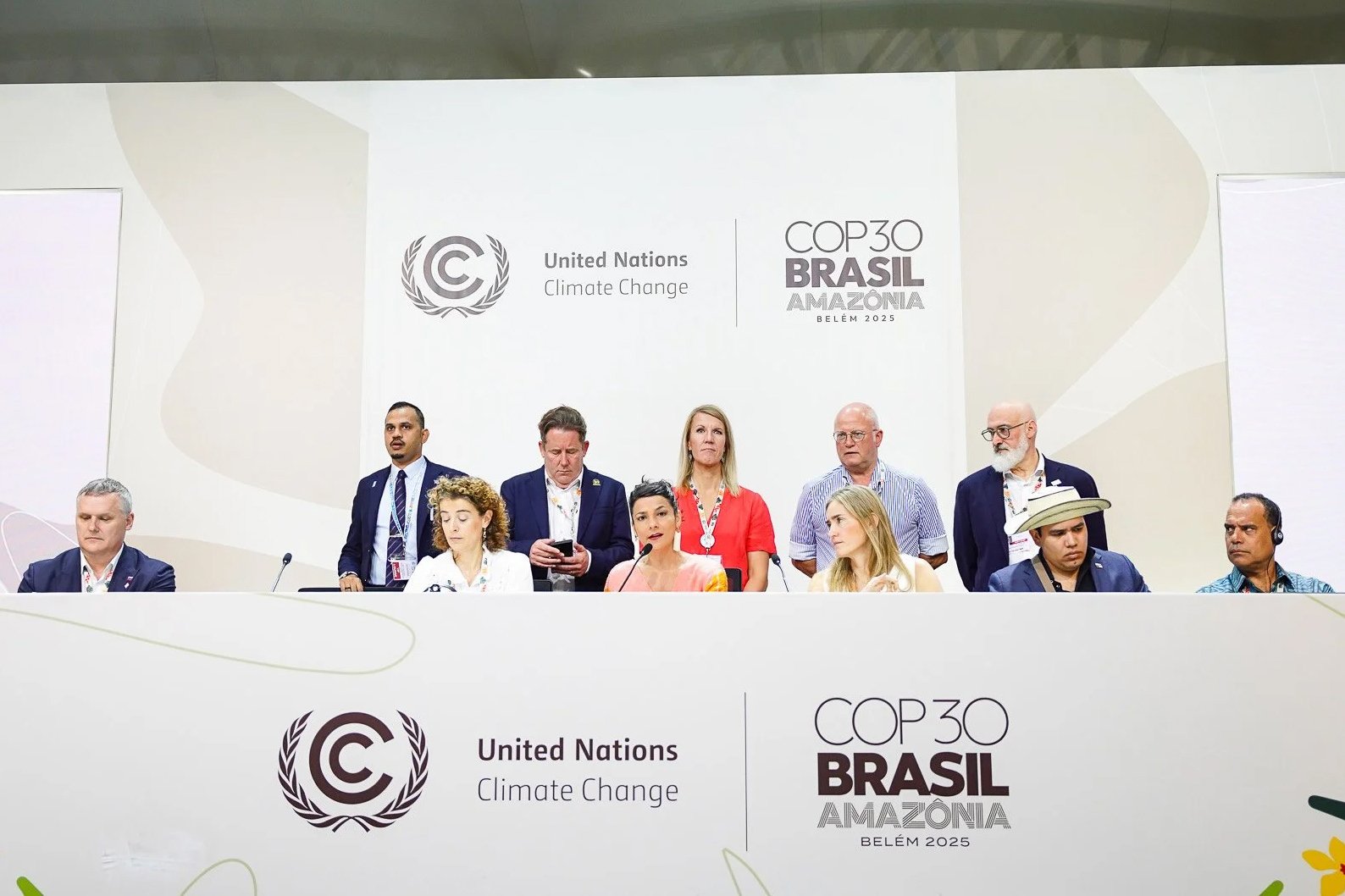
In an overheated and fractured world, teetering from one crisis to the next to supplement our dependence on oil and gas, cooperation on the energy transition may seem unrealistic, even radical.
But today, more than 50 countries are gathering in Santa Marta, Colombia, to begin developing concrete plans to phase out fossil fuels, going beyond the conditional global agreement on transitioning away from fossil fuels in energy systems agreed at COP28 in Dubai. The lack of progress toward this goal spurred Colombia and the Netherlands to build a coalition of countries that wanted to go faster and further.
Participating countries range from leading fossil fuel producers such as Australia, Norway, Brazil, Nigeria and Mexico, to climate-vulnerable island states such as Fiji, Tuvalu and the Maldives, to Denmark, Spain, France and the European Union. The United States, Russia, China, and major Gulf oil states such as Saudi Arabia and the United Arab Emirates are notably absent.
Former Irish President Mary Robinson offered a perspective from the Elders, a group of former independent world leaders who act as moral and ethical voices on peace, justice and climate issues, describing the conference as “a new multilateral space for doers – a commission of people who want to work together and take the lead on fossil fuels.”
In a webinar held a few days before the conference, Robinson placed the conference squarely in the context of current events. “It’s a very serious moment,” she said. “The United States and Israel are waging an illegal war against Iran, with repercussions around the world.”
He said the erosion of international law and impact on the global economy from the Iran war shows why a just transition to renewable energy is now a “security imperative.” She added that the second major energy shock in just four years is not just a wake-up call, but “a clear signal that our energy system requires urgent structural change.”
Rather than trying to drag all reluctant petrostates out at once, Colombia and the Netherlands want to build a modular coalition of states to develop practical timelines and mechanisms to protect people, communities, and ecosystems while electrifying transportation and industry and increasing conservation and efficiency alternatives to fossil fuels.
He said Spain, with its abundance of solar and wind power, has been able to keep electricity prices lower than countries that are even more dependent on fossil fuels, adding that Pakistan’s people-led solar revolution has already helped the country avoid more than $12 billion in fossil fuel imports.
Organizers planned the conference in the belief that some fast-moving countries could try out practical ideas now and later incorporate them into the slow-moving United Nations Framework Convention on Climate Change’s climate policy development.
Compared to the largest UN climate summit, which draws more than 50,000 participants and allows countries to negotiate for days over every comma in the legal text, the Santa Marta conference is designed to reach a wider audience with more open sessions and live streaming.
Rather than treat civil society as an afterthought, the Santa Marta conference will include a people’s summit of civil society community groups, trade unions, indigenous leaders and public interest activists in the formal process. Organizers hope that a successful conference will reinvigorate climate action among participating countries and build momentum to phase out fossil fuels as soon as possible.
Robinson said holding the conference at a difficult time when “some bullies are even trying to keep countries dependent on fossil fuels” is an achievement in itself and shows that despite political headwinds, much of the world wants to accelerate the transition away from fossil fuels.
He noted that the advisory opinion on climate change issued by the International Court of Justice in The Hague last year made clear that “weaning away from fossil fuels is no longer just a political imperative,” adding that the court said countries must take appropriate action to protect the climate.
Natalie Jones, a senior policy adviser at the International Sustainable Development Institute, a nonprofit organization that closely monitors and analyzes international environmental negotiations, said Santa Marta should be seen as the beginning of a new process, rather than “a place where you expect big, grandiose declarations.”
Jones said this is not a run-of-the-mill meeting, but a gradual process, and as the meeting supports Brazil’s ongoing efforts as COP30 president, what emerges from Santa Marta could inform a series of climate change conferences in the coming months and build further momentum for the transition at COP31, to be held in Antalya, Turkey, in November.
Any measures to accelerate the transition away from fossil fuels will not only benefit climate change reasons, but also “help energy security and affordable energy for households and businesses,” she said.
The current global energy system is uncertain and chaotic, and the most vulnerable are always hit first and hardest by rising prices and shortages. What is needed, he said, is a “stable and reliable policy environment” to create the conditions to accelerate the phase-out of fossil fuels. He added that the roadmap envisioned at the start of the conference is “a way for the government to give clear direction to investors, workers and communities.”
About this story
As you may have noticed, this article, like all news we publish, is free to read. That’s because Inside Climate News is a 501c3 nonprofit organization. We don’t charge subscription fees, keep our news behind paywalls, or fill our website with ads. We provide climate and environmental news free to you and anyone who wants it.
That’s not all. We also share our news for free with dozens of other news organizations across the country. Many of them cannot afford to do their own environmental journalism. We’ve established bureaus across the country to report on local news, partner with local newsrooms and co-publish stories to ensure this important work is shared as widely as possible.
The two of us started ICN in 2007. Six years later, we won the Pulitzer Prize for national reporting and now run the nation’s oldest and largest dedicated climate newsroom. We tell the story in its entirety. We hold polluters accountable. We expose environmental injustice. We debunk misinformation. We explore solutions and inspire action.
Donations from readers like you fund all aspects of our work. If you haven’t already, will you support our ongoing work, our coverage of the biggest crises facing our planet, and help us reach more readers in more places?
Please make a tax-deductible donation. Each one makes a difference.
thank you,

bob berwin
reporter, austria
Bob Barwin is an Austria-based reporter who has covered climate science and international climate policy for more than a decade. Previously, he reported on the environment, endangered species, and public lands for several Colorado newspapers, and also worked as editor and associate editor for a community newspaper in the Colorado Rockies.
