


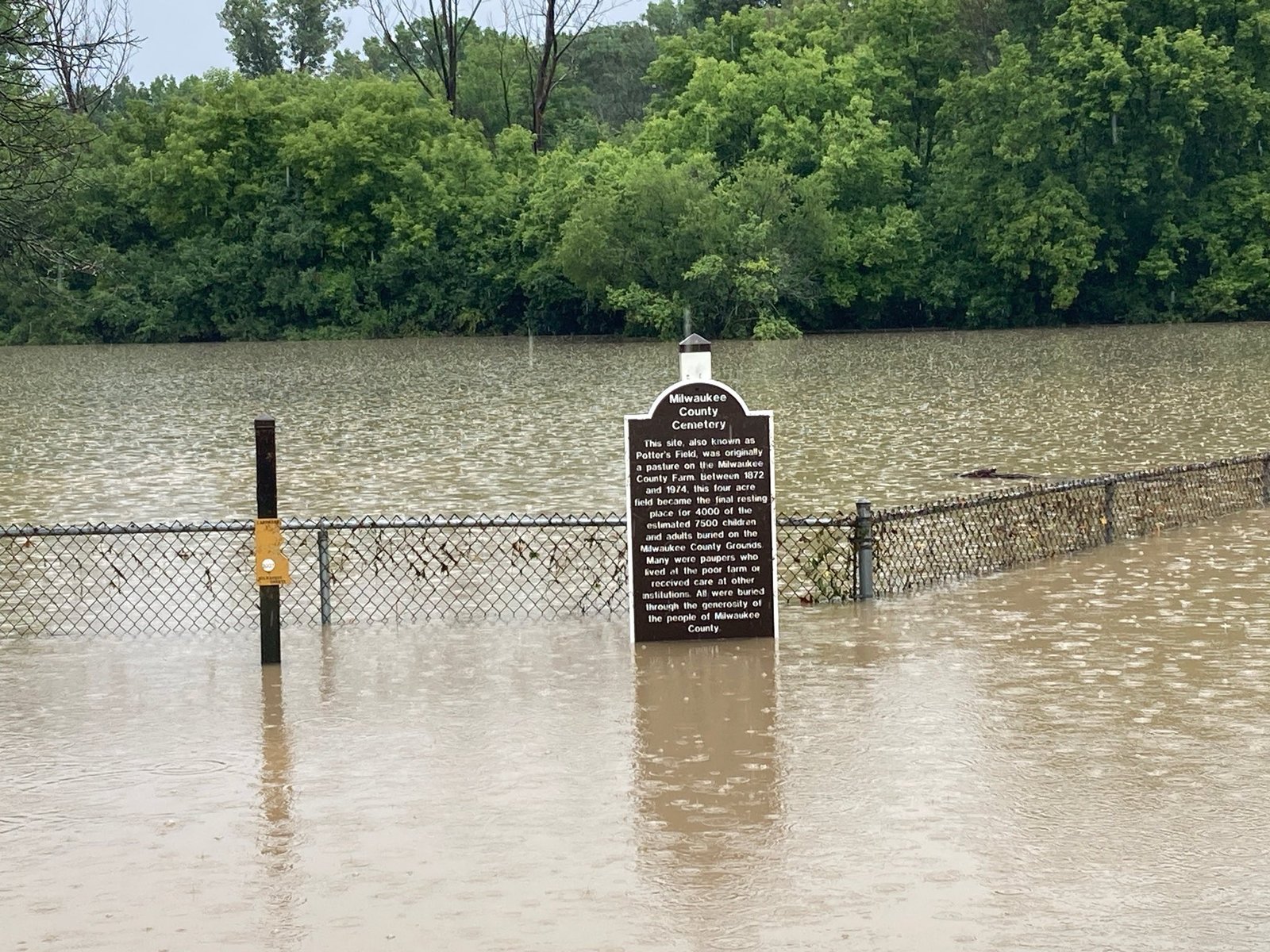
Communities that turn to the federal government for aid when a climate disaster occurs cannot expect that aid to arrive. This increasingly common reality was revisited in a recent report by the Wisconsin Policy Forum, which focused on the state’s historic flooding last August and found that federal aid to help rebuild public infrastructure damaged by the record-breaking storm fell short of what was needed.
The report took a closer look at the Milwaukee area, where 14.6 inches of rain set an all-time record for 24-hour rainfall in Wisconsin. “As a result, the Menomonee, Milwaukee, and Kinnickinnic rivers all flooded, flooding low-lying homes, roads, businesses, and schools with rainwater.Recovery efforts are still ongoing, and the impact of another major storm that hit the region in April 2026. These storms earlier this year also dumped record amounts of rain in Green Bay and Wausau, causing historic flooding along the Wolf River watershed in Shiocton, New London and Porterfield. Researchers have long warned that climate change increases the risk of flooding and more severe storms in Wisconsin, but President Donald Trump’s administration has downplayed that and dismissed it as a hoax.
 Photo of flooded roads in Milwaukee during the August 2025 storm. (Photo by Anne Tuchelski)
The August storm not only filled basements and damaged homes, but also caused extensive damage to roads, parks, bridges and other public infrastructure. In and around Milwaukee, damage occurred to county land, public schools, and public property owned by the city of Milwaukee and 18 other communities. At least $34.7 million. That included $10 million each to the Milwaukee Public Schools and Sewer District, and $1.4 million in damages calculated by county officials, half of which was road-related. City officials estimate damage at $1.7 million, plus $5 million in additional costs related to debris removal. In Wauwatosa, one of the suburban communities surrounding Milwaukee County, damage to city parks, roads and buildings was estimated at $6.8 million.
In the Milwaukee area, August’s storms left behind approximately $240 million in total damage to private and public property. After implementing the Federal Emergency Management Agency (FEMA), the Trump administration approved $210 million in aid to help individuals rebuild, but did not provide funding to assist local governments despite multiple requests from state and local leaders.
Wisconsin Democratic Gov. Tony Evers declared a state of emergency soon after the August storm and requested a federal major disaster declaration for Milwaukee, Waukesha, Washington, Door, Grant and Ozaukee counties. The Wisconsin Policy Forum report said Evers requested both private and public assistance. During the damage investigation, more than 26,000 separate reports of damage were received across the state. FEMA concluded that the 2025 floods were “severe enough to warrant a disaster declaration in Milwaukee, Waukesha, and Ozaukee counties, but only assistance to individuals was authorized; assistance to public entities was not warranted given the severity of the disaster,” the report said. “This meant that only individuals in these counties were eligible for assistance and not the government.”
 Flooding in Wauwatosa after the August 2025 storm. (Photo provided by Erol Layal)
The report says the federal government rarely approves one form of disaster assistance and rejects another, with only 2.7 percent of designated disasters since 2000 approved for individual assistance but denied public assistance. The federal government approved $4.5 million in aid to local governments when the Milwaukee area was hit by severe storms and flooding in 2008, and an additional $10.3 million in aid during severe storms in 2010. “Milwaukee County has also received $6.1 million to help with costs related to snowstorm cleanup since 2000,” the Wisconsin Policy Forum noted.
early this month$22.6 million in aid was provided to several counties. President Trump used this allocation to promote Republican Rep. Tom Tiffany as his candidate for governor of Wisconsin.
Local governments are trying to make up for the shortfall, but the cost is high. Typically, the state allocates between $1 million and $3 million to local governments to cover disaster costs, but the damage in 2025 was so extensive that $16.9 million was needed to cover damage claims, the highest annual amount on record since 2000. “This is due to both the scale of the August 2025 floods and the denial of federal funding that could have covered at least some of these costs,” the report said. Approximately 46,000 residents of Waukesha and Milwaukee counties in Washington State applied for individual assistance after the August storms, and as of June, grants have been distributed to 36,800 of those eligible.
Protect yourself from the effects of climate change
Some municipalities, including Milwaukee County We have taken policies to help Adapting to the effects of climate change. “Sewer districts are investing hundreds of millions of dollars in flood control systems in the region, including concrete infrastructure such as deep tunnel systems, as well as green infrastructure efforts such as wetland conservation, reducing hard surfaces such as concrete that cause runoff, and other methods to limit the speed and amount of flooding,” the Wisconsin Policy Forum reports. Without these measures, August’s floods could have been “much worse,” according to the policy forum. “However, it is clear from two storms in the past 10 months that there are still thousands of buildings in the region susceptible to flooding.”
Recovering from a disaster is fraught with difficulties. And the policy forum says that an increase in the frequency of severe weather is likely to cause more disasters, even though “the availability of federal disaster assistance is becoming increasingly difficult to predict.” If the federal government decides to deny a community’s request for assistance, “state residents have limited recourse other than petitioning FEMA and Congress for assistance.”
 Streets in Milwaukee flooded during storms that hit the city from August 9 to August 11, 2025. (Photo by Ann Tuchelski)
The report recommends state leaders approve using state tax revenue to provide additional funding for disaster relief. Such efforts by Mr. Evers and other lawmakers have so far been rejected by the Republican-controlled Legislature. State and local leaders could also invest in flood control and mitigation efforts and expand green infrastructure. Developing community-based insurance policies to deal with “these unpredictable and increasingly likely disasters” is another solution suggested by the Policy Forum.
“While state and local leaders have limited control over when and where flooding occurs, they can be better prepared to respond when it occurs,” the report concludes. “We can also reduce flood risk by investing in infrastructure that slows, stores, and redirects water.” These efforts can still be challenging, depending on the scale of the disaster. And with the federal government indicating that aid is not guaranteed for any reason, Wisconsin may need to become “more self-sufficient” in responding to future disasters.
Get your morning headlines.
