


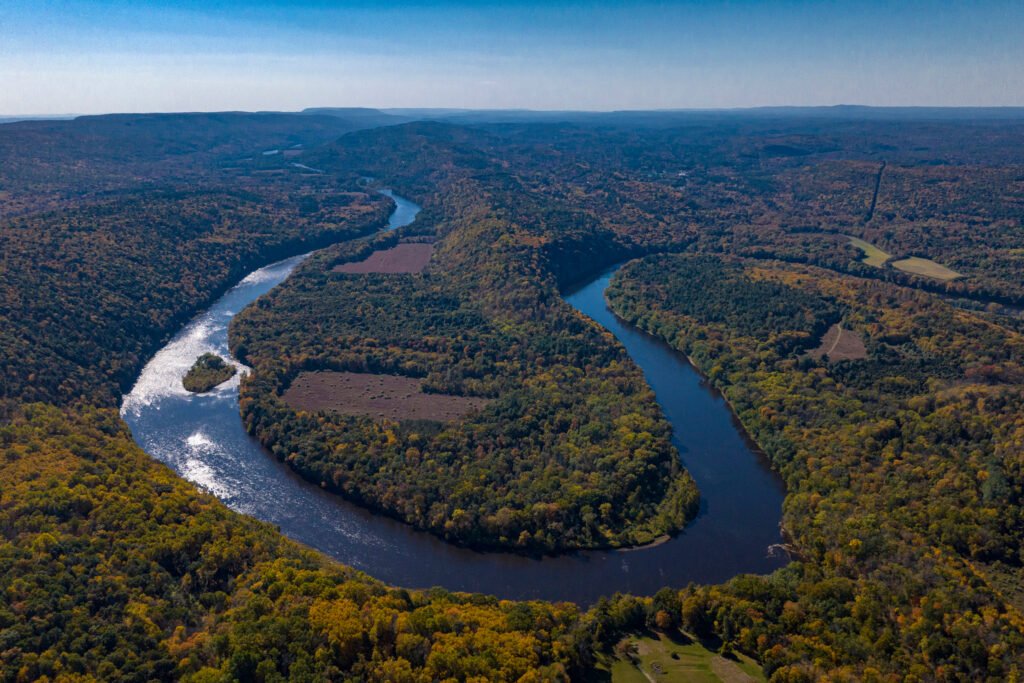
A Republican-led effort to end a ban on hydraulic fracturing in the Delaware River Basin failed Tuesday after an amendment to the Water Resources Development Act failed to make it to a congressional committee, allowing long-standing restrictions to remain in place for the time being.
The amendment, authored by Rep. Scott Perry, R-Pennsylvania, would strip the Delaware River Basin Commission, an interstate regulator, of its authority to regulate hydraulic fracturing in the 330-mile watershed that stretches from upstate New York to the mouth of the Delaware Bay, an area that provides drinking water to millions of people.
The measure would also preemptively block hydraulic fracturing bans by two other regulators, the Susquehanna River Basin Commission in central Pennsylvania and the Potomac River Basin Compact in Washington, D.C., and surrounding states. Perry’s office did not respond to requests for comment.
The Delaware River Basin Commission said the rules governing the three commissions do not appear to be changing and the House plans to vote on the Water Resources Development Act (WRDA) without proposed changes to the hydraulic fracturing ban.
“It is our understanding that the House intends to consider WRDA 2026 under a suspension of rules, which means no further amendments will be introduced and the status quo for the three mid-Atlantic river basins remains, but that is subject to change,” Beth Brown, a spokeswoman for the committee, said in a statement.
Tracy Carluccio, deputy director of the environmental group Delaware Riverkeeper Network, said the failure of the Perry amendment was a victory for water quality, but she doesn’t expect the victory to last long.
“They missed this opportunity to overturn the commission’s authority to ban hydraulic fracturing… but I have no doubt they will try again using every means they can think of,” she said. Carluccio said some elected officials are encouraged by the Trump administration’s support for rolling back environmental regulations and accelerating fossil fuel development.
Still, DRN leader Maya van Rossum said the repeal of the amendment was an “amazing success” thanks to the efforts of environmental groups who urged Congress to reject it.
 The amendment, authored by Rep. Scott Perry (R-Pennsylvania), would strip the Delaware River Basin Commission of its authority.
“We have made clear to members of Congress that DRBC’s fracking ban is critical to protecting our communities, is based on sound science, and is grounded in the reality of the devastation that would occur in our region and elsewhere in the country if fracking for fossil fuels were to take place,” she said.
The amendment would overturn the ban on fracking, which had been in place officially since 2021 and informally since 2010, when the commission first proposed it. After nearly a decade of public comment, the agency, which represents Pennsylvania, New York, New Jersey, Delaware and the federal government, concluded that allowing hydraulic fracturing in the basin would pose “significant, immediate and long-term” risks to water quality across the region, potentially contaminating water used by the region’s approximately 15 million people for drinking, agriculture and industry. New York City, Trenton, Philadelphia, and Wilmington all rely on water from their river basins.
Numerous studies and reports by government agencies outside the Delaware River Basin have concluded that hydraulic fracturing “adversely impacts” surface water and groundwater resources through spills and releases of hydraulic fracturing chemicals, including chemicals of “unknown toxicity,” the commission said in adopting the rule.
Perry has previously tried to overturn the DRBC ban. In 2025, he introduced the DRILL Now Act, which aims to prevent the commission from “enforcing regulations that are stricter than those established by the state.”
“We must stop unelected bureaucrats on various watershed commissions from restricting Pennsylvanians’ ability to exercise their mineral rights,” Perry said at the time. “My legislation will ensure that Pennsylvania remains a leading natural gas producer.”
The ban was a landmark regulation adopted by the commission after more than a decade of advocacy and public comment from environmental groups. Supporters have fiercely defended it as an important public health safeguard and curbing the production of climate-warming natural gas.
 A hydraulic fracturing drilling pad is in operation in the Marcellus Shale formation near Robinson Township, Pennsylvania. Credit: Robert Nickelsberg/Getty Images
Ahead of the commission’s decision on Tuesday, the commission issued a statement saying the proposed measures would undo decades of water quality improvements.
The DRBC, which was established by an act of Congress in 1961, said: “For more than 60 years, joint management through the DRBC has protected and improved water supplies and water quality for millions of water users. Recent legislative proposals pose a significant threat to this process. As stated in the document, the proposals could give one industry a more advantageous position than others, including public water supplies, energy generation, agriculture, and more.”
The proposed amendment states that the three commissions “may not finalize, implement, or enforce regulations regarding hydraulic fracturing that are promulgated under any authority other than the state in which the regulations are implemented or enforced.”
The Marcellus Shale Coalition, a trade group for Pennsylvania’s natural gas industry, said it strongly supports the amendment, which aims to repeal what it says is an illegal fracking ban.
This story is funded by readers like you.
Our nonprofit newsroom provides free advertising for our award-winning climate coverage. We rely on donations from readers like you to continue our work. Donate now to support our work.
donate now
MSC President Jim Welty said the DRBC ban has caused “irreparable harm to many landowners, and it is past time for Congress to correct this injustice.”
“It is never the job of the Basin Commission to regulate economic activity. It is the job of the Basin Commission to manage water resources within the basin for the benefit of all stakeholders,” he said in a statement. Last year, an industry group estimated that the ban would make $40 billion worth of gas unavailable at 2025 prices.
Steve Miano, an environmental attorney at Hungry Aronchick Segal Pudlin & Schiller in Philadelphia, said the proposed revocation of the right to regulate hydraulic fracturing would violate the DRBC’s Compact, a federal law that requires the DRBC to ensure water quality and quantity in the watershed and resolve disputes between member states.
“Because the DRBC’s regulatory authority was given to it by the Supreme Court, there will still be a valid argument that Congress cannot revoke this authority,” he said. “There is a good chance there will be a challenge in federal court over whether Congress can strip DRBC of its ability to do what the agreement says.”
President Donald Trump has called for accelerating domestic fossil fuel development in response to what he calls an “energy emergency,” a claim that environmentalists dispute.
The Delaware Riverkeeper Network, which has supported and defended the region’s fracking ban, said the amendment threatens the environment and water quality in the populated area.
“What they’re really trying to do is take power away from the DRBC and simply leave it up to the states,” Van Rossum said ahead of the commission’s action. “This removes independent regulatory authority when it comes to hydraulic fracturing.”
 Maya Van Rossum has been Delaware’s river steward for 30 years and is the leader of the nonprofit Delaware River Steward Network. Credit: Caroline Gutman/Inside Climate News
Although the DRBC operates with permission from the U.S. Supreme Court and federal and state lawmakers, Van Rossum said the amendment has legal credibility and poses a threat to the watershed.
“No one should discount or underestimate the tremendous threat this poses to our watershed in terms of hydraulic fracturing, and to the authority of the DRBC,” she said.
Filmmaker and environmental activist Josh Fox, whose 2010 film “Gasland” includes footage of residents in northeastern Pennsylvania’s severely cracked Susquehanna County setting fire to methane-soaked kitchen tap water, said the end of the ban could contaminate water far from drilling sites in Pennsylvania.
“If you’re doing hydraulic fracturing on the Pennsylvania side, all that wastewater goes directly into the river. Right now, there’s a buffer zone between the hydraulic fracturing that happens in Pennsylvania and the Delaware River. That area is the New York City, Philadelphia, southern New Jersey watershed,” he said.
New Jersey and Delaware have no gas reserves, while New York state banned hydraulic fracturing under state law in 2014.
Fox said Pennsylvania has done a “terrible” job of regulating fracking, which has become widespread in much of the state since the mid-2000s, making Pennsylvania the second-largest natural gas producer in the United States after Texas. A 2020 grand jury report on hydraulic fracturing concluded that state regulators “failed to adequately protect the health, safety, and welfare of thousands of Pennsylvanians affected by this industry.”
About this story
As you may have noticed, this article, like all news we publish, is free to read. That’s because Inside Climate News is a 501c3 nonprofit organization. We don’t charge subscription fees, keep our news behind paywalls, or fill our website with ads. We provide climate and environmental news free to you and anyone who wants it.
That’s not all. We also share our news for free with dozens of other news organizations across the country. Many of them cannot afford to do their own environmental journalism. We’ve established bureaus across the country to report on local news, partner with local newsrooms and co-publish stories to ensure this important work is shared as widely as possible.
The two of us started ICN in 2007. Six years later, we won the Pulitzer Prize for national reporting and now run the nation’s oldest and largest dedicated climate newsroom. We tell the story in its entirety. We hold polluters accountable. We expose environmental injustice. We debunk misinformation. We explore solutions and inspire action.
Donations from readers like you fund all aspects of our work. If you haven’t already, will you support our ongoing work, our coverage of the biggest crises facing our planet, and help us reach more readers in more places?
Please make a tax-deductible donation. Each one makes a difference.
thank you,
