


aA heatwave is intensifying across Europe, forcing most cities to install more air conditioning. But in Paris in the 1990s, plans began for a different kind of solution: one of the world’s largest district cooling networks.
The system includes 120 kilometers (75 miles) of underground pipes that provide chilled water to museums, offices, hospitals, schools, and other public buildings, including the Louvre, the Grand Palais, and some luxury hotels and business districts. Instead of thousands of individual air conditioning units, cooling is generated centrally and shared throughout the city, like a public utility.
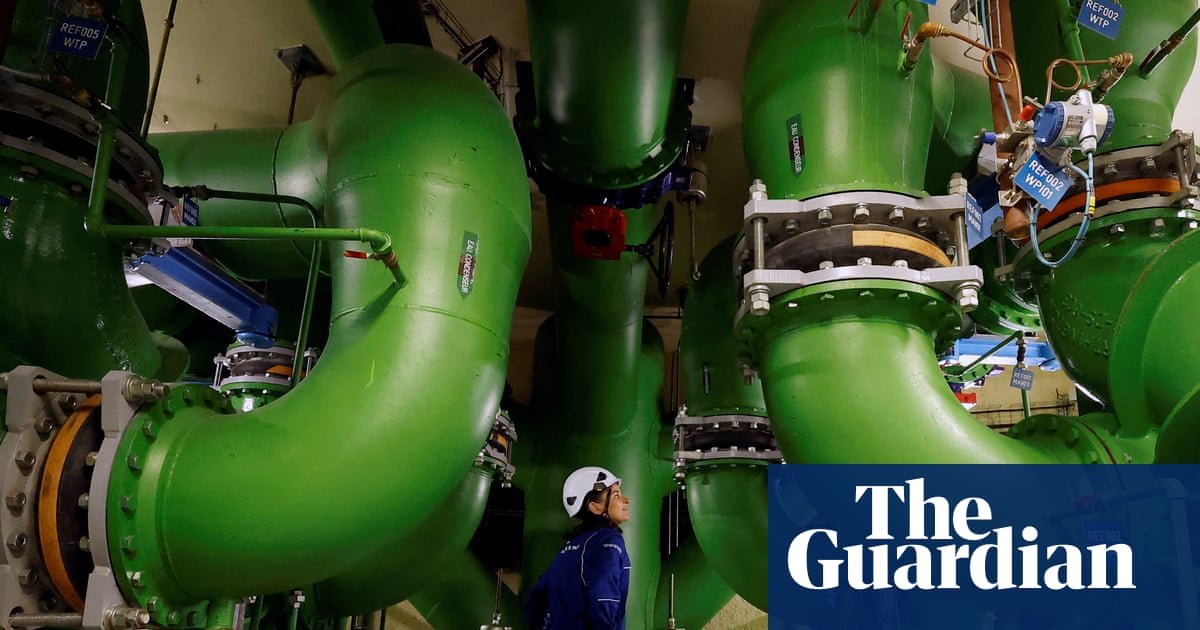
This system circulates cold water through a network of pipes. Cold river water from the Seine is pumped through one pipe, which runs right next to a second pipe that carries hot water from the city’s buildings. A thin metal wall separates them, and a heat exchanger allows heat from the warm city water to enter the cold Seine water without any liquid contact. This is similar to pouring hot tea into a bowl of cold water. The liquids won’t touch, but the tea will cool.
The system circulates cold water from the Seine through a network of pipes. Photo: Damian Meyer/AFP/Getty
That cold water is circulated through buildings connected to the system, and the Seine water is returned to the river, which is slightly warmer than before.
The plan was developed in the 1990s by Engie, a subsidiary of the city’s utility company, which began conceptualizing and building one of the world’s largest district cooling networks to combat the urban heat island effect and improve energy efficiency. In 2022, with the support of the Paris City Government, the company Fraîcheur de Paris, which stands for “Freshness of Paris,” took over the contract and began a major multi-year expansion of the existing underground infrastructure.
“This is a kind of miracle solution in the age of global warming,” says Thibault Voita, an energy and climate expert and consultant at the Jacques Delors Institute.
The City of Paris remains the owner of the network, which is operated by transport companies RATP and Engie through a 20-year concession agreement renewed in 2022. By 2042, the City of Paris plans to triple the size of the network, extending it to all boroughs and reaching more than 3,000 buildings, including critical infrastructure such as hospitals, schools, day care centers and nursing homes.
“Not all[Parisian buildings]have the same cooling needs, and not all are suitable to be connected to a network. The 3,000 number…reflects a realistic development trajectory. The goal is to move from a historic network focused on large tertiary buildings to a city-wide infrastructure,” said Tim Guigon, a spokesperson for Flessures de Paris.
Employees are working on the access stairs to the city’s underground cooling network. Photo: Christian Hartmann/Reuters
Beyond cooling the entire city, it is hoped that Fleissure de Paris will prevent at least some of Paris’ 2.1 million people from buying air conditioners. Air conditioners work by taking heat from inside a room and sending it to the street outside. “Everything that requires energy emits heat, and that heat has to go somewhere,” says Sophie Parison, a researcher in Paris who focuses on heating and cooling solutions for cities.
Flessure de Paris does not avoid this issue completely. It sends slightly hot water back into the Seine. But so far there is no clear evidence that it is having a negative impact on the Seine’s ecosystem. In general, research and monitoring have shown that the system’s heat exchange produces only small, controlled temperature changes that are within environmental limits.
Pauline Laveau, the city government’s director of climate change, said Flassure de Paris “offers much higher energy and environmental performance than individual cooling systems.”
Map of operational sites of underground cooling systems operated by Fraîcheur de Paris. Photo: Louis Joly/AP
This is supported by experts. Charles Simpson, a senior climate change researcher at University College London, said of air-conditioning units: “They should use much less energy than if you were to provide the same cooling with a modular system.”
Paris isn’t the only city doing this. Stockholm is using water from the Baltic Sea to reduce electricity use during heat waves, and Toronto is using water from Lake Ontario for cooling systems. Experts said this could work in big cities like London, but it cannot be copied and pasted.
Laveau said: “The development of district cooling networks requires significant investment. For this project to be economically viable and commercially attractive, cities must have sufficiently concentrated cooling demands, where a dense network is justified.”
Cost is one big hurdle. The total value of the 20-year contract with Fresheur de Paris was 2.4 billion euros (approximately 220 billion yen). It would cost at least that much to replicate a similar structure in London.
For developing countries in the Global South, community cooling could be a game-changer, but high interest rates and chaotic existing infrastructure likely make whole-city retrofits financially impossible. It may be more feasible in locations with less existing underground infrastructure.
Geography is also a hurdle. For example, the River Thames does not have the ideal water flow and temperature for the project, and the city’s underground is crowded with public buildings and tube lines.
“Behavior must always be adapted to the type of city and local issues,” says ecologist and environmentalist Emmanuel Gendreau of Sorbonne University. “It is important not to simply apply adaptation measures that have already worked in one city to another.”
