


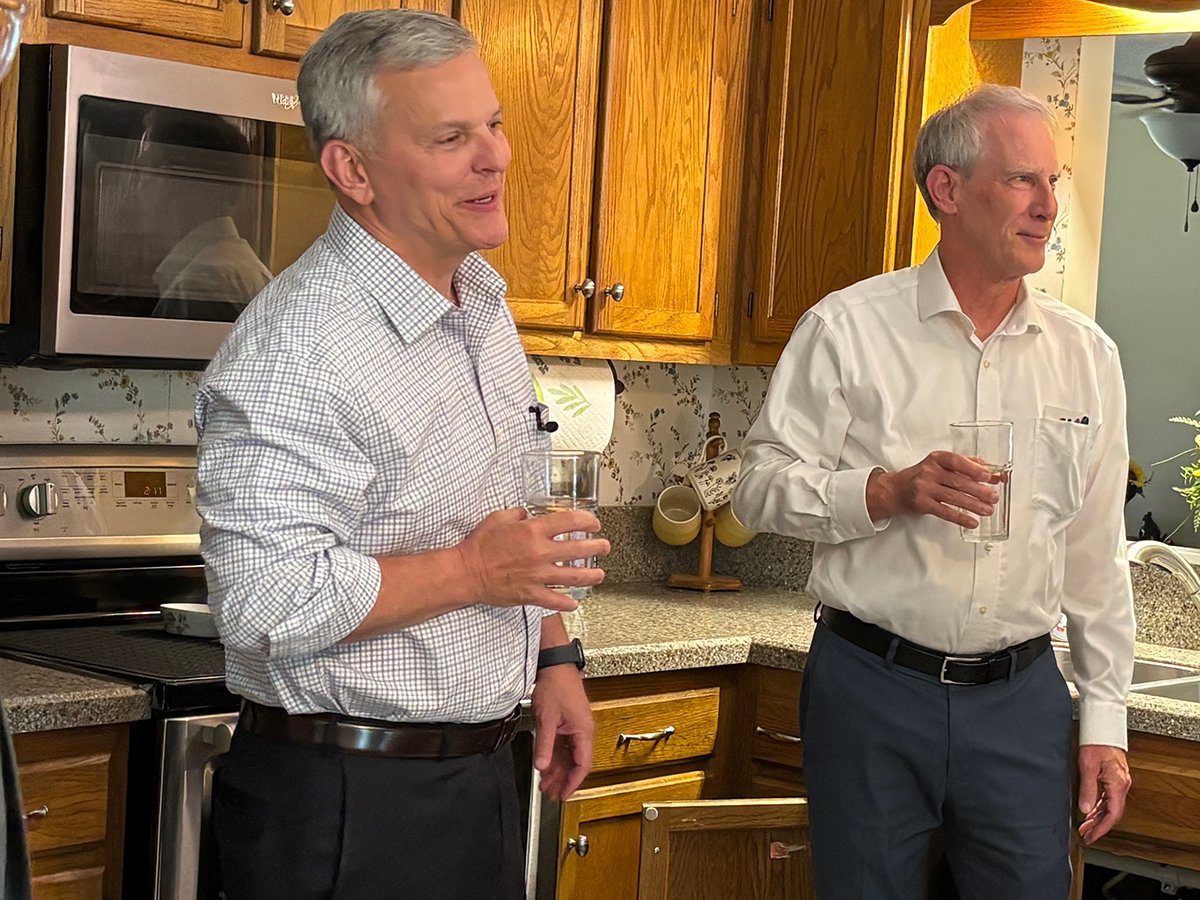
 North Carolina Gov. Josh Stein, left, and Department of Environmental Quality Secretary Reed Wilson sampled water from Brenda Moore’s kitchen faucet at her Wilmington-area home Wednesday. Photo: Trista Talton
WILMINGTON – North Carolina officials and environmental groups are slamming Chemours’ proposed $450 million federal settlement over PFAS contamination, arguing the deal would do little to help the state.
The U.S. Department of Justice announced the multistate agreement Wednesday, touting it as the federal government’s first comprehensive settlement for per- and polyfluoroalkyl contamination.
Under the terms of the settlement, Chemours will pay a civil penalty of $22.5 million over three years to the Environmental Protection Agency and the West Virginia Department of Environmental Protection and will spend $90 million over 15 years “to further reduce PFAS emissions and enhance existing off-site drinking water programs,” according to a company release.
According to the U.S. Department of Justice, the company spent an estimated $60 million installing pollution control equipment for surface water and air emissions at its West Virginia plant, and has provided residents in areas surrounding its facilities in West Virginia and New Jersey for more than a decade. It will cover an estimated $280 million in costs to provide clean drinking water and will “evaluate options and implement corresponding controls to reduce releases of PFAS and other toxic chemicals from North Carolina factories.”
Gov. Josh Stein expressed doubts about whether North Carolina, one of three states named in the deal, would actually receive some of these funds.
“There is a good chance that North Carolina is not getting a dime from this federal settlement,” Stein said Wednesday afternoon, visiting families in the Wilmington area who use state-funded water filtration systems to remove PFAS from their drinking water.
“The settlement just announced today has no meaningful impact on North Carolina or North Carolinians,” he said. “It might help West Virginia or New Jersey, but it doesn’t really help North Carolina.”
Emily Donovan, co-founder of Clean Cape Fear, agreed.
“If Chemours can’t control its pollution according to the law without constant litigation, there may not be a need to create permanently toxic chemicals,” she said in a release. “I’m not sure who this is in favor of. Not us in North Carolina, who have been dealing with almost half a century of PFAS contamination from the Fayetteville plant facility.”
Gene Tsang, senior attorney at the Southern Environmental Law Center, said the settlement lacks meaningful enforcement and “appears to be aimed at shielding Chemours from real liability.”
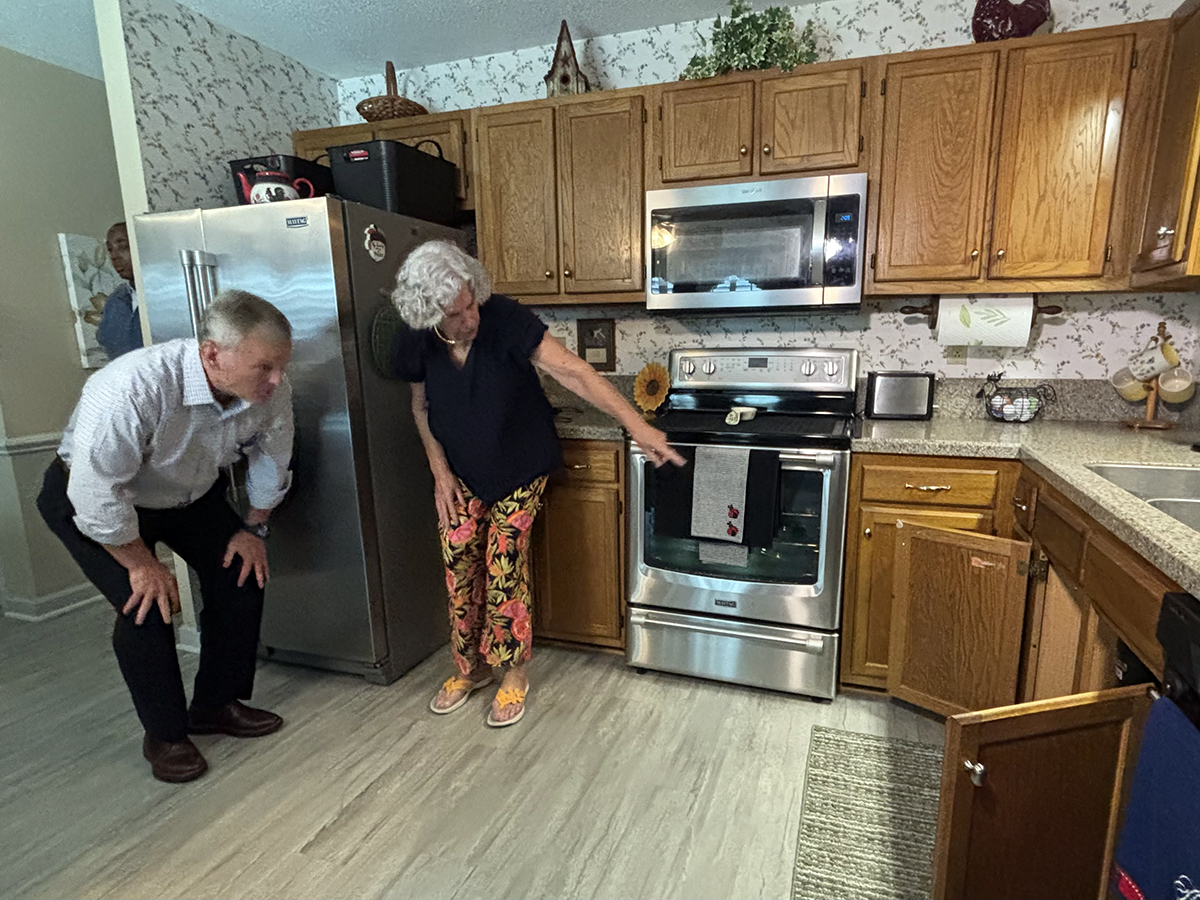 On Wednesday, North Carolina Gov. Josh Stein watched as Brenda Moore pointed to the reverse osmosis water filtration system under the kitchen sink in her Wilmington-area home. Photo: Trista Talton
“The Department of Justice has laid out in a resolution a wide range of allegations regarding drinking water contamination affecting millions of Americans, primarily requiring the company to monitor and plan for itself, while abandoning the company’s claims related to contamination from multiple facilities across multiple states,” Zhuang said in a release. “At the same time that the Department of Justice is settling the case on these generous terms, Chemours is actively challenging federal PFAS drinking water standards in court, seeking a major expansion of its North Carolina facility, and continuing to release extremely high concentrations of ultra-short-chain PFAS. The company knows that the chemicals are likely to enter the drinking water of approximately 500,000 North Carolinians.”
Public hearings that set standards
Wednesday’s announcement comes as the Environmental Protection Agency moves forward with a proposal to lower the nation’s first health standards for PFAS, a chemical contaminant found in the drinking water sources of millions of North Carolinians.
The agency is scheduled to hold a virtual public hearing on July 7 regarding its plan to rescind and reconsider the current federal standard for HFPO-DA, commonly referred to as GenX, PFNA, PFHxS, and PFBS. The agency also wants to push back by two years, from 2029 to 2031, the deadline by which water utilities must comply with mandatory standards for PFOA and PFOS, chemicals that are no longer manufactured.
Meanwhile, the North Carolina Environmental Control Commission is considering rules to monitor and minimize discharges into the state’s surface waters of PFOS, PFOA, GenX, and 1,4-dioxane, which the EPA classifies as a possible human carcinogen. The proposed rule has been widely criticized for lacking specific emission limits and penalties for PFAS emitters found to have violated the rule.
Stein said he was “not satisfied” with the EPA and the European Commission’s proposals.
“Both of these are unfortunate measures that give the public no assurance that their drinking water is clean,” he said.
For decades, Chemours’ Fayetteville plant in Bladen County discharged GenX and other compounds directly into the Cape Fear River, the drinking water source for tens of thousands of residents in the Cape Fear region.
Stein pointed out that Chemours is already required to mitigate PFAS emissions and releases from its Fayetteville plant facility under a 2019 consent order with the North Carolina Department of Environmental Quality and Cape Fear Riverwatch.
“What we need support from Chemours today, and the settlement doesn’t address this, is that we need Chemours and DuPont to pay money to clean up the contamination that exists in our communities,” he said.
As part of ongoing environmental remediation efforts in the state, Chemours is being asked to test tens of thousands of private drinking water wells for PFAS contamination across the Cape Fear region. Companies must provide a temporary drinking water supply, whether through a home filtration system or connected to a public water system, to households with wells containing PFAS in excess of concentrations determined by environmental health authorities until a new permanent supply is provided at the company’s expense.
Although Brenda and Vance Moore’s well water tested positive for PFAS, the levels of these contaminants in their drinking water source did not represent a threshold for Chemours to be responsible for providing them with alternative water.
State officials, including Stein and North Carolina Department of Environmental Quality Secretary Reed Wilson, made the briefing Wednesday during a visit to the Moore family’s home in Porter’s Neck, an unincorporated community in northern New Hanover County.
“My question is, we’re 16 miles from the river,” Brenda Moore said of Cape Fear. “How did these chemicals get here?”
Moore, a breast cancer survivor, said she cannot definitively prove whether her illness, or her daughter Lauren’s skin or thyroid problems, were caused by years of drinking water contaminated with PFAS. Still, “you’d wonder,” she said.
PFAS are a group of chemicals used to make consumer products that are water-, stain-, and oil-resistant. The EPA currently classifies approximately 15,000 PFAS, most of which have not yet been studied for their potential effects on human health. However, the known human health effects of PFAS include weakened immune systems, low birth weights in newborns, thyroid disease, and certain types of cancer.
The Moores were eligible for funding through the Bernard Allen Emergency Drinking Water Fund. The fund will reimburse residents for the cost of water treatment systems and, where possible, public water connections if their wells become contaminated.
The North Carolina General Assembly in 2006 established a fund to improve the state’s response to water contamination in drinking wells and help low-income households receive safe drinking water.
In 2022, DEQ launched the program statewide to allow residents with private drinking water wells contaminated with PFAS to receive assistance if the individual or business is not held responsible for the contamination.
The program funded an approximately $3,500 reverse osmosis filtration system that was installed under the Moore family’s kitchen sink in October 2023.
Stein said North Carolina will continue legal action to obtain compensation from Chemours and its affiliates in response to the PFAS contamination.
“There is already a lot of pollution in southeastern North Carolina, and the polluters, not our people, should pay to clean it up. That’s why I took them to court, and the lawsuit continues,” he said.
