


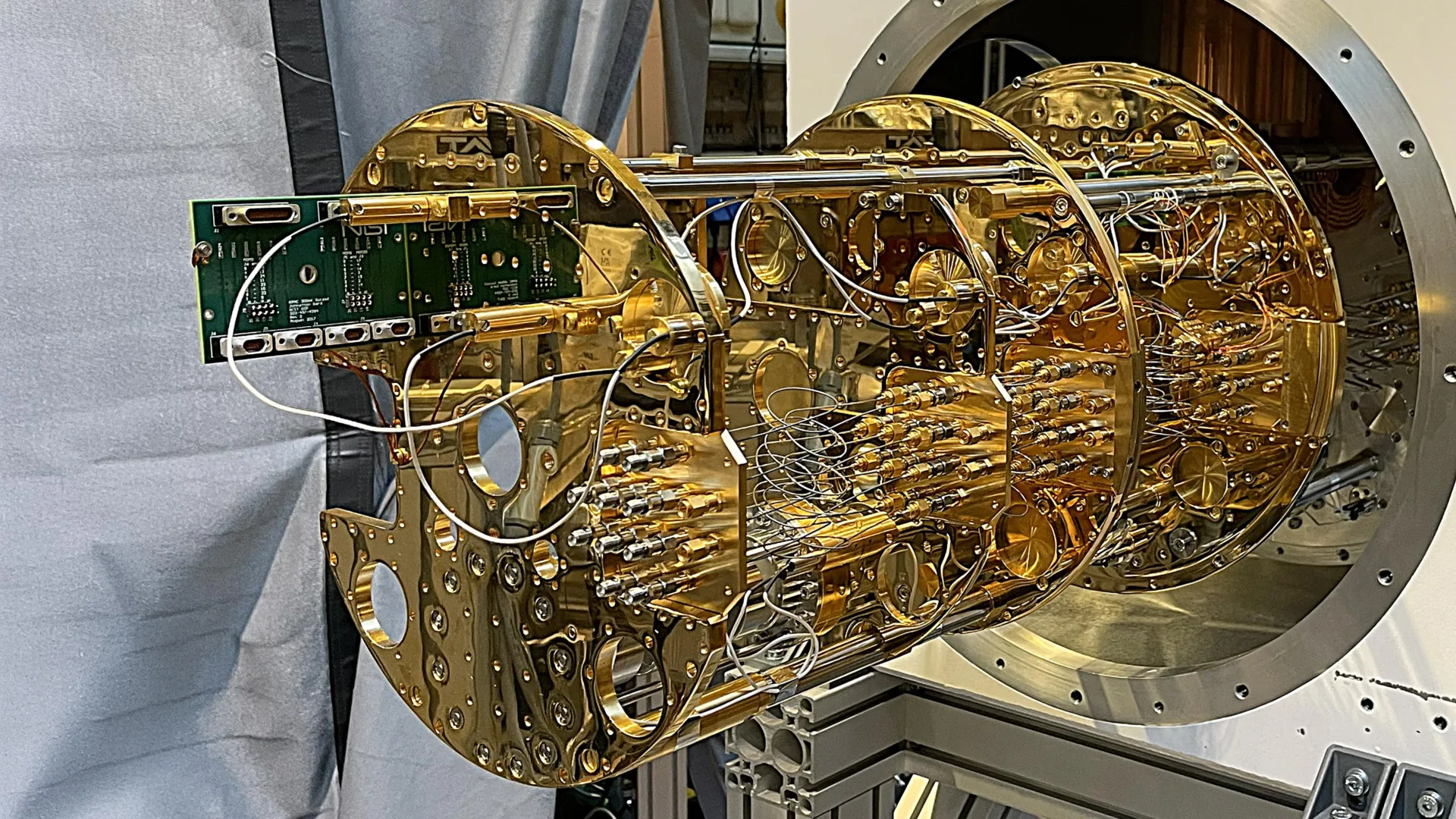
A major new tool for X-ray research has started operating at BESSY II. Developed jointly by HZB, MPI-CEC (Mülheim an der Ruhr, Germany), and NIST (Boulder, Colorado, USA), this instrument is the first and only TES spectrometer to operate at a synchrotron facility in Europe.
This new system dramatically increases photon detection efficiency, outperforming traditional wavelength-dispersive X-ray emission spectrometers by a factor of 100 to 1000. The researchers plan to use this system to study the electronic properties of atomically thin materials, nanostructures, and highly dilute atomic and molecular samples. The research team is currently soliciting research proposals from the scientific community.
Improving the sensitivity of X-ray spectroscopy
Facilities such as BESSY II produce extremely bright and powerful synchrotron X-rays, allowing scientists to analyze a wide range of materials. However, techniques such as X-ray emission spectroscopy (XES) and resonant inelastic X-ray scattering (RIXS) face significant challenges. These methods rely on detecting photons emitted by the sample, and therefore require large numbers of photons to produce useful measurements.
As a result, XES and RIXS experiments have traditionally been limited to concentrated samples and bulk materials.
“The superconducting transition edge sensor (TES) array photon detector currently operating on BESSY II is approximately 100 to 1000 times more efficient at detecting photons than conventional XES and RIXS spectrometers,” said HZB’s Regis Dekker, lead scientist for this new instrument.
Exploring quantum materials and ultrathin systems
Increased sensitivity opens the door to experiments that were previously difficult or impossible.
“This provides new insights not only into molecular chemistry and molecular biology, but also into the quantum properties of systems in reduced dimensions, such as atomic monolayers, nanostructures, and impurities. TES spectroscopy complements methods such as ARPES, which scans the electronic band structure of such systems,” says Regis Dekker.
This instrument can also significantly reduce data collection time. Some XES and RIXS experiments that normally take hours can now be completed in just minutes.
248 superconducting sensors operating near absolute zero
At the center of the TES array spectrometer are 248 sensors that become superconducting when cooled to 25 millikelvin. To achieve this temperature, researchers use He4-He3 dilution refrigerators similar to those used in quantum computing systems.
When the X-rays interact with the sample, the sample emits photons. These photons strike individual sensors within the TES array, causing a sudden increase in temperature. This short-term temperature increase destroys the superconducting state and increases the electrical resistance of the sensor. The changes are then measured using a circuit based on an array of superconducting quantum interference devices (SQUIDs).
Advanced sample processing and future upgrades
The spectrometer is connected to a custom ultra-high vacuum sample chamber that supports sample transfer, preparation, and measurement. This chamber also provides precise temperature control from 10 K to room temperature.
The complete system is installed on the BESSY II UE52-SGM beamline and provides complete polarization control. Planned upgrades include enhanced sample preparation capabilities and the ability to study materials in magnetic fields in X-ray absorption (XMCD) and emission (RIXS-MCD).
Europe’s only synchrotron TES spectrometer
TES spectrometers were originally created for astrophysical applications where the detection of very weak photon signals was essential. Prior to the installation on BESSY II, there were only five TES spectrometers operating in X-ray facilities around the world, including four in the United States and one in Japan.
BESSY II is currently equipped with Europe’s only synchrotron TES spectrometer.
“We look forward to receiving exciting research proposals from our user community,” says Decker.
