


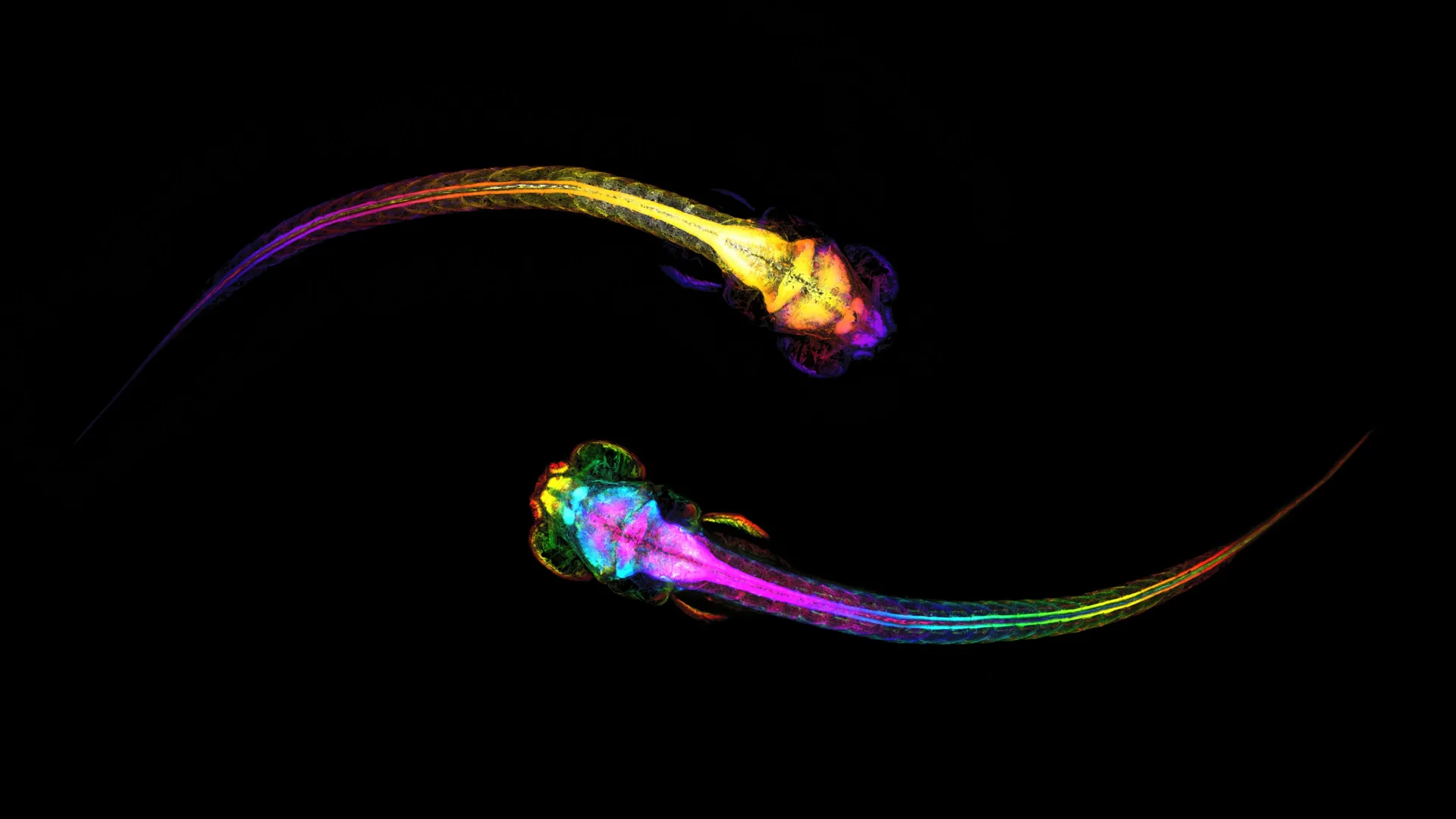
Why do we want to get close to other people? According to a new study from the Hebrew University of Jerusalem, answers can begin to unfold in the brain seconds before the movement occurs.
The study found that social behavior is preceded by a unique pattern of activity spread throughout the brain. Researchers also found that the strength of this neural pattern was related to an individual’s level of social motivation.
The study was led by Dr. Lila Avitan and conducted by other members of the Abitan lab, including doctoral student Imri Lifshitz of the Edmund Lilly Safra Brain Science Center (ELSC) at the Hebrew University of Jerusalem.
Track social decisions in real time
To investigate how the brain turns social information into behavior, the researchers used zebrafish, a model organism that allows scientists to monitor brain activity at the level of individual cells.
The research team created a new experimental system in which one fish observes and reacts to another fish swimming nearby. While this was happening, the researchers recorded the brain activity of the observer fish in real time.
This setup allowed us to investigate the neural events leading up to a social decision and trace the process as it unfolds moment by moment.
Whole-brain signals appear before social behavior
Researchers found that when a fish attempts to swim toward another fish, changes in brain activity begin several seconds before the movement itself.
This process involved coordinated changes across multiple parts of the brain, rather than relying on a single brain region specialized for social behavior.
There was increased activity in the pallium, a higher brain region associated with complex behaviors. At the same time, activity in other brain regions also decreased.
Together, these changes created what researchers call the neural “pre-decision state.” This brain-wide pattern indicates that social behavior is about to occur and can be used to predict behavior before it occurs.
Brain activity related to social drive
The study also revealed that the strength of this neural signature varies from person to person.
Fish that showed stronger brain-wide patterns tended to be more sociable overall, suggesting that neural signals reflect an individual’s underlying social impulses.
This finding further highlights the importance of the pallium. The results suggest that this brain region plays a central role in creating the motivation to approach others and participate in social interactions.
“This study identified brain-wide neural signatures of social approach that appear before movement begins,” Dr. Abitan said. “This signature not only predicts whether future behavior will be prosocial, but also predicts how strongly the individual is socially driven.”
What the findings mean
Understanding how the brain generates social behavior may help researchers better explain why some individuals are naturally more social than others.
Because similar brain structures contribute to social behavior in many species, the findings may also provide clues about human social functioning and the conditions under which social behavior is altered or disrupted.
