

Close Menu

    Subscribe to Updates

    Get the latest creative news from FooBar about art, design and business.

    What's Hot

    2026 Pharma Outlook: Key Trends for Pharmacologists and Drug Development Leaders

    September 26, 2026

    The Climate-Health Crisis in Urban Environments: Who It’s For and What You’ll Gain

    September 25, 2026

    Overcoming Access Barriers to Evidence-Based Psychiatric Treatments in Inpatient Settings

    September 24, 2026
    Facebook X (Twitter) Instagram
    Facebook X (Twitter) Instagram
    Health Magazine
    • Home
    • Environmental Health
    • Health Technology
    • Medical Research
    • Mental Health
    • Nutrition Science
    • Pharma
    • Public Health
    • Discover
      • Daily Health Tips
      • Financial Health & Stability
      • Holistic Health & Wellness
      • Mental Health
      • Nutrition & Dietary Trends
      • Professional & Personal Growth
    • Our Mission
    Health Magazine
    Home » News » Terraforming Mars may be more realistic than scientists once thought
    Nutrition Science

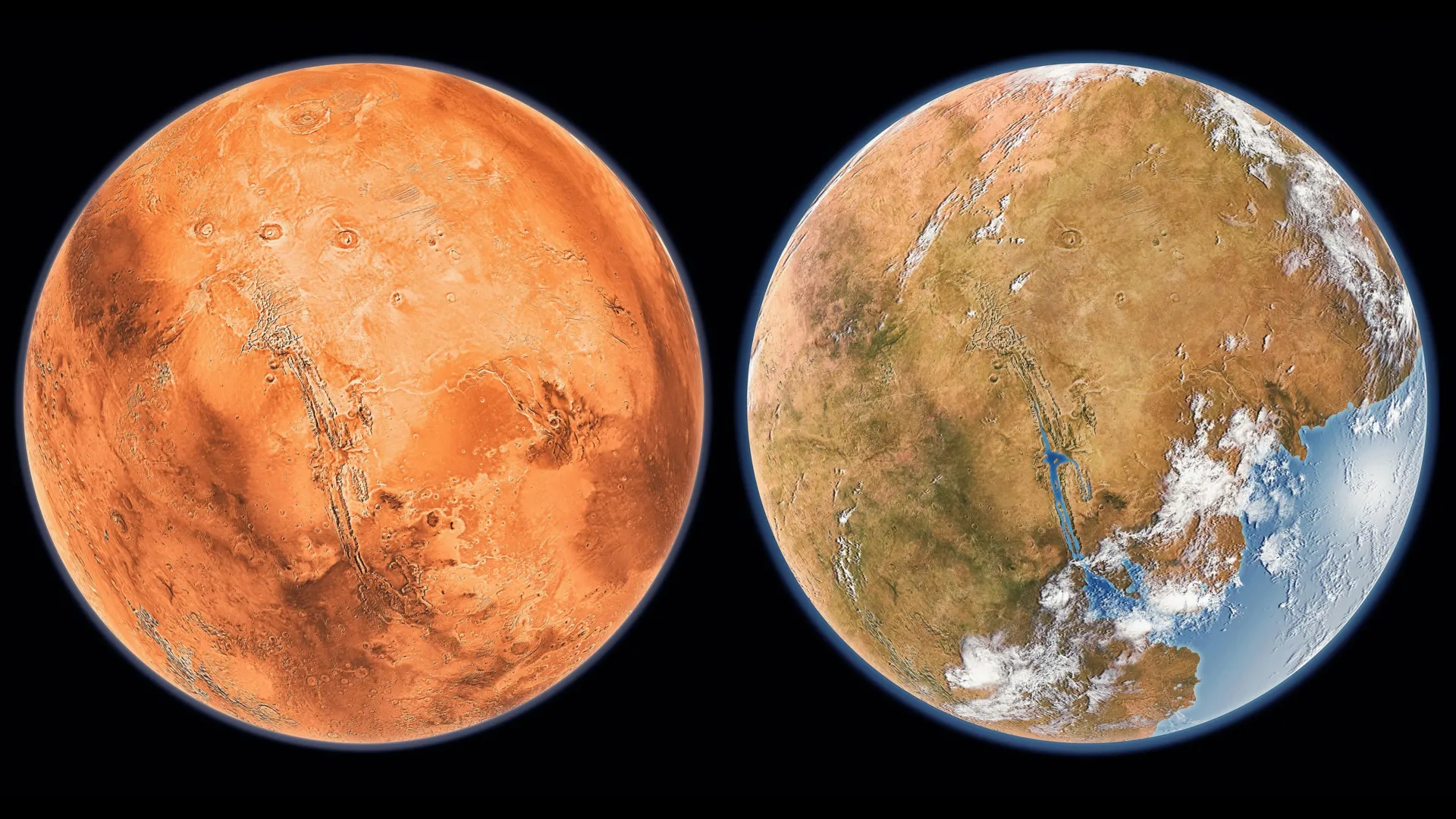
    Terraforming Mars may be more realistic than scientists once thought

    healthadminBy healthadminJuly 17, 2026No Comments5 Mins Read
    Terraforming Mars may be more realistic than scientists once thought
    Share
    Facebook Twitter Reddit Telegram Pinterest Email


    Terraforming is the process of reshaping planets and moons so that they can support humans and other Earth-like life forms. In theory, that means making an otherworld’s atmosphere, climate, and surface more similar to Earth’s by adding oxygen, creating a stable mass of liquid water, and creating temperatures suitable for life. Mars has long been considered a top candidate, with proposals ranging from releasing greenhouse gases to warm the planet to using microbes that can slowly produce oxygen over centuries.

    For decades, the concept of terraforming Mars existed primarily in the world of science fiction. The vision of turning a cold, dusty planet into a living world has inspired generations, but most scientists thought it was far beyond the reach of our technology. But a new workshop brief argues that recent advances mean terraforming should be treated as a legitimate field of scientific research, even if actual attempts are far in the future.

    Dr. Erica DeBenedictis, CEO of Pioneer Labs, wrote the brief prepared for the 2025 Green Mars Workshop. She argues that just a few decades ago terraforming Mars was virtually impossible, but major technological advances have changed that assessment. The potential for dramatic reductions in launch costs with SpaceX’s Starship and breakthroughs in synthetic biology and climate modeling have changed the conversation. Rather than asking whether terraforming violates the laws of physics, researchers believe the more important question is whether humans should pursue terraforming and what the safest path is.

    Mars terraforming roadmap

    Rather than starting with today’s technology, the workshop brief begins by imagining what a habitable Mars might eventually look like, and then works backwards to identify the steps needed to get there.

    The first phase will focus on global warming. Researchers envision using artificial aerosols and greenhouse gases to raise the average temperature of Mars by tens of degrees Celsius over several decades. Research suggests there is enough frozen water on Mars to eventually support an ocean spanning some 4 million square kilometers and averaging around 300 meters deep. If temperatures rise by about 30 degrees, these ice reserves could begin to melt, allowing stable liquid water to appear on the surface.

    Genetically engineered microorganisms may play an important role

    Once conditions are less harsh, the next step involves introducing microbial life.

    Researchers propose engineering extremophiles, microorganisms that naturally survive in harsh environments, by combining properties such as resistance to extreme temperatures, radiation, and low pressure. These specially engineered organisms could spread across Mars in algae-like layers within a few decades. Through photosynthesis, they would begin the very slow process of changing Earth’s atmosphere.

    Build a breathable atmosphere

    Creating an oxygen-rich atmosphere capable of supporting complex life will take centuries, and perhaps even longer.

    The researchers envision starting inside a giant dome-shaped habitat about 100 meters high. Within these closed environments, respirable oxygen can be produced by photosynthesis or water electrolysis. Over time, vegetation spreading beyond the dome could gradually add oxygen to the wider atmosphere, but the researchers estimate that natural oxygen production alone would take around 1,000 years. If successful, future explorers may eventually be able to live on Mars without relying on a protective dome.

    Major scientific unknowns remain

    The proposal also highlights fundamental questions that must be answered before large-scale efforts are considered.

    Scientists still don’t know what lies beneath Mars’ vast ice sheets. We also need a better understanding of how dust storms will change if the Earth becomes warmer and wetter. Another important question is whether there is enough material on Mars for large-scale water electrolysis, or whether those resources will need to be transported from Earth at great expense.

    Ethical questions about Mars changes

    Scientific obstacles are only part of the challenge. Terraforming Mars would also raise serious ethical questions.

    Large-scale changes to Earth could permanently erase parts of its natural history, limiting future opportunities to study Mars in its original state. If there is indigenous life on Mars, even microscopic life, the introduction of Earthly life could destroy it before it is fully understood.

    At the same time, researchers argue that terraforming research could yield important benefits closer to home. Technologies developed to support life on Mars, such as drought-tolerant crops and efficient closed-loop life support systems, could improve Earth’s sustainability. Green technology advances designed for space exploration may find valuable applications here on Earth.

    As a closet space enthusiast, I find this shift in thinking particularly interesting. The workshop brief does not propose that humans start terraforming Mars tomorrow. Instead, exploring local warming techniques will require careful laboratory studies, more sophisticated climate modeling, and perhaps small-scale experiments on future Mars missions.

    Before attempting to reshape the entire planet, we first need to better understand Mars itself and the scientific, environmental, and ethical implications of changing it. The conversation gradually moves away from the question “Can you do it?” And to the question, “Should we do that? And if so, how should we do it?” It may be the most meaningful step forward yet.


    Source link

    Visited 9 times, 1 visit(s) today
    Share. Facebook Twitter Pinterest LinkedIn Telegram Reddit Email
    Previous ArticleMedicare to increase compensation for doctors for smoking cessation advice
    Next Article New battery-powered device detects Bundibugyo Ebola virus in 30 minutes
    healthadmin

    Related Posts

    Bridging the Gaps in 2025-2030 Dietary Guidelines for Metabolic Health

    September 22, 2026

    The Challenge of Updating Dietary Guidelines for Metabolic Health in Clinical Practice

    September 20, 2026

    Navigating Confusion Around the 2025-2030 Dietary Guidelines

    September 18, 2026

    Navigating Gaps in 2025-2030 Dietary Guidelines for Clinical Practice

    September 10, 2026

    Navigating 2025 Dietary Guidelines Challenges in Clinical Practice

    September 3, 2026

    Navigating 2025-2030 Dietary Guidelines for Metabolic Health Challenges

    August 30, 2026
    Add A Comment

    Comments are closed.

    Categories

    • Daily Health Tips
    • Discover
    • Environmental Health
    • Exercise & Fitness
    • Featured
    • Featured Videos
    • Financial Health & Stability
    • Fitness
    • Fitness Updates
    • Health
    • Health Technology
    • Healthy Aging
    • Healthy Living
    • Holistic Healing
    • Holistic Health & Wellness
    • Medical Research
    • Medical Research & Insights
    • Mental Health
    • Mental Wellness
    • Natural Remedies
    • New Workouts
    • Nutrition
    • Nutrition & Dietary Trends
    • Nutrition & Superfoods
    • Nutrition Science
    • Pharma
    • Preventive Healthcare
    • Professional & Personal Growth
    • Public Health
    • Public Health & Awareness
    • Selected
    • Sleep & Recovery
    • Top Programs
    • Weight Management
    • Workouts
    Popular Posts
    • 1773313737_bacteria_-_Sebastian_Kaulitzki_46826fb7971649bfaca04a9b4cef3309-620x480.jpgHow Sino Biological ProPure™ redefines ultra-low… March 12, 2026
    • pexels-david-bartus-442116The food industry needs to act now to cut greenhouse… January 2, 2022
    • 1773729862_TagImage-3347-458389964760995353448-620x480.jpgDespite safety concerns, parents underestimate the… March 17, 2026
    • 1774403998_image_28620e4b6b0047f7ab9154b41d739db1-620x480.jpgGait pattern helps distinguish between Lewy body… March 24, 2026
    • 1773209206_futuristic_techno_design_on_background_of_supercomputer_data_center_-_Image_-_Timofeev_Vladimir_M1_4.jpegMulti-agent AI systems outperform single models… March 11, 2026
    • Leukemia-620x480.jpgBiomimetic platform powers CAR T therapy for… March 9, 2026

    Demo
    Stay In Touch
    • Facebook
    • Twitter
    • Pinterest
    • Instagram
    • YouTube
    • Vimeo
    Don't Miss

    2026 Pharma Outlook: Key Trends for Pharmacologists and Drug Development Leaders

    By healthadminSeptember 26, 2026

    Explore 2026 pharma trends including AI in drug discovery, regulatory changes, and biopharma manufacturing shifts for pharmacologists and executives.

    The Climate-Health Crisis in Urban Environments: Who It’s For and What You’ll Gain

    September 25, 2026

    Overcoming Access Barriers to Evidence-Based Psychiatric Treatments in Inpatient Settings

    September 24, 2026

    Bridging Gaps in Evidence-Based Psychiatric Treatments

    September 23, 2026

    Subscribe to Updates

    Get the latest creative news from SmartMag about art & design.

    HealthxMagazine
    HealthxMagazine

    At HealthX Magazine, we are dedicated to empowering entrepreneurs, doctors, chiropractors, healthcare professionals, personal trainers, executives, thought leaders, and anyone striving for optimal health.

    Our Picks

    Bridging Gaps in Evidence-Based Psychiatric Treatments

    September 23, 2026

    Bridging the Gaps in 2025-2030 Dietary Guidelines for Metabolic Health

    September 22, 2026

    Overcoming Access Barriers: Evidence-Based Insights for Mental Health Professionals

    September 21, 2026
    New Comments
      Facebook X (Twitter) Instagram Pinterest
      • Home
      • Privacy Policy
      • Our Mission
      © 2026 ThemeSphere. Designed by ThemeSphere.

      Type above and press Enter to search. Press Esc to cancel.