


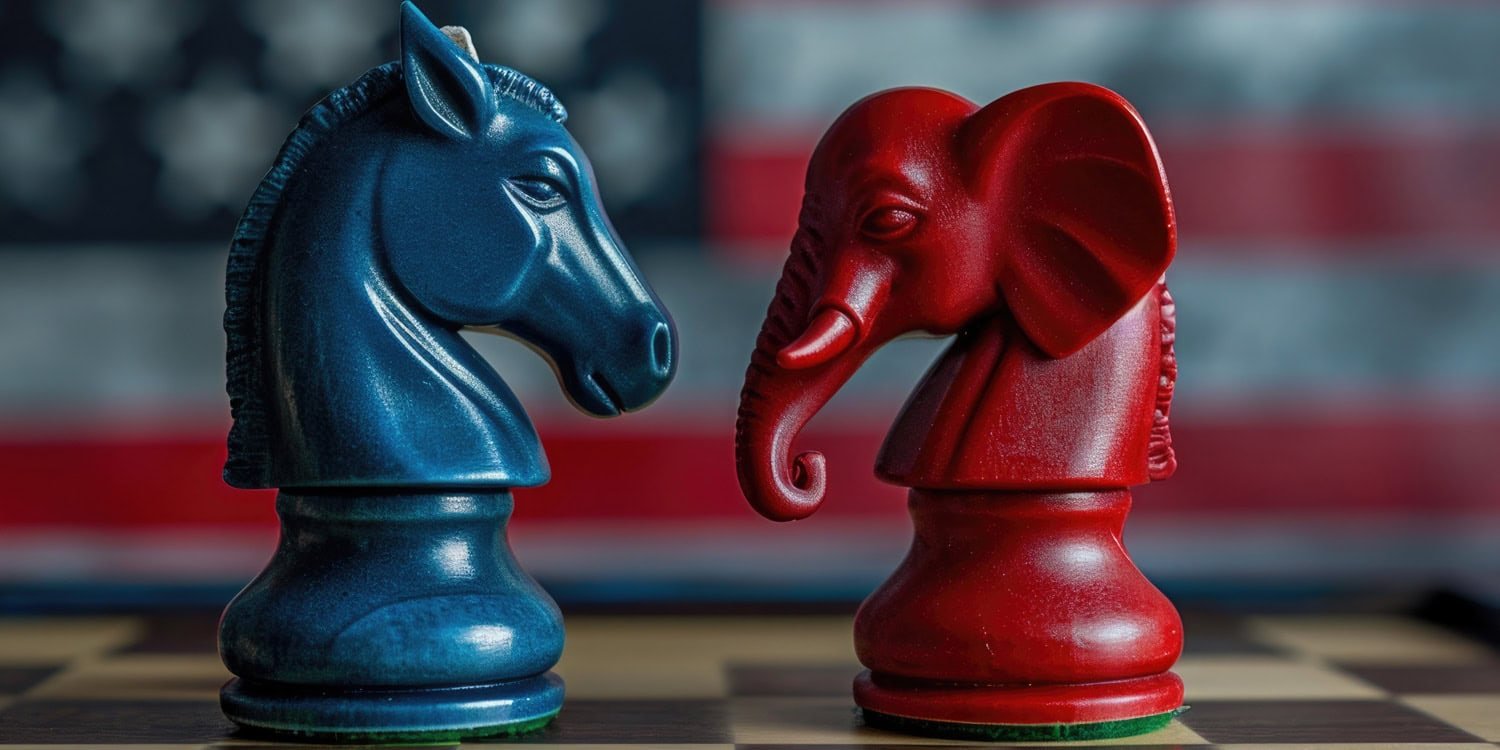
Democrats have increasingly negative feelings toward Republicans because they perceive the opposition to actively oppose policies aimed at reducing racial inequality. This perception operates independently of how voters feel about the racial statistics of the opposition party itself. These findings were published in The Journal of Race, Ethnicity, and Politics.
Political scientists have tracked a growing trend in American politics in which voters not only disagree with the opposing party but actively despise its members. Researchers call this phenomenon emotional polarization. Over the past few decades, voters have come to view members of the opposing party as a stigmatized outgroup. This deep-seated hostility has far-reaching social and economic consequences, changing everything from family relationships to employment practices. People are often reluctant to date someone across their political lines. Many employers even show bias against job applicants who show opposing political affiliations.
Researchers have developed two main models to explain why voters have such strong aversion to political opponents. The first model suggests that ideological differences cause this hostility. In this view, debates over the size of government and reproductive rights create deep divisions among voters. When people develop fundamentally different beliefs about how society should function, they begin to antagonize the other side.
The second model focuses on the demographic composition of the two parties. This theory proposes that people categorize themselves into political groups based on their social and racial identities. In recent decades, the Republican and Democratic coalitions have become demographically distinct. Some researchers argue that as the Democratic coalition becomes more racially diverse, hostility toward specific racial groups spills over into an overall dislike of the Democratic Party.
This demographic explanation helps explain why some Republican voters have negative views of a diverse Democratic coalition. This doesn’t fully explain why Democratic voters have such strong negative feelings toward the white-majority Republican Party.
To solve this puzzle, political scientists have developed a third approach to explaining this political hostility. Tyler Rennie of Claremont Graduate University led a recent effort to test this new framework. Rennie collaborated with Byengseon Bae, also of Claremont Graduate University, and Kirill Zhirkov of the University of Virginia.
Researchers proposed a racial ideology model. This framework suggests that Democrats’ dislike of Republicans stems from their policy stances rather than demographics. Specifically, Democrats are increasingly disliking the Republican Party because they see Republican lawmakers as opposed to racially progressive policies.
Throughout recent election cycles, the Democratic Party’s platform has increasingly focused on addressing racial inequality. During past presidential campaigns, candidates made certain rhetorical choices to emphasize their commitment to racial justice. In 2016, Hillary Clinton said that “erasing racial inequality” would be “the mission of the president.” In contrast, the Republican platform frequently criticizes government intervention in racial issues.
This partisan divide became even clearer during the 2024 election cycle. Kamala Harris recently said her opponents are “trying to destroy access to opportunity for marginalized people,” referring to conservative politicians. Donald Trump frequently commented on race and American identity, employing rhetoric that researchers have described as a “racial megaphone.” The researchers wanted to see whether Democratic voters would respond to this change in conditions by judging Republicans primarily on the basis of their racial policy stances.
Rennie and his colleagues tested the racial ideology model using an experimental research design. They recruited more than 3,000 adult participants from an online platform designed to match the demographic benchmarks of the broader U.S. population. Participants represented a wide range of ages, genders, ethnic backgrounds, and political affiliations. Approximately 40% of participants had a college degree.
The researchers first asked participants to rate how much they liked or disliked the Republican Party. Responses ranged from 0, meaning strong dislike, to 10, meaning strong liking. Participants also answered a series of questions to measure basic attitudes toward race and racism. These first questions established a baseline for how each respondent views both politics and racial equality.
Next, the researchers used a specific type of survey experiment in which participants evaluated a hypothesized profile. Political scientists use this method to assess which specific attributes influence decisions without directly asking participants about their biases. Participants read aloud a description of a hypothetical rank-and-file Republican supporter. Each participant reviewed 20 unique profiles during the experiment.
The researchers randomly generated nine different combinations of traits for each profile. These characteristics include demographic markers such as age, gender, race, educational level, social class, and religious attendance. It also included views on the size of government, views on racial equality, and a list of personal characteristics. Personal characteristics categorized individuals as having positive attributes such as honesty and patriotism, or negative attributes such as laziness and selfishness.
By randomly assigning characteristics, researchers were able to pinpoint which characteristics influenced participants’ judgments. By combining and matching characteristics such as economic views and racial views, the researchers could distinguish between the effects of favoring smaller government and the effects of opposing racial equality policies. After reading one profile, participants rated how typical they thought the hypothetical person was of a modern-day Republican.
The survey measured racial ideology through questions about specific policies. A fictional character with a liberal racial ideology was portrayed as believing that the government should support black Americans. A person with conservative racial ideology was described as believing that black Americans should help themselves without government intervention.
When researchers analyzed the survey responses, they found discernible patterns across all political and racial groups. White Democrats, nonwhite Democrats, and white Republicans all perceived the typical Republican as white, religious, and economically conservative. Participants broadly agreed on the basic profile of the typical Republican voter.
The analysis also revealed strong perceptions of racial politics. Participants generally strongly associated Republicans with opposing policies aimed at reducing racial inequality. This association matched or exceeded the association with economic conservatism. In other words, Americans across political affiliations view conservative racial ideology as a key characteristic of the typical Republican.
When researchers looked at how these perceptions translated into disgust, they found a clear difference. The researchers mapped the profile ratings against participants’ initial feelings about the Republican Party. This mapping allowed us to see which specific typical characteristics were causing hostility between the parties.
For white Democratic voters, perceiving the Republican Party as economically and racially conservative predicted negative feelings toward the opposition party. Differences in both types of policies contributed to the overall distaste. This suggests that white Democrats evaluate their political opponents on multiple policy dimensions.
For nonwhite Democratic voters, the results looked different. Perceiving the Republican Party as racially conservative was the only factor predicting negative feelings toward the Republican Party. Perceptions of economic policy and personal characteristics did not sway their overall hostility. Opposing perceptions of racial equality obscured other policy differences.
The researchers found yet another pattern among white Republican participants. For these voters, viewing party members as economically conservative or having negative personal characteristics was associated with lower approval ratings. Perceiving a fellow Republican as racially conservative did not result in negative feelings for these voters. This difference highlights the stark differences in how voters in the two parties weigh policy issues.
Accurate survey responses showed that people with low levels of racial prejudice were most likely to criticize the Republican Party’s perceived racial conservatism. Those who held conservative racial attitudes themselves did not change their overall feelings toward the party based on these specific policy stances. The hostility comes precisely from voters who prioritize racial equality.
Through this experimental setting, the researchers demonstrated that demographic differences alone cannot explain political hostility. White Democrats do not inherently dislike a party just because it features a primarily white voting base. Rather, voters positively evaluate the racial policy goals of their opponents. The researchers suggest that this racial ideology framework bridges the gap between previous theories that were based entirely on group demographics or basic economic disagreements.
The researchers noticed several limitations within their experimental design. This study captures a snapshot as of summer 2023. The team cannot conclusively prove whether these particular perceptions have strengthened over time, or whether the recent political dominance of populist leaders has directly changed public perceptions.
This experiment also relied on a single specific expression to measure racial conservatism and focused entirely on government aid to black Americans. The researchers noted that the debate over racial policy has expanded into many other areas in recent years. Discussions about diversity initiatives, border control, and immigration enforcement currently occupy considerable space in contemporary political discourse. The current study does not measure how these alternative issues might change voters’ perceptions.
Future research could examine how these political stereotypes play out among specific ethnic minorities. The study categorized all nonwhite voters into broad categories, making it impossible to analyze in detail how different ethnic groups view political opponents. Increasing sample size could help political scientists determine how different marginalized groups build intergroup solidarity around common policy goals.
Continued disagreements between the two major parties on racial issues will shape voter behavior for years to come. Accurately identifying policy disagreements, rather than just demographic classifications, provides a more accurate picture of voter hostility.
The study, “Perceived Opposition to Racial Progressive Policies Among Democrats and Their Negative Impact on the Republican Party,” was authored by Tyler Rennie, Kirill Zhirkov, and Byungsung Bae. The paper was published in the Journal of Race, Ethnicity and Politics.
