


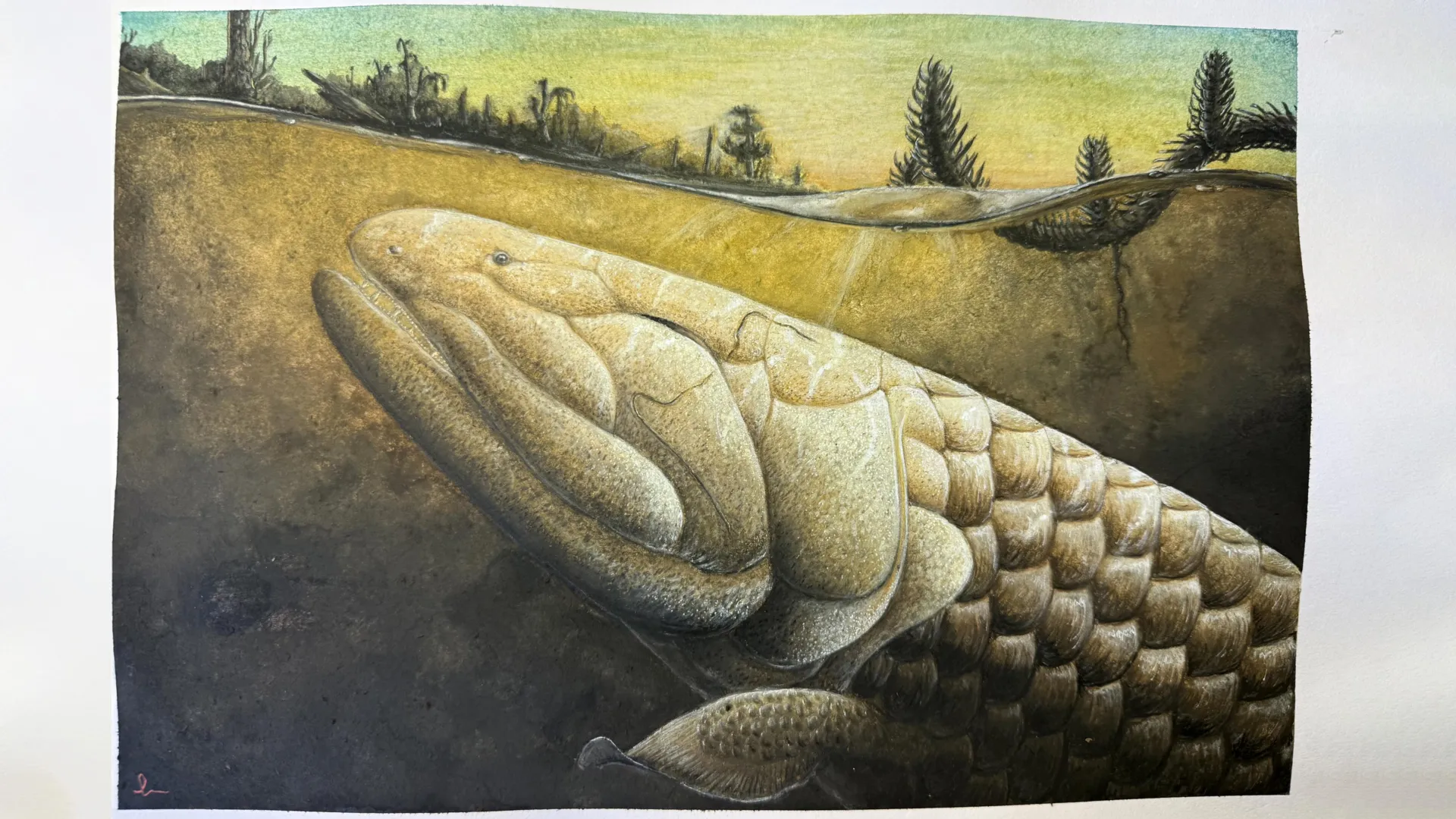
Flinders University researchers have revealed new details about one of the ancient fish species closely related to the first animals that eventually migrated from water to land more than 380 million years ago.
Using advanced neutron imaging techniques, scientists examined the skull and brain box. Kohalalepis jarubikia large predatory fish that lived during the Devonian period, often called the “Age of Fish.” This fossil was discovered in the Lashley Mountains region of Antarctica and is the only known fossil of its kind.
High-tech image processing reveals ancient anatomy
The researchers used non-destructive scanning methods to peer inside the fossil and study structures that had been hidden for hundreds of millions of years.
“This rare fossil belongs to a group called Canowindridae, which highlights an ancient link between Australia and Antarctica,” said Dr Alice Clement, a Flinders University researcher and co-author of the new 2016 paper. Frontiers of ecology and evolution.
“It’s important to study fish specimens from the Devonian period, when waters were full of these predatory lobe-finned fish, which are closely related to land animals (tetrapods),” says Dr. Clement, from the School of Science and Engineering.
Kohala Lepis It belongs to the family Canowindridae, a group of fish that once lived throughout East Gondwana, and fossils have now been found in both Antarctica and Australia. Scientists believe that these fish are relatives of the earliest tetrapod vertebrates that later evolved into land animals.
Clues about the transition from water to land
Lead author Corinne Mensforth, a PhD candidate at the Flinders Institute of Paleontology, said the fossil was particularly valuable because it preserved the internal bones of the skull.
“We chose to focus on Kohalalepis because it is the only fossil in the entire family that preserves the internal bones of the skull, providing valuable insight into its brain structure and neuroanatomy.”
The scans revealed that fish brains share similarities with species associated with the evolutionary transition from aquatic to terrestrial life.
“We found evidence that the brain of Kohala lepis is similar to the brain of fish that span the water-to-land transition of vertebrates.
“We also discovered adaptations for life near the surface, such as openings in the top of the skull for additional air intake and organs in the brain that detect light and circadian rhythms.”
Researchers believe these characteristics may have helped the animal survive in shallow environments where access to oxygen near the water’s surface is important.
Ancient predators relied on more than sight
This study also examines how Kohala Lepis They may have acted in that environment. The fish, which grew to about 1 meter long, is thought to have been an ambush predator that hunted small animals in freshwater systems.
“Growing to about a meter in length, Kohala lepis was an ambush predator that preyed on other small animals around it, and with its relatively small eyes it must have relied heavily on other senses to catch its prey.”
John Long, professor emeritus at Flinders University, was involved in the initial study that was first reported. Kohala Lepis In 1992, he stated that modern imaging techniques made it possible to study the internal structure of fossils without damaging them.
“This has allowed us to understand some of Kohalalepis’ behavior, adaptations, and relationships with its environment and other quadrupedal fishes, and how fish first emerged from water to live on land about 385 million years ago,” he says.
This new discovery provides another important piece to the story of how vertebrates evolved from aquatic animals to animals that can live on land.
A study by Corinne L. Mensforth, John A. Long, Joseph J. Bevitt (Australian Neutron Scattering Centre, ANSTO), and Alice M. “New data on the late Antarctic Devonian sarcophagus Kohalalepis jarubiki (Tetrapodomorpha, Canowindridae) revealed using synchrotron and neutron tomography” (2026) Clement published: Frontiers of ecology and evolution.
This research was supported by the Australian Research Council (DP 200103398) with additional support from Dr Matthew McCurry (Australian Museum) and Mr Anton Maksimenko from the Australian Nuclear Science and Technology Agency.
