


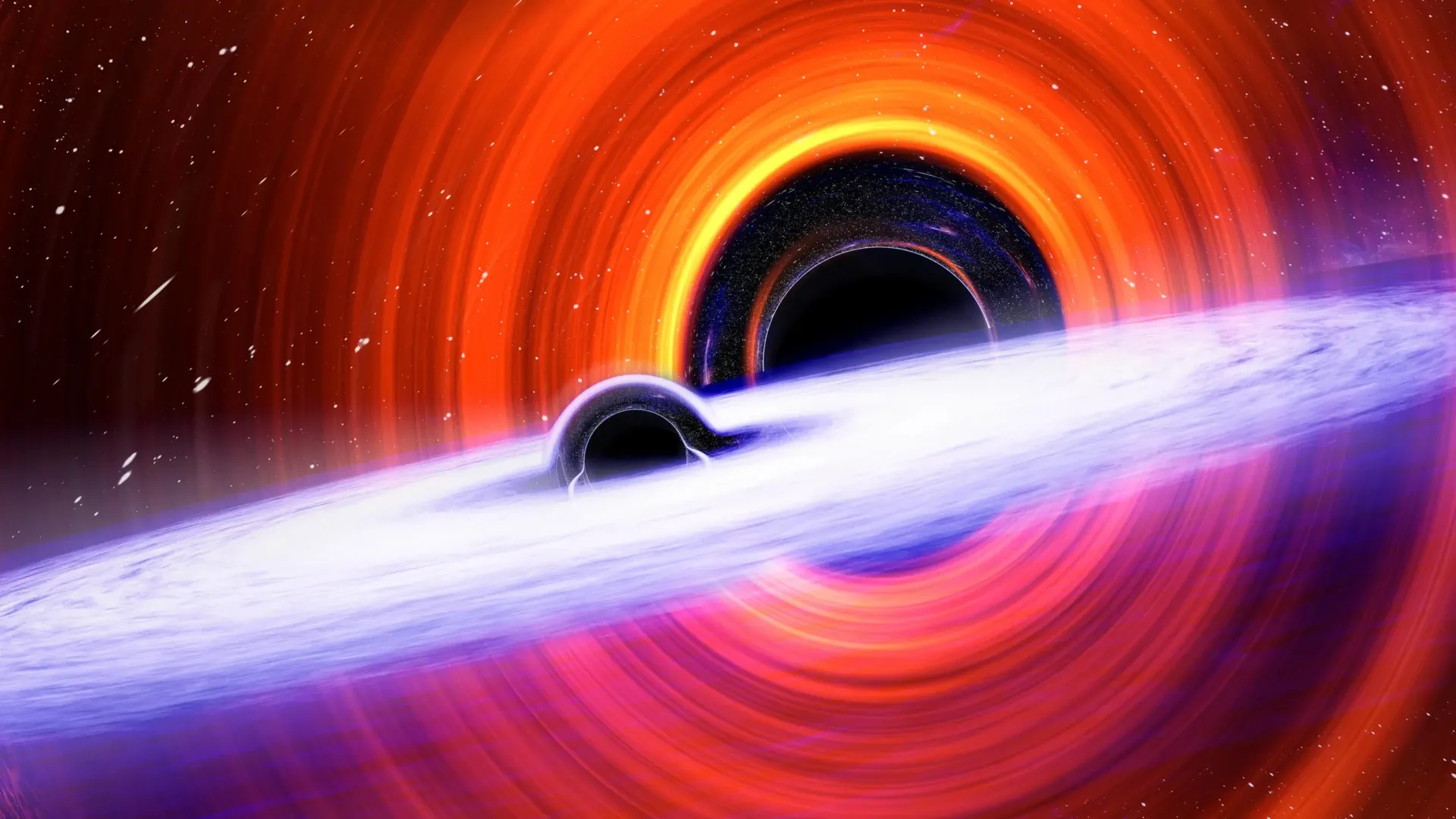
Primordial black holes have been one of astronomy’s most intriguing ideas for decades. Now, researchers at the University of Miami believe that recent detections of gravitational waves may bring them closer to confirming that these ancient objects are real, a breakthrough that could also help solve the enduring mystery of dark matter.
Primordial black holes are thought to have formed during the first few minutes after the Big Bang, long before the first stars and galaxies existed. Unlike black holes, which result from the collapse of stars, these hypothetical objects range in size from as small as an asteroid to much larger objects.
Although primordial black holes have never been identified, scientists believe they can answer some major questions about the universe. One of the biggest is the nature of dark matter, the invisible matter that makes up about 85 percent of all matter and provides the gravitational force that helps hold galaxies together.
“We believe our work helps confirm that they actually exist,” said Nico Caperti, an associate professor in the Department of Physics at the University of Miami, referring to his work with Dr. Student Alberto Magaraggia.
Abnormal LIGO signal
Their research builds on a possible discovery reported by the Laser Interferometer Gravitational-Wave Observatory (LIGO), which detected an unusual gravitational-wave signal late last year. Gravitational waves are ripples in space-time caused by some of the most violent events in the universe, such as collisions between black holes.
The most well-known black holes form after massive stars explode as supernovae. Their masses typically range from several times that of the Sun to billions of solar masses.
“The most common black holes form as a result of a supernova explosion, the death of a massive star. Therefore, their mass can range from several solar masses to billions of solar masses,” Cappellutti explained.
However, LIGO issued an automatic alert in November about a merger in which at least one object appears to be less than one solar mass. Such small black holes are difficult to explain by traditional stellar evolution and may instead represent primordial black holes.
Not everyone is convinced. Some astrophysicists have suggested that the signal may simply be noise in LIGO’s extremely sensitive detectors, rather than evidence of a surprising new discovery.
Could this explain dark matter?
Cappelutti and Magaraggia argue that the detected object is best explained as a primordial black hole, formed in the dense conditions of the early universe, long before stars existed.
To test this idea, the researchers estimated how many primordial black holes exist throughout the universe and how often LIGO should detect them.
“We tried to estimate how many primordial black holes there could be in the universe and how many of them LIGO could detect,” Magalajja said. “And our results are encouraging. We predict that the subsolar black holes that LIGO may have observed should actually be rare, consistent with how infrequently such phenomena have been observed to date.”
Their findings were; astrophysical journalsuggesting that the mysterious LIGO signal has no conventional astrophysical explanation and is most consistent with a primordial black hole.
The study “suggests that the most plausible explanation for the LIGO signal, which lacks any traditional astrophysical explanation, is the detection of a primordial black hole,” Cappellutti said. “And our study shows that these primordial black holes may account for a significant portion, if not all, of the dark matter.”
Still, both researchers stress that a single detection is not enough to answer the question.
For now, scientists will have to wait to see if LIGO and its international partners record additional events matching the same pattern.
“LIGO has captured very strong evidence that these kinds of black holes exist, but we need to detect another similar signal, or several others, to have definitive confirmation that they are real,” Cappellutti said. “But what is clear is that they cannot be ruled out as genuine.”
A theory developed over several decades
The concept of primordial black holes dates back to the Cold War, when Soviet scientists Yakov Zeldovich and Igor Novikov first proposed their existence. In the early 1970s, Stephen Hawking expanded on this idea, arguing that these objects are abundant throughout the universe, emit radiation, and may explain dark matter.
LIGO then provided the first opportunity to look for evidence to support those theories. On September 14, 2015, the observatory made history by detecting gravitational waves for the first time, confirming a key prediction of Albert Einstein’s theory of general relativity and opening up an entirely new way to study the universe.
The future of gravitational wave astronomy
LIGO consists of two observatories located in Hanford, Washington, and Livingston, Louisiana. Together with Italy’s Virgo detector and Japan’s underground KAGRA observatory, they form the international LVK collaboration to explore black holes, regions of space where gravity is so strong that not even light can escape.
The planned upgrades will further increase LIGO’s sensitivity and increase its chances of discovering additional primordial black hole candidates. But the observatory’s two L-shaped detectors, each with a 2.5-mile-long vacuum arm, are designed to detect high-frequency gravitational waves produced by relatively recent cosmic collisions, rather than waves generated directly during the Big Bang itself.
Future observatories will be able to reach far into the past. The European Space Agency’s Laser Interferometer Space Antenna (LISA), scheduled to launch in 2035, is expected to detect gravitational waves from the earliest epochs of the universe after the Big Bang.
Another planned facility, Cosmic Explorer, is currently in the design stage in the United States. The researchers expect the sensor to be about 10 times more sensitive than LIGO and able to detect mergers between black holes and neutron stars dating back to the time when the first stars formed.
