


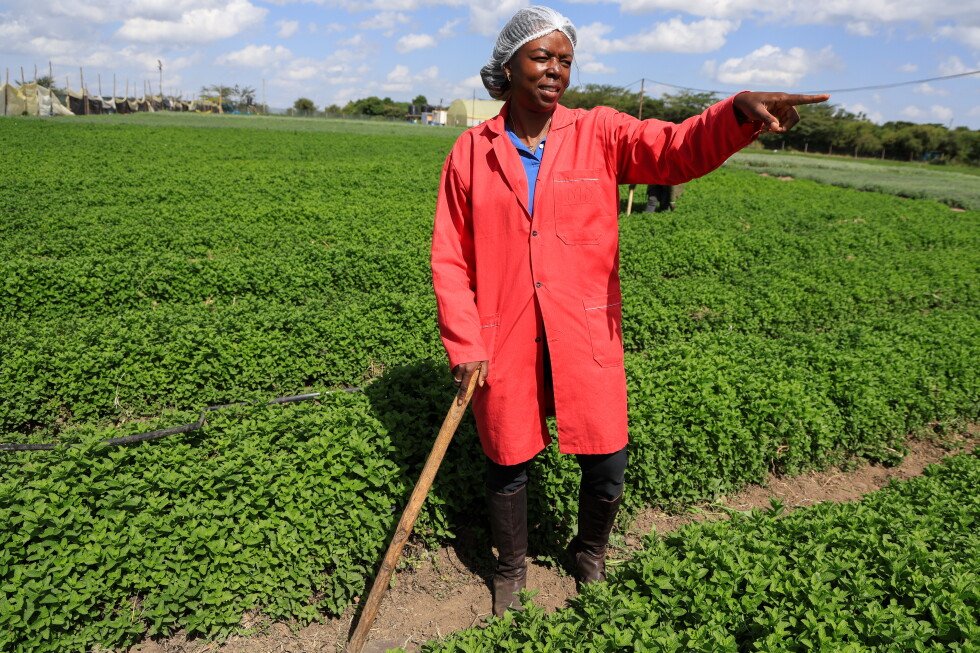
NAIROBI, Kenya (AP) – Early in the morning, Kenyan farmer Yvonne Anyoni Mumia walks among rows of rosemary, basil and other crops destined for European supermarkets. She used to worry that transportation delays and extreme heat would ruin much of her crop, but now she uses solar-powered refrigeration to keep her produce fresh.
The pay-as-you-go model offered by cold chain company SoKo Fresh, which charges farmers based on kilograms (pounds) stored, is part of a trend in Africa to use solar-powered cold storage to prevent food from spoiling, one of agriculture’s most persistent problems.
The Food and Agriculture Organization of the United Nations estimates that up to 40% of food produced in Africa is lost between harvest and market. This is mainly due to inadequate storage, transportation and processing infrastructure.
Solar power can keep products fresh on the market
Solar-powered off-grid cold rooms, warehouses and cooling hubs allow farmers and traders to store perishables without relying on expensive and unreliable electricity grids. This change is gaining momentum across Kenya, Nigeria, Ethiopia, Rwanda and South Africa.
“The biggest challenge was maintaining quality after harvest,” Mumia said. Like many other small farmers, they couldn’t afford the initial cost of about $30,000 for their own solar-powered cold storage warehouse.
“You can do everything right on the farm, but if your produce isn’t stored properly, you lose both production and income,” she said, noting the increased flexibility that cold storage provides. “You no longer have to sell your produce right away for fear of it spoiling. You can wait for collection while maintaining quality.”
Cooling technology is becoming increasingly important as food handling systems come under pressure from climate change, rising temperatures and, at times, supply chain disruptions.
African farmers face special challenges
In countries such as India, China, Japan, the Netherlands, and the United States, sophisticated cold-chain networks allow fresh produce to reach the market for weeks. However, in many parts of Africa, farmers often do not have access to cooling facilities and must sell their crops soon after harvesting, incurring significant losses.
This challenge will become more acute as temperatures rise, as extreme heat accelerates the spoilage of vegetables, fruits, dairy products and fish. Traditional refrigeration occurs due to unreliable power supply expensive Or it’s just not practical in many rural areas.
“Cold storage remains one of the missing links in Africa’s agricultural value chain,” said Emmanuel Ajibor, Africa regional director at CLASP, a nonprofit organization that supports the adoption of energy-efficient appliances and production technologies.
“When farmers can store their produce for longer periods of time, they have access to better markets, reduce waste and increase income,” he says.
Solar power accelerates supply chain improvements
Soko Fresh says it has reduced spoilage rates for its customers from up to 50% to less than 2% and helped farmers increase their income per kilogram by up to 50%.
In Nigeria, companies like ColdHubs have installed solar-powered walk-in cold rooms at major agricultural markets, allowing farmers and traders to rent space on a daily basis without investing in expensive equipment. In Rwanda, solar-powered refrigeration equipment is being used to support dairy cooperatives and improve milk collection. Ethiopia is increasing investment in cold chain to support horticulture exports, one of the country’s fastest growing agricultural sectors.
Analysts say such innovations are becoming increasingly important as African countries seek to improve food security while reducing greenhouse gas emissions.
Traditional refrigeration systems often rely on diesel generators, especially in areas where power is unstable. Alternatives to solar power Reduce fuel consumption and operating costs while reducing emissions.
But experts argue that the most important benefit may be economic rather than environmental. For decades, development efforts have focused on expanding electricity access across Africa. Millions of households now have access to electricity, but less attention has been paid to ensuring that electricity is available as a source of income.
“We have ignored the conversation about how people can turn electricity into opportunity,” Ajiboh said. “As we continue to expand our electricity infrastructure, the economic benefits will not be fully realized unless people can use that power productively.”
It goes beyond refrigerated storage.
Across Africa, solar-powered irrigation systems are enabling year-round farming. Solar flour mills and processing equipment can help rural areas add value to agricultural products close to where they are grown.
Funding remains a challenge.
“The challenge today is not to demonstrate that these systems work,” said Carol Koech, vice president for Africa at the Global Energy Alliance for People and Planet. “We are building well-financed projects that can attract larger investment pools and scale internationally.”
Grants, low-interest loans, and donor support can help cover initial costs. Industry experts say attracting enough commercial investment remains difficult because many agricultural markets are fragmented and dominated by small producers.
“These investors view emerging technologies as risky because we don’t have enough proven business models to deliver reliable returns,” Soko Fresh CEO Dennis Kalema said. “That makes financing our type of project expensive.”
___
Associated Press climate and environment reporting receives funding from several private foundations. AP is solely responsible for all content. Find AP standard Please see below for our philanthropic efforts, list of supporters and areas funded. AP.org.
