


He said voters made their voices heard. “They said Iowa doesn’t belong to the political class. They said our state doesn’t belong to lobbyists, special interests and big corporations,” he said.
When he moved on to the subject of corporate monopolies in Iowa agriculture, a woman in the crowd yelled, “Shut it down!”
“Kill them! Let’s go!” replied Rahn. “I will take on the big agricultural cartels. I will break up their monopolies. I will give Iowa farmers a fair deal.”
Rahn’s victory speech came after months of campaigning in which he rejected many of the Iowa Republican Party’s traditional talking points, including publicly pointing out the potential links between heavy use of chemical pesticides and fertilizers, water quality and chronic disease.
And he rose to national prominence when MAHA Action, the political arm of Robert F. Kennedy Jr.’s Make America Healthy Again (MAHA) movement, endorsed him. Kennedy later supported him.
This election cycle, more than in past elections, questions about how corporations influence farmers and the overall health and quality of life of Iowans are more central. Iowa’s drinking water is increasingly contaminated, and cancer rates in the state are rising. The governor, senate and agriculture secretary positions are all up for grabs.
In that political context, Rahn’s message is not surprising. But based on his background in business and politics, Rahn as a messenger is. And with so much at stake in Iowa, farmers and other voters are paying close attention to his record.
One of his past employers, the conservative political advocacy group Americans for Prosperity (AFP), has a long history of lobbying for policies that give more power to the fossil fuel and petrochemical industries, while lobbying against environmental regulations governing pollution.
Earlier this year, AFP lobbyists were also on the ground in Iowa, lobbying for a pesticide company exemption bill that MAHA supporters fiercely oppose.
AFP was founded and funded by David H. Koch and Charles Koch, brothers who ran Koch Industries, one of the largest privately held companies in the United States. David passed away in 2019. As CEO, Charles now oversees Koch Industries’ vast network of operations, including fertilizer production in Iowa, and funds political advocacy groups focused on deregulation. Rahn remains connected to the Koch family through family ties and the private school he helped found.
Mr. Rahn’s campaign did not respond to Civil Eats’ multiple interview requests or follow-up questions via email seeking comment on these specific issues.
But J.D. Scholten, an Iowa congressman who serves on the agriculture committee and is pushing for corporate power to reign in agriculture, said his past work at AFP casts doubt on his intentions.
“I appreciate his message,” Scholten said of Rahn. “But on the other hand, I don’t trust that you’ve been working for the American people for years and years of prosperity. I think that’s important, because it’s a value.”

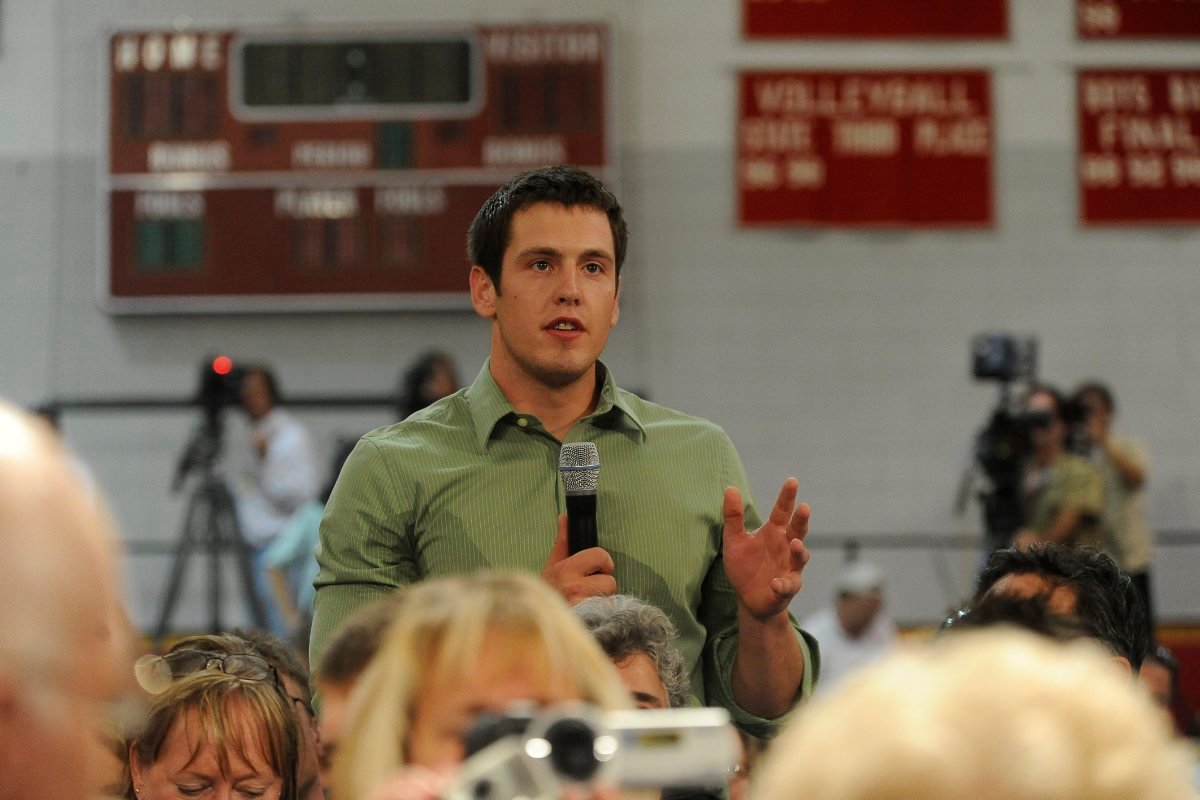
As a student, Zach Rahn listened to then-President Barack Obama’s response at a town hall rally in Grand Junction, Colorado. (Photo by Craig F. Walker/The Denver Post, Getty Images)
Mr. Rahn’s early political views were publicly recorded as early as 2009. While still an undergraduate at the University of Colorado Boulder, he stood at a town hall hosted by then-President Barack Obama and argued against a public option in health care on the premise that it would make it difficult for private insurance companies to compete with the government.
After college, Rahn worked for the Republican Party in Washington, D.C., first for then-Rep. Cory Gardner of Colorado and then for Steve Daines of Montana. Mr. Daines is now a senator, but at the time he was a member of the House of Representatives.
In 2014, Mr. Rahn was hired to lead AFP’s Montana operations. At the time, AFP was sending political operatives across the country to block states from expanding Medicaid under President Obama’s Affordable Care Act. Rahn’s role was to stop the spread in Montana, but Montanans ultimately rejected those efforts and voted to expand coverage anyway.
AFP Montana has since worked to promote the expansion of fossil fuel extraction in the state and oppose regulation of the industry.
In Iowa, AFP has been working on similar issues locally for years. In 2017, former Republican Gov. Terry Branstad drew criticism when he was photographed with an AFP lobbyist while signing a bill that would sharply restrict union rights and take away the ability to negotiate health care benefits and working conditions in contracts.
Therefore, in Rahn’s candidacy for governor, opponents point out that his past affiliations are inconsistent with his campaign promises.
The most controversial issue related to Rahn’s past relationship with AFP is whether Iowans have the right to sue pesticide companies if they become ill from products linked to cancer or other health problems.
This is a struggle that has been central to the MAHA movement. This year, MAHA supporters rallied in front of the Supreme Court to fight for individuals’ right to sue, helped block a federal law that would immediately repeal it, and continued to fight liability protection bills in states across the country.
Rahn said he is on MAHA’s side.
“No company should be exempt from liability,” Rahn said in a news interview posted to his Instagram account in May. “I will veto any future pesticide immunity bill.”
AFP is in the exact opposite position. Earlier this year, AFP sent two lobbyists to the Iowa Legislature to promote a proposed pesticide company immunity bill in the state Legislature, according to records from the Iowa Legislature.
Rahn’s campaign did not respond to Civil Eats’ questions about its previous work with Americans for Prosperity.
In an interview with PBS in early July, responding to questions about his relationship with AFP, Rahn said his work is focused on eliminating loopholes in the Affordable Care Act. But he never distanced himself from his work at AFP or from AFP politics overall.
During a preliminary debate in May, Rahn said agricultural companies were lying to farmers about the safety of chemicals and said “we need to have the truth on our side” when it comes to cancer risks. He reiterated that he opposes exemptions for pesticide companies, but did not answer a direct question about what he would do to reduce exposure to pesticides.
For some, Mr. Rahn’s choice of Iowa Rep. Derek Wolf as his running mate amplified skepticism about his position on pesticide liability.
In June, Iowa political journalist Laura Belin reported that Bayer’s 2024 Modern Ag Alliance had placed an ad in the Des Moines Register that included Mr. Wolf on a list of legislators who “support this important bill.” She also reported that Wolf attended a concert sponsored by the Modern Ag Alliance.
People involved in the bill fight, who requested anonymity, told Civil Eats that they understood Wolf was a supporter of the bill, but the bill never came to a vote in the Iowa House of Representatives, and there is no record of Wolf voting for it.
Mr. Wolf said in an email that he does not know how or why his name ended up appearing in the Bayer advertisement. “I did not support these bills when they were introduced, and I do not support them now. My position has not changed,” he said. “When both of these bills passed in the Iowa Senate, they went through several different committees that I served on in the Iowa House of Representatives, where they were defeated each time before coming to a vote.”
Modern Ag Alliance did not respond to Civil Eats’ questions about Wolf’s inclusion on the list.
Agribusiness involvement in Iowa politics is common, and Mr. Wolf has received campaign contributions from Bayer and other agribusiness giants.
Campaign finance records show he received $1,000 from Bayer PAC in 2024. That year, a PAC made up of Bayer employee donations significantly increased its political spending in Iowa and donated similar amounts to many other Iowa senators and representatives, according to an analysis by Food & Water Watch. He received an additional $1,000 from Bayer PAC in 2025, in addition to many other contributions from agribusiness.
In an interview with PBS, Rahn said Wolf’s experience in Congress prepared him for the role in the first place. “Secondly, it’s about getting hands-on experience with farming and ranching and understanding the challenges that farmers are currently experiencing,” he said. “He introduced legislation to encourage more Iowa-grown food to be offered in public schools.”
Mr. Wolf has also taken on powerful farm equipment manufacturers by working on right-to-repair legislation, which is important to many farmers.
