


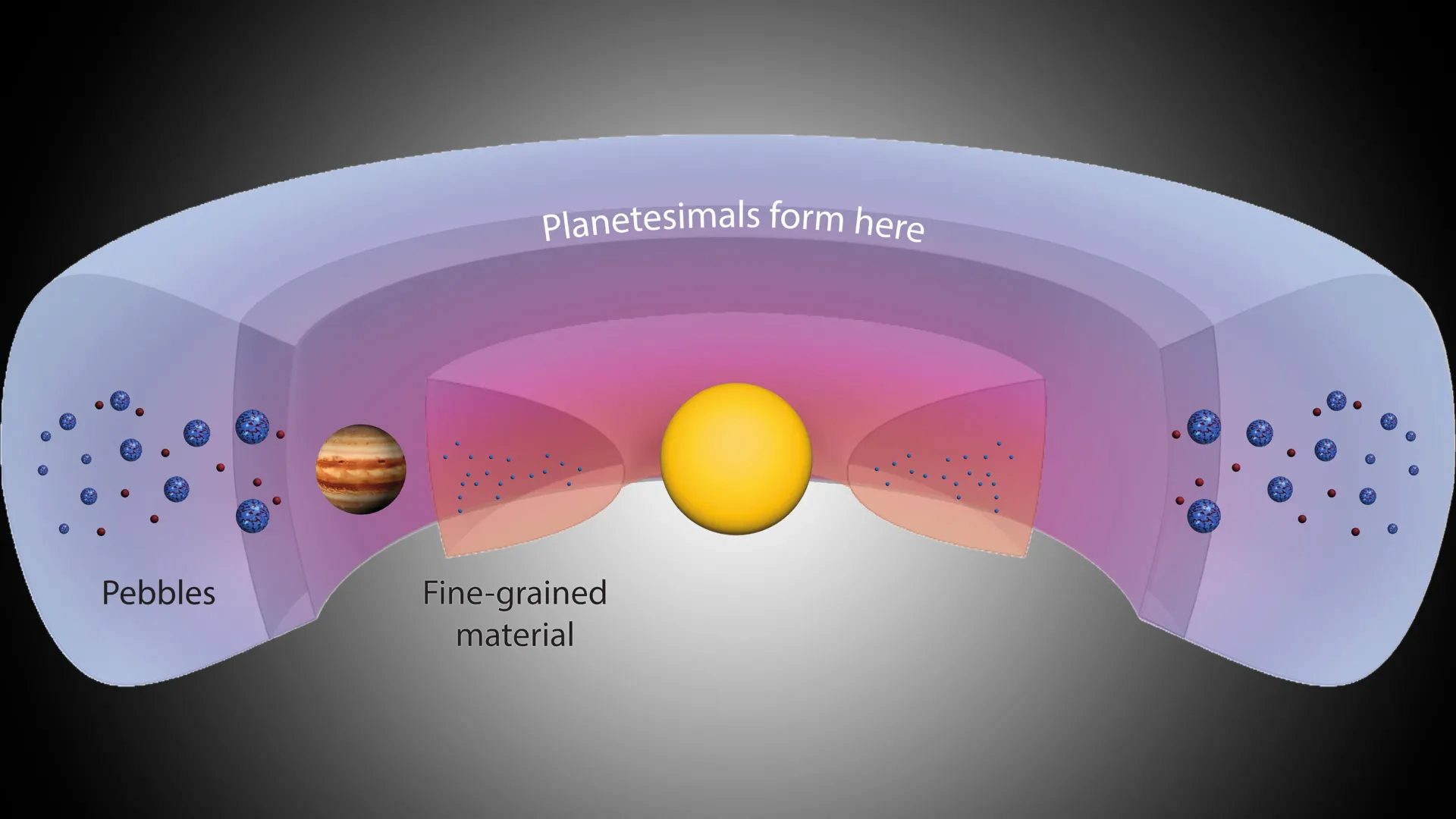
About 4.6 billion years ago, the young Sun was surrounded by a huge disk of gas and dust. Over time, small dust particles collided and stuck together, eventually forming large rocky bodies called planetesimals, the building blocks of planets and asteroids. But scientists believe the process was far from simple. Different regions of the early solar system likely evolved under very different conditions, and multiple stages of planet formation may have occurred simultaneously.
Now, researchers at the Max Planck Institute for Solar System Research (MPS) in Germany have announced that they have identified one of the solar system’s most important planet-forming regions. According to a new study published in astrophysical journala ring-shaped region just outside Jupiter’s orbit served as an efficient and surprisingly versatile “breeding ground” for planetesimals.
Using computer simulations, the research team found that this region produced planetesimals with very different compositions over a period of about 2 million years.
“It seems that different types of planetesimals formed in the same region of the early dust and gas disk, just at different times. The region just outside Jupiter’s orbit provided the perfect conditions for this,” said Joanna Dronszkowska, director of the Lise Meitner Group on Planet Formation.
How Jupiter created a cosmic dust trap
The study focused on a period between about 2 million and 4 million years after the formation of the solar system. By that time, Jupiter had already gathered most of the nearby material around its orbit, creating a gap in the surrounding disk of gas and dust.
Scientists believe this process also created a ring of high-pressure gas just outside Jupiter. That pressure trapped large amounts of dust, causing it to collect in small clumps known as pebbles. Previous research had already suggested that such “dust traps” could help planetesimals form rapidly during the solar system’s early stages.
What remained unknown was whether these dust traps could continue to produce very different types of objects for long periods of time. New simulations suggest it’s possible.
The researchers showed that a diverse population of planetesimals may have formed in this same region over millions of years. Their discovery also connects these simulated objects to known meteorites found on Earth.
“For the first time, we have succeeded in accurately reproducing the results of laboratory studies of meteorites using computer simulations of the early solar system. This meteorite is, so to speak, a touchstone for the theory of planet formation,” said MPS director and cosmochemist Torsten Kleine.
Meteorite preserves clues to solar system’s past
A meteorite is a piece of space rock that survives its journey through Earth’s atmosphere and lands on the planet’s surface. Many of them are thought to be fragments of ancient planetesimals that have changed little since the early days of the solar system.
The researchers focused specifically on carbonaceous chondrites, a type of carbon-rich meteorite. Laboratory studies suggest that these meteorites formed beyond Jupiter during the same period studied in the simulations.
Scientists classify carbonaceous chondrites into six groups based on their age and composition. Some are fragile and made primarily of fine-grained material, while others are stronger and have visible inclusions embedded within the finer material.
In the new simulations, these two components matched two types of materials thought to be present in the early solar system. One consisted of a brittle powdery material, and the other consisted of a tougher mass that formed very early in a hotter region before spreading throughout the disk.
“In our simulations, it was important to model the behavior and interactions of both materials at both large and small scales,” said Nerea Gurrutxaga, a PhD student at MPS and first author of the paper.
Simulation reveals multiple generations of space rocks
The researchers’ model tracked both microscopic particle collisions and large-scale movements across a giant disk of gas. Particles can break apart, stick together, drift toward the sun, or become trapped in certain areas.
The simulations showed that Jupiter acts as a stronger barrier to larger, tougher particles than smaller dust particles. At the same time, the formation of new planetesimals steadily consumed some of the available material.
Over millions of years, these combined effects caused the two types of material to gather in different proportions across Jupiter’s orbit. This change in balance ultimately led to the formation of distinctly different generations of planetesimals.
During the first 500,000 years, the amount of friable material decreased, but increased again over the next 1 million years. Two distinct populations of planetesimals then appeared. One is made up primarily of fragile materials, and the other is made up of more stable materials.
Based on their results, the researchers suspect that other types of meteorites besides carbonaceous chondrites may have formed within the same dust traps even earlier in the solar system’s history.
“There is strong evidence that dust traps were a favorable birthplace for planetesimals in our solar system,” said Joanna Dronszkowska.
