


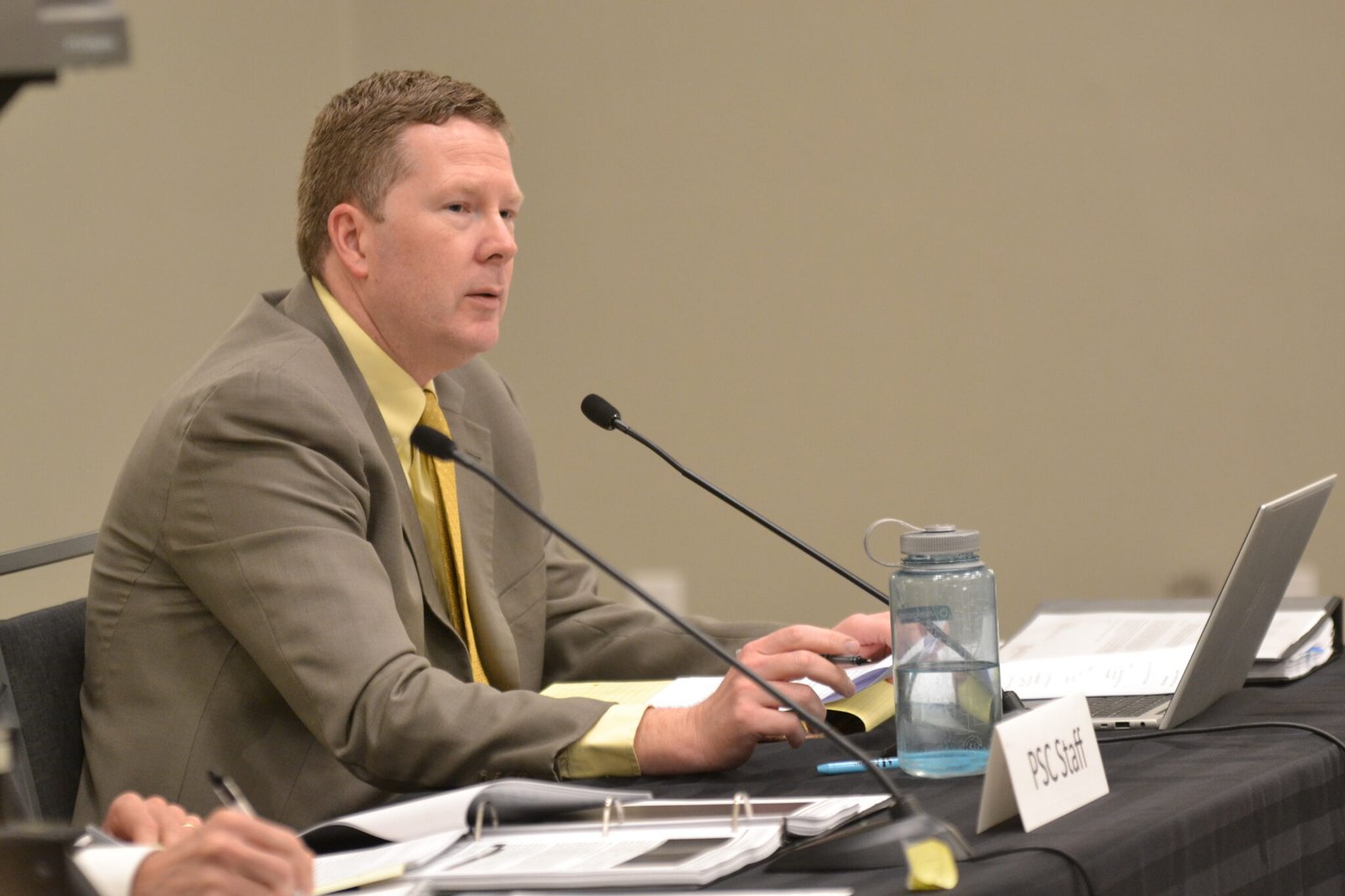
An attorney for the North Dakota Public Service Commission said Tuesday that the agency cannot consider public safety when issuing permits for pipelines.
Attorney Zachary Pelham said the commission must consider the public welfare, but that does not include safety.
“Welfare and safety are two different things,” Pelham said during a hearing on the permitting dispute for the Summit Carbon Solutions Pipeline.
Two counties and a group of landowners have sued the Public Service Commission and Summit over what attorneys say is a flawed permit approval process. The lawsuit seeks to revoke the permit and send the application back to the PSC for further review.
 South Central Judicial District Judge Jackson Lofgren will preside over the trial on January 27, 2025 in Bismarck. (Mary Stuerer/North Dakota Monitor)
South Central Judicial District Judge Jackson Lofgren did not issue a ruling Tuesday.
One of the flaws noted Tuesday was that the three-person panel did not appear to consider evidence about what would happen if the pipeline ruptured. Carbon dioxide is a dangerous substance and can be fatal if inhaled in high concentrations.
Summit Carbon Solutions has developed the so-called plume dispersion model. This model was not made public and did not become part of the PSC record of the permit case.
Randall Bakke, an attorney representing Burley County, said the model will help determine the safety risks posed by carbon pipelines. Bakke noted that Summit provided a model for some people, including Bismarck developers and oil industry lobbyists, but not for lawyers representing stakeholders in litigation.
Attorney Steve Leibel said the plume model is relevant for another reason. That will help determine whether the setbacks through Burley and Emmons counties are considered reasonable. These setbacks (minimum distance required between the pipeline and residences) are also the basis for permit applications.
But Pelham said safety is strictly a federal issue.
So Lofgren asked Pelham, “If the PSC doesn’t have the authority to dictate where pipelines go or how safe they are, what role does the PSC play in regulating pipelines?”
Summit carbon pipeline rerouted to storage site in Wyoming. North Dakota’s future uncertain
Mr. Pelham responded that the PSC could take into account factors such as the impact on state land, the environment and wildlife. He said commissioners can ask questions about things like pipeline thickness and shutoff valves, but they don’t have authority in those areas.
Bakke said Pelham’s argument that public welfare does not include safety “simply defies logic.”
Bakke and Leibel also argued that the PSC did not adequately address insurance liability concerns from landowners in the event of a pipeline rupture, and that the regulator did not properly analyze alternative routes. They also challenge the PSC’s interpretation of state law. State zoning laws preempt. Local government regulations.
Safety was one of the major public concerns at the time. committee hearing The pipeline is proposed to capture carbon from ethanol plants and transport it to western North Dakota for permanent underground storage.
The Public Service Commission initially denied a 2023 permit for Iowa-based Summit Carbon Solutions. The summit was rerouted. Avoid areas with potential for landslides.
P.S.C. Approved in 2024 Revised route.
But the project’s future is uncertain because Summit has not been able to obtain state permits in South Dakota.
Furthermore, two district court judges issued the following judgments: Underground storage permit and the law under which they were issued; is unconstitutional. These cases are on appeal to the North Dakota Supreme Court.
The summit has recently Wyoming carbon storage area That would bypass the Dakotas and Minnesota.
A spokesperson said in May that North Dakota, South Dakota and Minnesota “remain important to us.” A spokesperson did not respond to a request for comment Tuesday.
Contact North Dakota Monitor Deputy Editor Jeff Beach at email protected.
Get your morning headlines.
