



New York Governor Kathy Hochul on Tuesday signed an executive order that would become the first state in the nation to suspend new hyperscale data center construction.
The Democratic governor said he would suspend environmental permits while the state researches and develops a regulatory framework to protect ratepayers, the environment, the energy grid and communities. The state already has four hyperscale data centers operating and applications for 39 more locations are pending. These facilities raise concerns about their potential energy and water consumption at a time when there is overwhelming scientific consensus about the need to conserve energy and halt fossil fuel emissions that warm the planet’s climate and intensify disasters.
“This moratorium will last for up to one year until New York establishes guardrails to protect our communities, reduce risks to our energy grid, minimize land disturbance and noise pollution, and establish the strongest possible framework to protect our natural resources, especially our water supply,” Hochul said in remarks accompanying the executive order.
The New York State Assembly approved a broader moratorium in June, but there were doubts whether Hochul, who is up for re-election this year, would sign the bill because he has said the issue should be left to local governments.
Eric Wood, senior environmental program coordinator at the nonprofit New York Public Interest Research Group, said Tuesday’s order is a good first step but doesn’t go as far as previous legislation.
“While the Legislature’s bill would provide more protection for individuals in New York state, the governor’s proposal appears to be a middle ground between the multibillion-dollar tech industry and voters,” he said.
Kate Bocourt, New York state director for the Environmental Defense Fund, said the executive order is a step toward creating “clear rules” that are standardized across the state.
“There are things that need to become a statewide standard,” Boiscourt said. “Otherwise, if you have specific rules for each municipality, you could change what is allowed in one area and not another. There are a number of clean energy standards that will be added to New York State’s climate change goals, and they appear to be important for crossing boundaries within the state’s reach.”
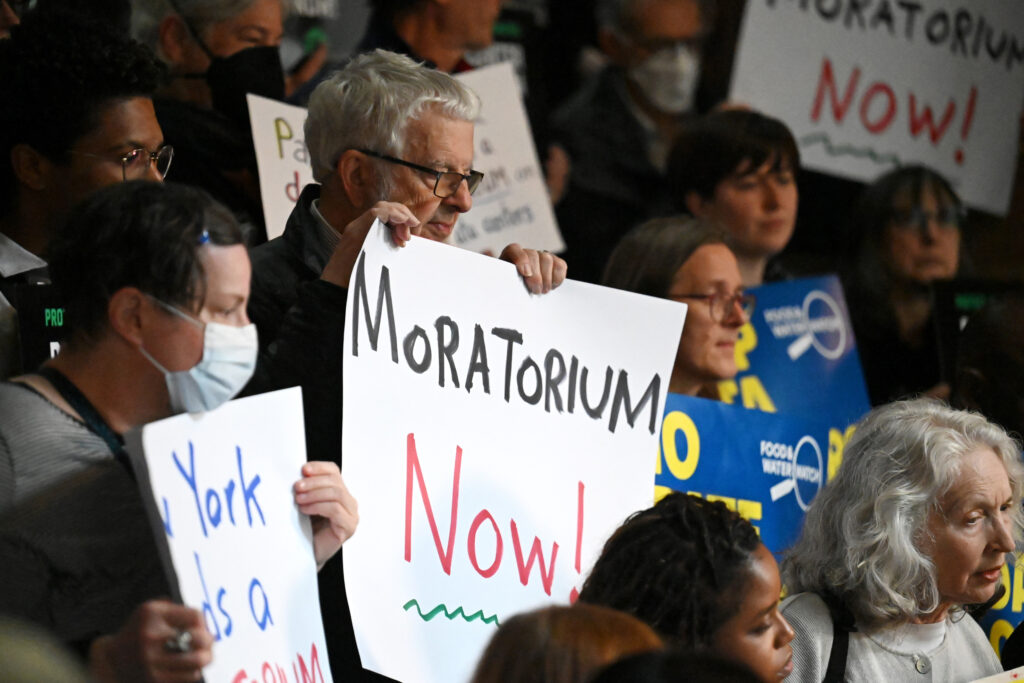 Environmental advocates and lawmakers hold a rally in support of the data center moratorium bill at the Capitol in Albany, New York, on May 13. Credit: Will Waldron/Albany Times Union via Getty Images
Some business and industry groups decried the suspension, saying it would hurt business.
“This short-sighted moratorium accomplishes only one thing: take away good-paying union jobs,” said Mark McManus, president of the United Association of Plumbers and Plumbers, which has advocated for data center construction.
The state was one of about a dozen states this year to introduce legislation to suspend or ban data centers. In April, the Maine Legislature became the first state in the nation to approve a moratorium, but Gov. Janet Mills vetoed the measure. Darrell West, a senior fellow at the Brookings Institution who studies AI and technology policy, said the effort in New York is important because it is a “trend-setter state.”
“What happens there often spills over into other regions, so the fact that New York adopted a one-year moratorium suggests that other regions may follow suit, which is a huge problem for the future of data centers and AI in general,” he said. “Public opposition to data centers is widespread across the country. It’s not limited to Democratic or Republican areas, urban or rural areas. Many states could move in this direction because public concerns are broad-based and cross political lines.”
This story is funded by readers like you.
Our nonprofit newsroom provides free advertising for our award-winning climate coverage. We rely on donations from readers like you to continue our work. Donate now to support our work.
donate now
Commercial real estate services firm Cushman & Wakefield ranks the New York/New Jersey data center market near the bottom of the nation’s top 12 markets, with 657 megawatts of projects in operation by the end of 2025.
By comparison, the largest market, Virginia, had 11,275 megawatts in operation. The suspension in New York is significant, but far less than the suspension in larger markets such as Portland, Oregon. Columbus, Ohio. And Phoenix.
Mitch Jones, managing director of policy and litigation at the national advocacy group Food & Water Watch, welcomed the moratorium, saying data centers threaten electricity bills, water supplies and air quality.
“I’m really glad that New Yorkers can pause the construction of hyperscale data centers in our state so we can better educate our communities about the risks posed by data center construction and continue to educate our elected officials about why we need to put permanent protections in place afterward,” Jones said.
Jones called data centers a “cross-cutting issue” that unites the Democratic and Republican opposition parties, and said he hopes Hochul’s action will set a national precedent. A Gallup poll released in May found that nearly three-quarters of Americans oppose building local data centers, including more than 60% of Republicans.
“It’s going to put more pressure on lawmakers to actually pass the moratorium bills that are being introduced in the state, and it’s going to put pressure on governors to act on their own and issue executive orders similar to the one Governor Hochul signed today (but perhaps a little more aggressive),” Jones said.
Cole Jarmin, an energy transition attorney at the Environmental Defense Fund, said New York’s next step is for regulators to discuss the details of long-term data center policy.
“This is a very detailed issue, and an executive order is typically not the place to try to do detailed regulatory policy for public utilities,” Jarmin said. “The impact of this executive order depends on its efforts,” he added.
Jones said he expects Hochul’s executive order to allow New York state to extend its data center moratorium to nearly three years as originally proposed.
“What we need to do is take advantage of this moratorium and work on the research that is included in this moratorium, but we need to go further, we need to go deeper, and that will probably require a longer moratorium period,” Jones said.
About this story
As you may have noticed, this article, like all news we publish, is free to read. That’s because Inside Climate News is a 501c3 nonprofit organization. We don’t charge subscription fees, keep our news behind paywalls, or fill our website with ads. We provide climate and environmental news free to you and anyone who wants it.
That’s not all. We also share our news for free with dozens of other news organizations across the country. Many of them cannot afford to do their own environmental journalism. We’ve established bureaus across the country to report on local news, partner with local newsrooms and co-publish stories to ensure this important work is shared as widely as possible.
The two of us started ICN in 2007. Six years later, we won the Pulitzer Prize for national reporting and now run the nation’s oldest and largest dedicated climate newsroom. We tell the story in its entirety. We hold polluters accountable. We expose environmental injustice. We debunk misinformation. We explore solutions and inspire action.
Donations from readers like you fund all aspects of our work. If you haven’t already, will you support our ongoing work, our coverage of the biggest crises facing our planet, and help us reach more readers in more places?
Please make a tax-deductible donation. Each one makes a difference.
thank you,
