


New research suggests Europe could spend more than €100bn (£85bn) a year remediating PFAS pollution while capturing less than 2% of current emissions. 1 Researchers say their findings reinforce the need to prioritize reducing PFAS use and emissions at the source, rather than trying to clean up pollution after it has occurred.
PFAS are a class of anthropogenic chemicals used in industrial and consumer products such as flame retardants and nonstick cookware, and their persistence in the environment has been linked to cancer and thyroid dysfunction in humans. Historically, PFAS production has focused on long-chain compounds such as perfluorooctanoic acid (PFOA), but increasing regulations are prompting the industry to transition to short-chain PFAS and other alternative fluorinated chemicals. As a result, there is growing concern about very short chain compounds such as trifluoroacetic acid (TFA), which are also produced by the environmental degradation of many fluorinated chemicals. They are particularly difficult to remove from contaminated water due to their high water solubility, low adsorption affinity, and high mobility.
The European Commission’s 2026 report predicts that between 2024 and 2050 soil remediation and drinking water treatment will cost up to 80.2 billion euros per year, and healthcare costs up to 39.5 billion euros per year, depending on the level of preventive measures. Now, a team led by Ali Lin from the University of St. Thomas in Minnesota analyzed publicly available datasets to estimate the current and future costs of treating PFAS contamination in Europe. “While the European Commission’s report looked more broadly at societal costs, including health costs, our report focuses on a more comprehensive analysis of PFAS remediation,” Lin explains.
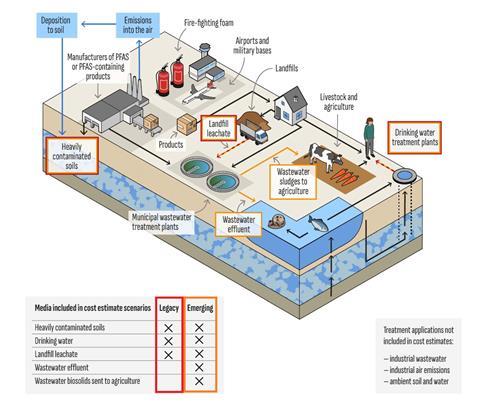
A new study details two possible scenarios for PFAS remediation. The first, what Ling and colleagues refer to as the legacy scenario, considers the cost of treating historic long-chain PFAS in drinking water, landfills, and heavily contaminated soil sites using current remediation technologies such as granular activated carbon adsorption and off-site soil cleaning. The second scenario, called the Emerging Scenario, extends to continued remediation of both long-chain and short-chain PFAS from future wastewater effluents. Based on these scenarios, Ling et al. estimate the cost of legacy remediation to be €37 billion over 20 years, equivalent to €1.8 billion per year, and new remediation costs at €100 billion per year.
However, these estimates account for only a small portion of future emissions because they do not include industrial wastewater, air emissions, or the treatment of surrounding soil and water. “This nagging question was at the back of our minds: ‘How much PFAS can we actually achieve with this level of remediation?'” Lin says. “The new scenario we presented was a fairly aggressive remediation strategy, and we wanted to know how much PFAS could be remediated with that strategy.” We crunched the numbers and found it was less than 2% of current emissions. Frankly, I couldn’t believe it.[This discovery]frees us from the paralysis of feeling like we need to get everything done, but we can’t. We need to focus on reducing usage and emissions and taking care of people. ”
full screen
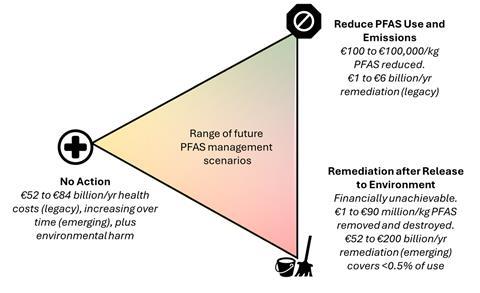
Marta Benier, an expert on persistent organic pollutants at Indiana University in the US, agreed: “This study highlights how limited remediation is in addressing ongoing emissions.” “This reinforces the need for stronger source controls and for regulators to consider new PFAS, including TFA, before environmental and public health costs increase further.”Consumers will pay for these chemicals even if they do not require them to be used, and it will be more cost-effective for companies to control emissions at the source than to remediate them at the end. ”
“The main point is to encourage action,” Venier concludes. “Rather than remediate, it is important to act now to prevent future contamination.”
