


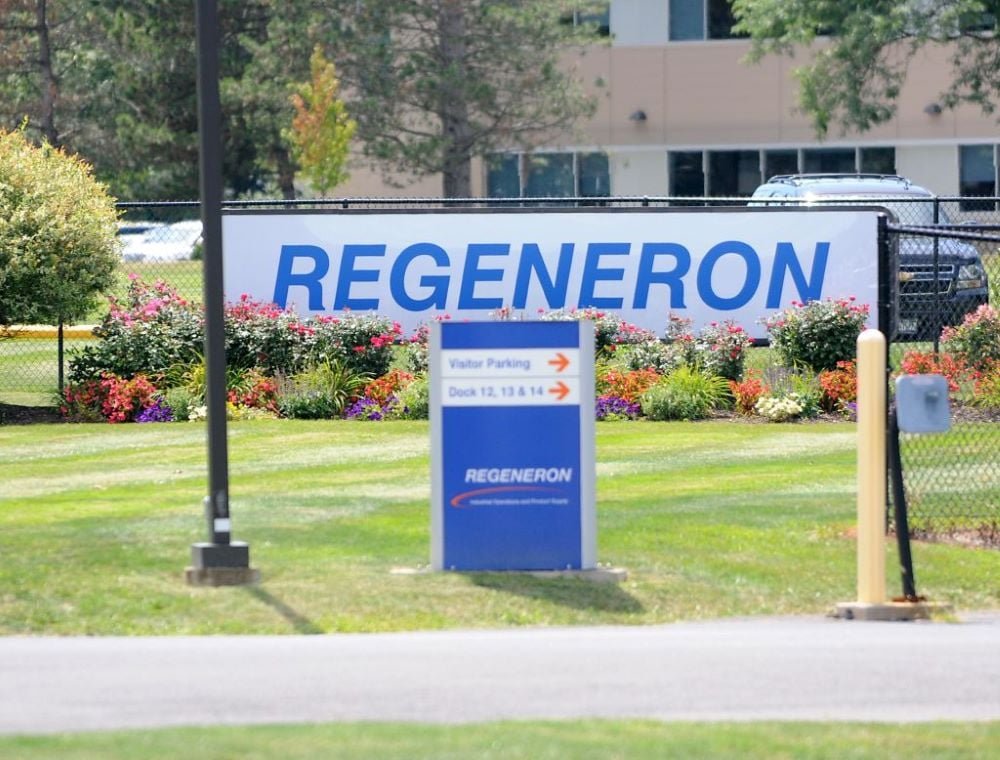
And there was nothing.
Regeneron’s announcement of a drug pricing agreement with the White House on Thursday means all 17 companies targeted in a series of letters by the Trump administration last year have agreed to abide by the president’s “most-favored-nation” strategy.
Regeneron, which now joins the ranks of MFN policy proponents ranging from Novo Nordisk and Eli Lilly to Gilead, Roche and Novartis, has pledged to lower the prices of its drugs on Medicaid, in line with other developed countries.
Regeneron is also committed to matching the cost of future treatments with prices “set in a defined group of other countries,” the company said in an April 23 release.
As part of the agreement, Regeneron will offer the cholesterol-lowering drug Praluent at a discount through the government’s online drug purchasing portal Trumprx.gov.
Thursday’s drug price announcement coincided with news that Regeneron had received FDA approval for Otarmeni, the first gene therapy for inherited hearing loss, and the company announced it would make it available free of charge in the United States.
“For too long, U.S. patients and taxpayers have borne a disproportionate share of the costs of biotechnology innovations, effectively subsidizing drug price reductions to other high-income countries that are not paying their fair share,” Regeneron co-founder and CEO Leonard Schleifer, MD, said in a statement.
“For more than a decade, we have argued that the most direct path to meaningful relief for American patients ultimately depends on getting other high-income countries to pay their fair share, as we do, for the breakthrough treatments they rely on,” he added.
Regeneron was among 17 major drug makers targeted last year in a series of letters from the president urging companies to adopt the administration’s most-favored-nation pricing strategy, which matches U.S. costs to the lowest prices available in comparable developed countries.
The letter, which also targeted companies such as Amgen, AstraZeneca, Boehringer Ingelheim, Bristol-Myers Squibb, Merck and Pfizer, called on drugmakers to offer most-favored-nation pricing to “all Medicaid patients,” while also pledging not to offer “new drug prices that are more favorable than those offered in the United States.”
Pfizer signed the first MFN deal with the White House, with AbbVie and J&J joining recently, ahead of Regeneron.
In addition to the Medicaid price reduction promise, many drug companies that signed onto the MFN agenda also pledged to invest in U.S. research, development and manufacturing, and the agreement also provides them with a period of immunity from the administration’s threat of drug tariffs.
Meanwhile, Regeneron has committed to domestic investment in recent months with a $3 billion commercial manufacturing agreement with CDMO Fujifilm Biotechnologies in North Carolina, and plans to invest about $2 billion in a production site in Saratoga Springs, New York, which the company acquired last April.
In a release Thursday, the company said it has committed to investing more than $9 billion in U.S. manufacturing and research and development “over the next few years.”
The agreement exempts Regeneron from “future pricing obligations and provides a three-year tariff exemption,” the company said.
Many of the world’s largest drug companies have been able to secure price and tariff deals with the White House, but there are growing concerns that the framework overlooks small and medium-sized biopharmaceutical companies, potentially putting them at a disadvantage.
Additionally, lawmakers and patient advocates are seeking more information about the detailed terms of the deal. Sen. Ron Wyden, D-Ore., sent a letter directly to 11 drug manufacturers in March asking for more information on what drugs would be included in the deal and what state Medicaid programs would actually expect to receive under the agreement.
Editor’s note: This article has been updated with additional information from Regeneron’s press release.
