


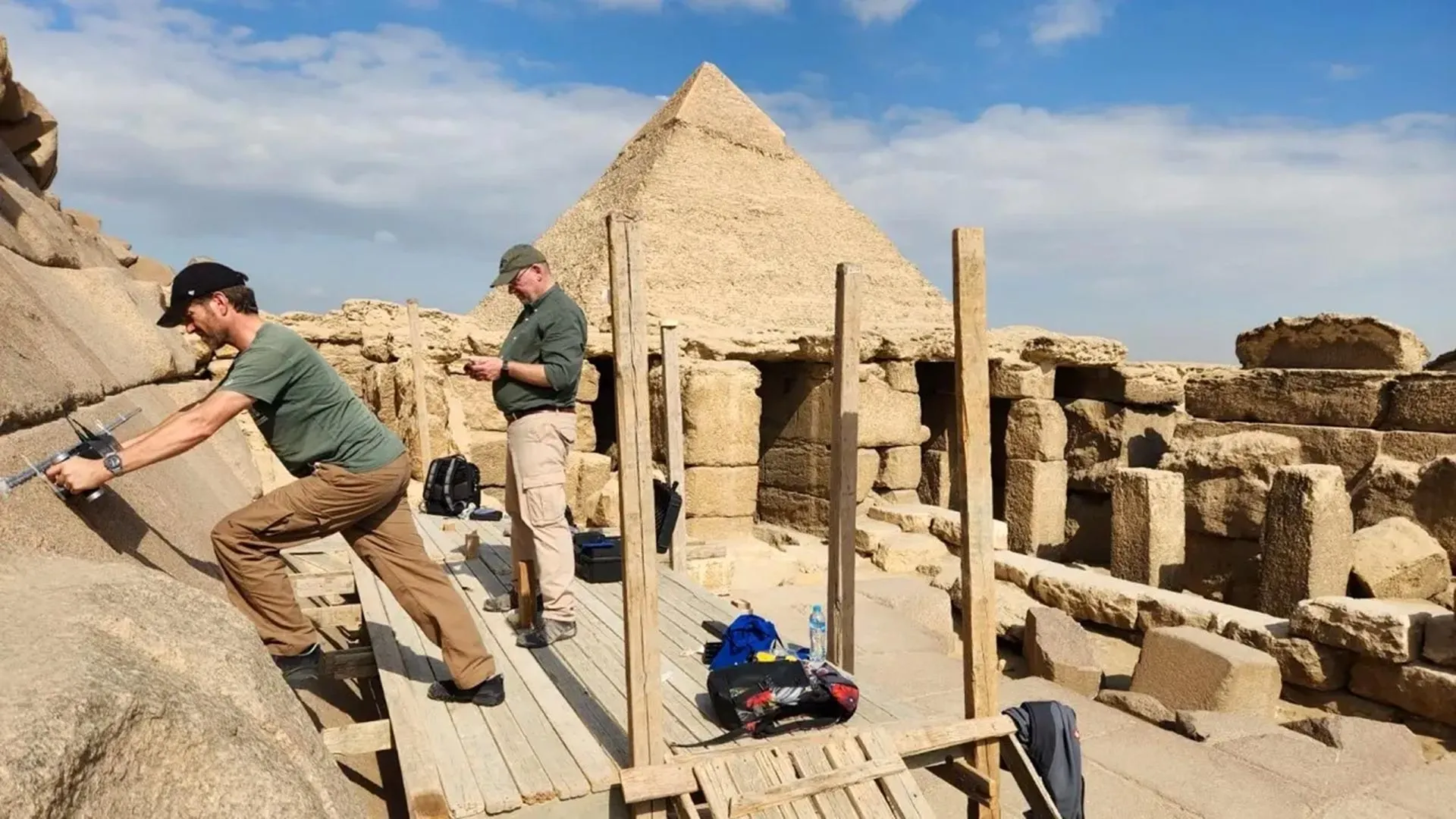
Researchers from Cairo University and the Technical University of Munich (TUM) working on the ScanPyramids research project have discovered two hidden air-filled anomalies inside the third largest pyramid at Giza. Scientists have suspected for years that there is an undiscovered entrance on the east side of Menkaure’s pyramid. New research using radar, ultrasound, and electrical resistivity tomography (ERT) confirms the existence of two hidden cavities beneath the east façade, providing the first hard evidence to support the idea.
The eastern face of Menkaure’s pyramid, which is more than 60 meters high, has long puzzled researchers. Some of the granite blocks, about 4 meters high and 6 meters wide, appear unusually smooth and polished. A similar finish is found only at the known entrance on the north side of the pyramid. This unusual feature led researcher Stein van den Hoven to propose in 2019 that there may be a second entrance to the site.
Uncover hidden cavities with advanced scanning
As part of the ScanPyramids project, the research team took a closer look at the eastern facade and detected two anomalies behind the polished surface. Using a combination of non-invasive techniques such as ground-penetrating radar, ultrasound, and electrical resistivity tomography, they were able to clearly identify the two air-filled cavities. This is the first time that a structural anomaly has been identified behind this distinctive part of the pyramid.
The two cavities were located behind the exterior wall at depths of 1.4 meters and 1.13 meters. One is approximately 1 meter high and 1.5 meters wide, and the other is approximately 0.9 meters by 0.7 meters. Achieving this level of accuracy required integrating data from multiple scanning methods. The use of image fusion, which combines all collected measurements, played a key role in confirming the existence and dimensions of these hidden spaces.
Findings support the entry hypothesis
“Following the important verification of the hidden corridors of the Pyramid of Khufu in 2023, ScanPyramids has once again made an important discovery at Giza. The testing method we have developed allows us to draw very precise conclusions about the nature of the pyramid’s interior without damaging the precious structure. The alternative entrance hypothesis is very plausible and our results bring us a big step closer to its confirmation,” said Professor Christian Gross. Non-destructive testing at TUM.
Project collaboration and support
- Work on the pyramids was carried out in collaboration with and under the supervision of the Egyptian Supreme Council of Antiquities and the Egyptian Ministry of Tourism and Antiquities.
- These ScanPyramids project results were primarily achieved through collaboration between researchers from Cairo University, Technical University of Munich (TUM), Portland State University, Dassault Systèmes, and the Heritage Innovation and Preservation Institute.
- Additional partners and financial supporters are the Science, Technology and Innovation Funding Agency (STDF), La Fondation Dassault Systèmes, NHK, TNG Technology Consulting and Mondaic AG. TUM was directly supported by TUM IGSSE and DAAD (German Academic Exchange Service).
- Christan Große is Professor of Non-Destructive Testing at the TUM School of Engineering and Design.
