


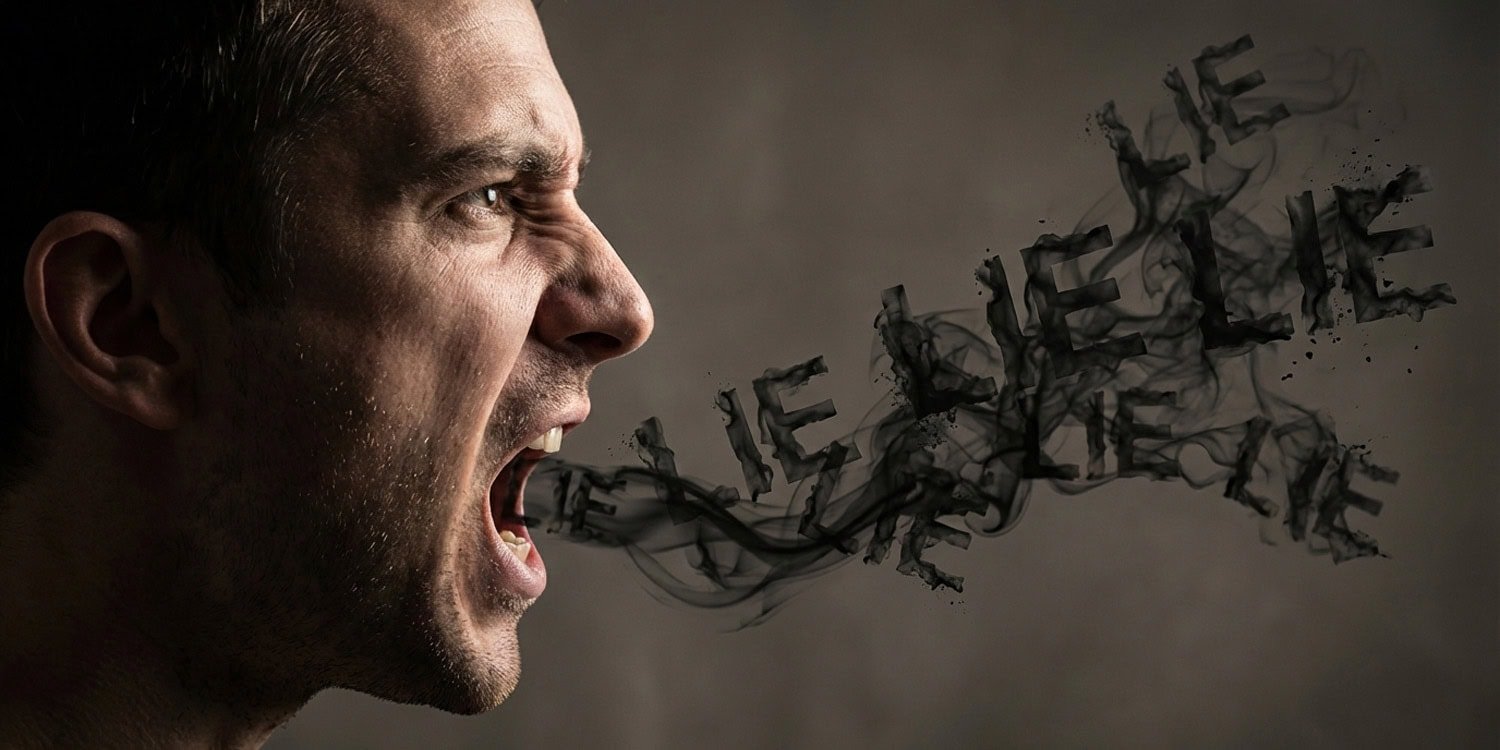
Recent research published in current psychology This suggests that people are more likely to believe disinformation from someone who ignores the truth than from a liar who actively tries to deceive. This research shows that when a fact-insensitive person repeats a statement, it significantly increases how true that statement is perceived by the reader. These findings provide evidence that casual disregard for reality poses a uniquely powerful threat to public knowledge and beliefs.
The digital age has made it increasingly difficult to track down misinformation. Information is often spread through acts known in psychology as “bullshit” as well as intentional deception. In academic terminology, a liar is someone who knows the truth and intentionally tries to mislead his audience. Bullshit people, on the other hand, communicate with little or no regard for truth, evidence, or established facts.
What a bullshit person says may happen to be true, or it may be false. The defining feature is the speaker’s complete indifference to reality. People who bullshit don’t actively try to hide certain truths, so people often judge them less harshly than they judge outright liars.
John V. Petrocelli, professor of psychology at Wake Forest University and author of the book Life-changing science to see through the bullshitwanted to test the impact of this behavior in the real world. He noted that philosopher Harry Frankfurt proposed the “insidious bullshit hypothesis” in 1986. This idea suggests that a society’s tolerance for bullshit actually does more long-term damage to public knowledge than lies.
Past research supports this distinction. In a 2023 study, Petrocelli and his colleagues investigated how untrustworthy sources of information affect consumer attitudes over time. Participants read an ad for a fictitious gluten-free pizza and learned that the advertiser was either a known liar or a known hoaxer.
After a two-week delay, participants who were warned about the hoax reported more positive attitudes toward pizza than those who were warned about the liar. This demonstrated the “sleeper effect,” in which the deceptive influence of a bullshit person actually becomes stronger over time. The researchers also found that people have a high “rejection readiness” for lies. This means that it is easier to reject a known lie outright than a made-up statement.
“Consistent with Mr. Frankfurt’s (1986) essay, we already knew that people judge bullshit less harshly than lies,” Petrocelli explained. “But the harder question that Frankfurt posed, which almost no one has ever tested empirically, was whether bullshit actually does more damage to what people believe, because it doesn’t arouse the same skepticism as known lies.”
To further test this idea, researchers looked at how bullshit interacts with the illusion of truth effect. The illusion of truth effect is a psychological phenomenon in which a person believes false information to be true after hearing it many times. Because the human brain processes information more easily when it encounters repeated statements, people often mistake this mental comfort for actual truth.
The scientists wanted to see if knowing the source of the claims would change this effect. “The literature on the illusory truth effect has given me a clean, well-validated paradigm to directly test not only people’s attitudes toward bullshit, but its consequences,” Petrocelli said. People who know that a statement is bullshit rather than a liar may filter out repeated information less rigorously.
To investigate these dynamics, the authors designed a series of three experiments. In the first experiment, 204 undergraduate students rated 42 different statements. Half of these statements were true and half were completely false.
Participants were told that the statement was made by either an ordinary person, a known liar, or a known bullshit. The researchers provided participants with specific definitions of liars and bullshit to ensure they understood the difference. Students then rated the likelihood that each statement was true on an 11-point scale.
The data showed that participants rated statements made by the alleged liar as more truthful than statements made by the alleged liar. Ordinary people were the most trusted, but random people were trusted much more than liars. This first finding shows that people naturally find bullshit more likely to be true than intentional lies.
The specific terminology used to describe the information source was not the primary driver of these results. “It’s not that ‘bullshit’ simply sounds better than ‘liar,’ just because the label itself was less important than we expected,” Petrocelli said. “When we controlled for the base rate of false statements in Experiment 3 and very clearly and carefully defined what the source instructions were, the effect persisted.”
Petrocelli added that this consistency is reassuring. “That gave us even more confidence that this wasn’t just a reaction to the words that were loaded, but that we were actually tracking something about how people process a source’s indifference to the truth,” he explained. The researchers then moved on to test how this baseline confidence interacted with repeated exposure in a second experiment.
In the second experiment, 293 students participated in a test of the illusion-truth effect. The researchers exposed 66 statements to participants and asked them to rate how interesting they were. This acts as an initial exposure stage, with some statements appearing once and some statements appearing twice.
Before the final truth rating task, the authors divided the participants into different groups. One group was told that the makers of the statement were instructed to include obvious lies. Another group was told that the authors had been instructed to include statements that ignored the truth.
The scientists also manipulated when participants were warned about false information. Half of the participants were warned at an early stage before reading the statement. The other half read the statements first and were alerted only before the final truth-rating task.
In the final task, everyone rated the truthfulness of 88 statements on a 6-point scale. These included a mix of entirely new claims and repeated claims from the first stage. The researchers then compared how different warnings affected students’ beliefs.
The results revealed that forewarning people about the falsehood before reading the statement reduced the truth illusion effect across all groups. But once the warning was issued after the initial exposure, a big difference emerged. Participants in the liar and control groups were able to recognize that the false statements were not true and were able to modify their judgments.
In contrast, participants in the bullshit group still fell into the illusionary truth effect. Even after learning that the author had no regard for truth, these students rated the repeated false statements as highly true. By repeating false claims, he successfully tricked their minds into believing what he was saying.
Petrocelli found this particular dynamic particularly interesting. “The most striking pattern for me was that the effects of forewarning varied greatly depending on timing,” he said. “When people were warned before being exposed that some of the information might be fake or false, the illusion of truth effect was largely nullified overall.”
The delayed warning produced a very different reaction. “But when people learned after the fact that they had been exposed to the bullshit, the effect was not only lasting against the bullshit, but the strongest state in the entire design,” Petrocelli noted. Lies and honest claims of control were actually revised downwards once people learned the truth after exposure.
“That asymmetry, the remedial efforts that seemed to work but backfired on lies, or simply had no effect on bullshit, were the clearest empirical signs of the insidiousness we were expecting,” Petrocelli explained. To confirm these patterns, the researchers conducted a third experiment with 318 students. The setup was almost identical to the second experiment, but with strict conditions to ensure that the results were not based solely on assumptions about the lying frequencies.
They clearly told participants that exactly half of the statements were false, lies, or bullshit, depending on the group they were assigned. This made the frequency of deception perfectly equal across all scenarios. The authors found exactly the same pattern as in previous tests, providing evidence that repeated exposure to truth-indifferent claims evades critical thinking.
These results suggest that perceiving a source as a liar causes the brain to stop associating repetition with truth, but perceiving a source as bullshit fails to erect a similar mental blockade. Petrocelli highlighted how this trend leaves people vulnerable. “The instinct to let your guard down when someone is ‘talking free’ rather than intentionally lying is exactly the opposite,” he explained.
“Claims from known liars are flagged and dismissed, but claims from bullshit get passed over with less resistance because they are definitely not lies, and they only feel more true over time through repetition,” Petrocelli said. He suggested changing the way people evaluate everyday conversations. “If anything, the practical lesson is not just to ask, ‘Is this person lying to me?’ but to ask, ‘Does this person really know or care whether this is true?’ and treat repeated exposure to insensitive conversations with at least as much scrutiny as you would treat claims you know will be refuted.”
Recognizing the boundaries of this study helps place the findings in their proper context. Petrocelli noted two major caveats about the study. “First, our operation is narrow in scope; we tested a specific cognitive manifestation of insidiousness, the magnitude of the illusion of truth effect under repetition, rather than Frankfurt’s full philosophical assertion about the corrosive effects of bullshit on public discourse in general,” he explained.
A second limitation concerns how the sources were presented to participants. “Our operation relied on labeling someone a ‘bullshit’ or a ‘liar’ through the direction of the source, rather than an act in itself that was clearly indifferent to the truth,” Petrocelli noted. “Strictly speaking, these findings are about label effects and associated expectations, and future research really needs designs that operationally instantiate the bullshit rather than just explain it.”
Future research may focus on extending these initial findings to more complex scenarios. While the current study relied on neutral trivia-style descriptions, real-world misinformation often centers around highly emotional topics. “We are moving away from neutral trivia statements to emotionally charged real-world content, political advocacy, and health misinformation, as motivated inferences can plausibly amplify or weaken these effects,” Petrocelli said of next steps.
He also plans to test whether the effect holds when people are not explicitly warned about the source’s intentions. “And in the long term, we want to push towards intervention, but beyond just teaching general fact-checking and lie-detecting skills, can platforms and media literacy programs actually teach people to identify their indifference to the truth? Our research suggests that may not translate well to bullshit,” he added.
The study, “When Fools Have More Influence than Liars: Testing the Insidious Bullshit Hypothesis Using the Illusory Truth Effect,” was authored by John V. Petrocelli, Elijah N. Rice, and Joseph M. Curran.
