


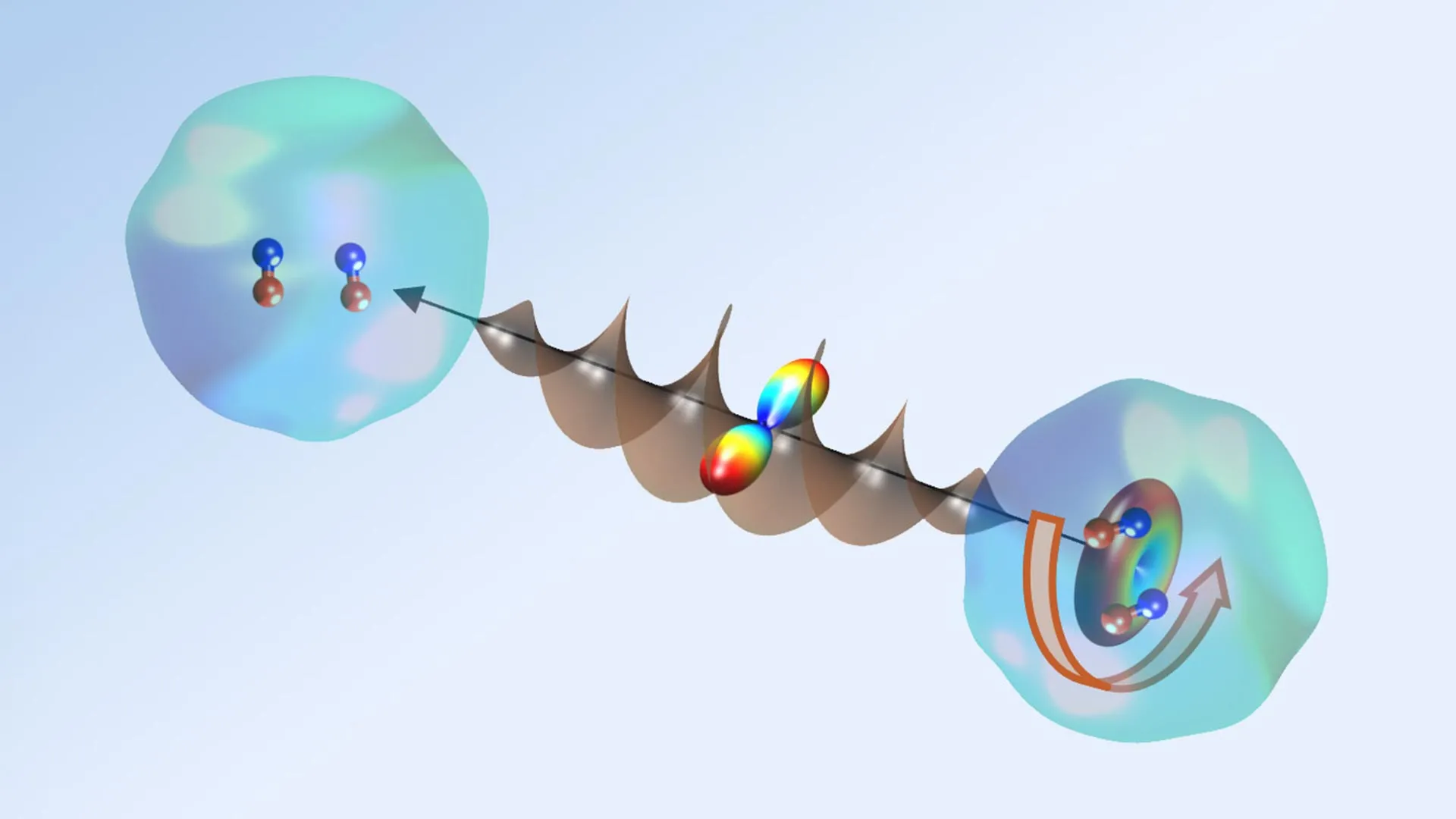
Physicists have developed a new way to control the rotation of molecules within tiny droplets of liquid helium, marking a significant advance in the study of superfluids. Using a specially designed optical centrifuge, the team was able to precisely rotate the molecules suspended in nanodroplets of liquid helium, giving scientists a powerful new tool to explore these unusual frictionless materials.
This result marks the first successful demonstration of controlled molecular rotation in a superfluid. Researchers can now directly tune both the direction and speed of a molecule’s rotation, allowing them to investigate how molecules interact with their quantum environment at different rotational frequencies. The study, led by researchers at the University of British Columbia (UBC) in collaboration with the University of Freiburg, physical review letter.
“Controlling the rotation of molecules dissolved in any liquid is difficult,” says Valerie Milner, Ph.D., associate professor of physics and astronomy at UBC and author of the study.
“The dissolved molecules interact with the atomic or molecular constituents of the fluid, effectively making them larger and less likely to rotate. Imagine making a snowball. It’s very easy to move when it’s small, but becomes increasingly difficult as snow builds up.”
Understanding superfluids
Superfluids such as liquid helium cooled to temperatures close to absolute zero are rare substances that flow without viscosity. Despite the lack of internal friction, it still acts as a solvent, allowing molecules to dissolve inside.
“An interesting question in the science of quantum materials, and one that this new approach will help us explore, is what changes in terms of solvated (dissolved) molecules when you go from an ordinary fluid to this type of quantum superfluid,” Dr. Milner added.
New optical centrifugation technology
Traditional optical centrifuges have been used to spin molecules in a gas by applying rotating laser pulses. As the laser’s electric field rotates, the gas molecules align with it and begin to rotate. However, until now, the same approach has not been successful for molecules immersed in superfluids.
To overcome this limitation, Dr. Milner and his colleagues embedded the molecules in helium nanodroplets doped with a dimer of nitric oxide. Next, we introduced a short delay between laser pulses. The resulting interference produced a much slower and more stable rotational speed, making the molecule easier to rotate and increasing what the researchers called the molecule’s “rotability.”
Exploring the limits of superfluidity
The researchers now plan to vary the rotational frequency (using a new “control knob” provided by the new centrifuge) to identify a critical point where the rotation of molecules is expected to slow down dramatically as superfluidity begins to break down.
“We don’t really understand how, when, or for example at what frequency this transition occurs on such a small atomic scale,” Dr. Milner says. “That’s a key area we’re currently investigating.”
This research was supported by the Natural Sciences and Engineering Research Council of Canada, the Canadian Foundation for Innovation, and the BC Knowledge Development Fund.
