


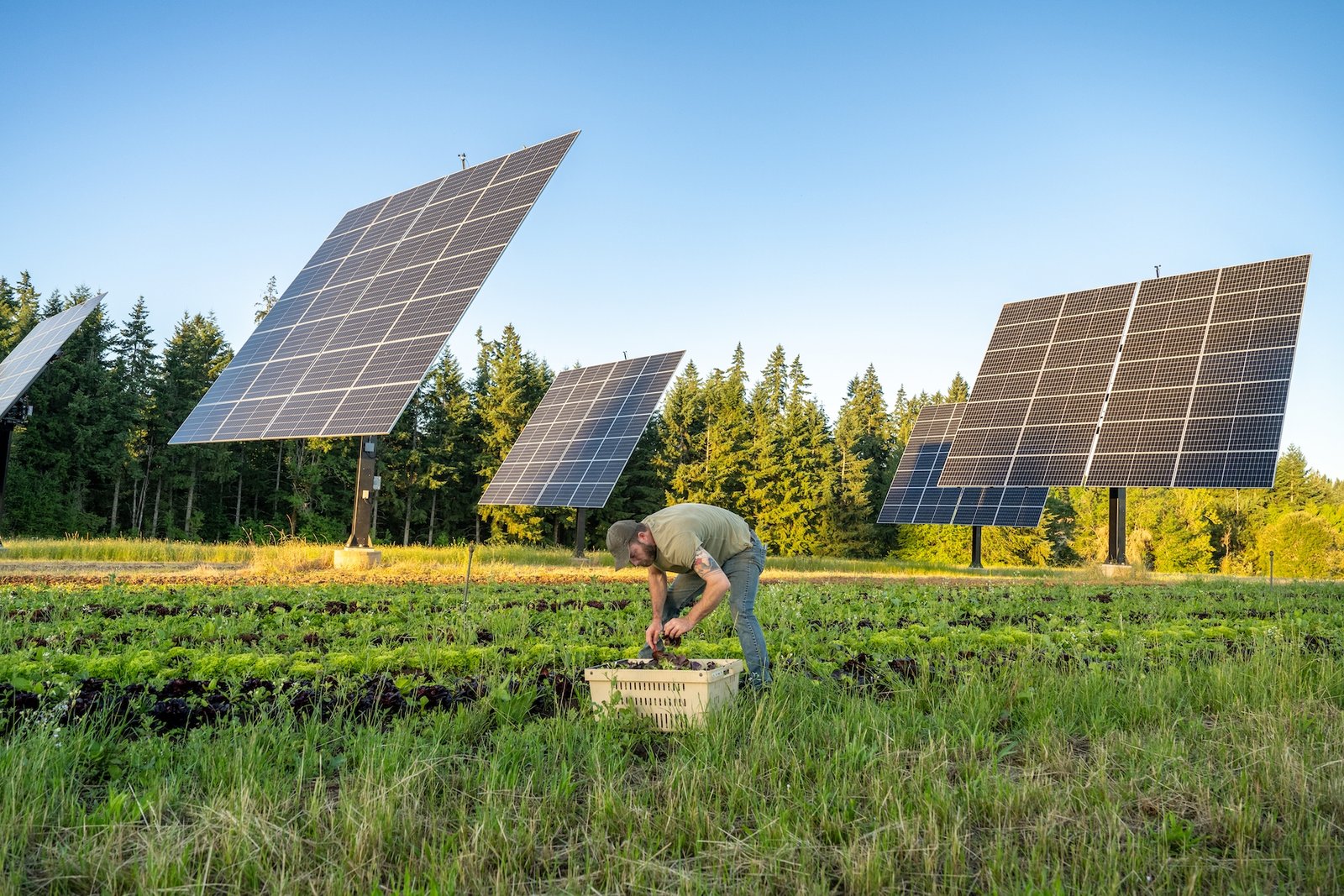
The Pacific Northwest, especially west of the Cascade Mountains, is known for its mild, humid climate, which has historically been ideal for growing leafy vegetables. But as mercury increases due to climate change, those harvests are becoming harder to come by.
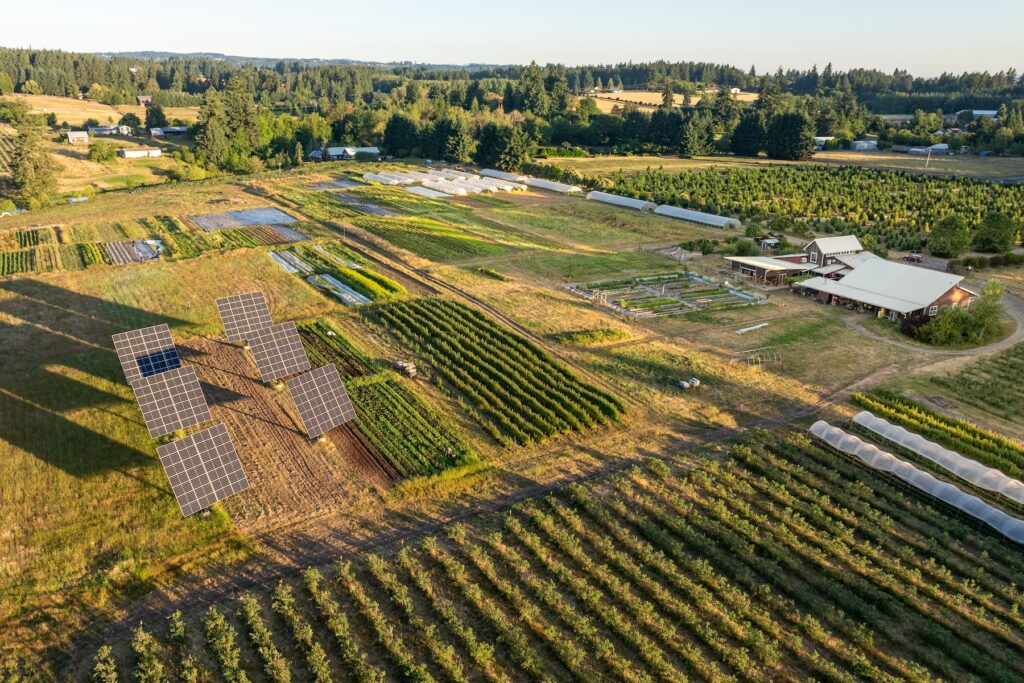
At Our Table Cooperative, a 58-acre farm 15 minutes south of Portland, Oregon, co-founder Narendra Varma saw his crop cut in half as the weather warmed. And the problem is exacerbated because vegetables are most vulnerable during the summer, precisely when customers crave cold, refreshing salads the most.
Varma and his team began looking for ways to protect the heat-sensitive plants they were sowing. “The obvious thing was to provide some kind of shade,” he said. However, the standard method of tying translucent fabric with string is imperfect. Shade sails only allow a certain amount of light through, and once up, they stay put. “You can’t say you want to be in the shade for two hours of the day, but not the other seven hours of the day.”
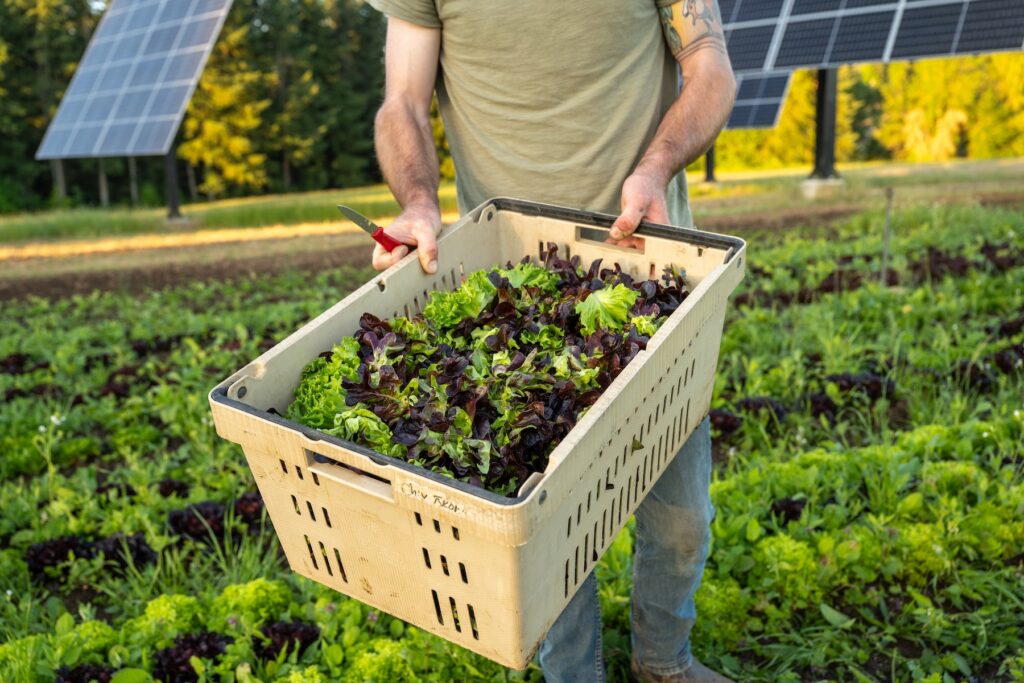
He wanted something he could control. Solar panels seemed like the solution as they could use additional energy. As the 2024 growing season concludes, Our Table debuts the Lettuce Shine Microgrid. This innovates on the established technology agrivoltaics and provides the controllable shade that farms demand.
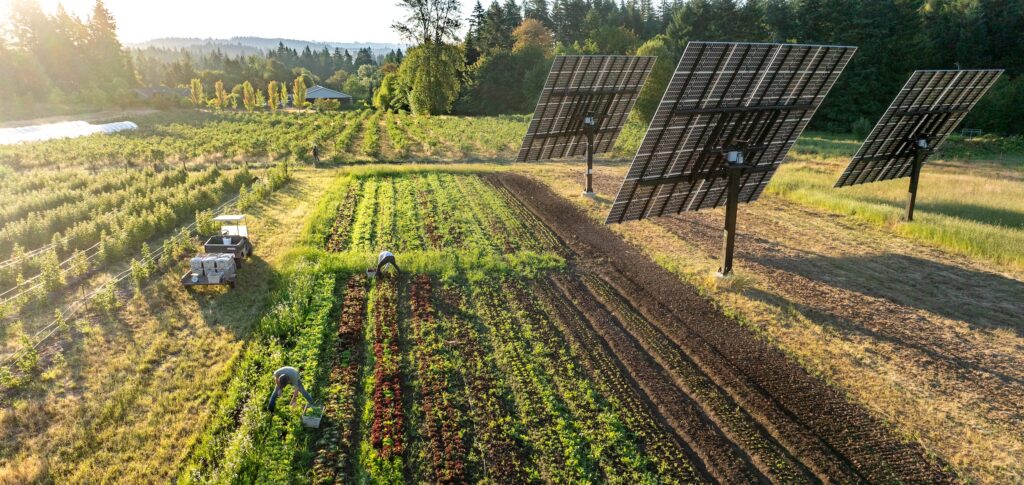 All photos courtesy of Narendra Varma.
make the most of the sun
Agrivoltaics, the installation of solar power systems on top of productive farmland, has been around for decades. Two German researchers proposed the concept in 1981, and Japanese engineers built the first prototype in 2004. At the time, it was called “solar sharing,” with an emphasis on efficiency.
Neither the plants nor the panels absorb all the sunlight they receive. At best, chlorophyll can convert only 6 percent of the sun’s energy into sugar, and even the most efficient solar cells currently available capture less than 50 percent of the sunlight that falls on them. However, most solar cells on the market are only 20% efficient, so you can make the most of the sun’s rays by sharing the light between your panels and your plants.
In 2010, a team of French scientists built the first experimentally designed agricultural power generator. The layout resembled a typical solar power plant. Like orderly infantry, long rows of panels reveal a flat surface in one direction. Most arrays have a ground clearance of a few feet, but these panels were more than 13 feet off the ground. The spacing between each row was also increased to allow extra light to reach the undergrowth.
The practice has spread around the world, there is a wealth of data showing its benefits, and there has been only one additional innovation in the 20 years since this first prototype. In 2014, a French team upgraded the array to allow the solar panels to perform a kind of slow-motion backflip over the course of a day, following the sun.
When Chad Higgins, an Oregon State University professor who focuses on agricultural sustainability, walked by a new solar array on OSU’s campus more than a decade ago, it was clear to him that the panels had changed the microclimate beneath them. “The grass literally looked greener under the solar array,” he told me.
Higgins and his doctoral students began what he called an “experiment of opportunity” to study how temperature, humidity, soil moisture, wind speed, grass growth, and other conditions change in the shadow of the solar field compared to conditions in nearby sun-exposed areas.
Their research is also growing. Since then, he has become an internationally recognized expert in this field. Higgins even has his own experimental agrivoltaic array, called Solar Harvest, at OSU’s Research and Extension Center in Aurora, Oregon, about 20 miles south of Portland.
A new era of agricultural power generation
Despite the early success of agrivoltaics, Mr. Varma at our table still felt that the standard approach was limited compared to what he wanted. “You get a checkerboard pattern of shade and sunlight underneath,” he said. “There’s about 50 percent shade, and it changes throughout the day. But none of them were able to change the amount of shade.”
Varma partnered with the Oregon Clean Power Cooperative, which helped build Solar Harvest, to come up with a way to adjust the shade. Clean Power Cooperatives pointed to Stracker Solar, a new entrant to the state’s renewable energy industry, on Our Table. Stracker Solar has developed a product that Varma describes as a giant controllable sun umbrella.
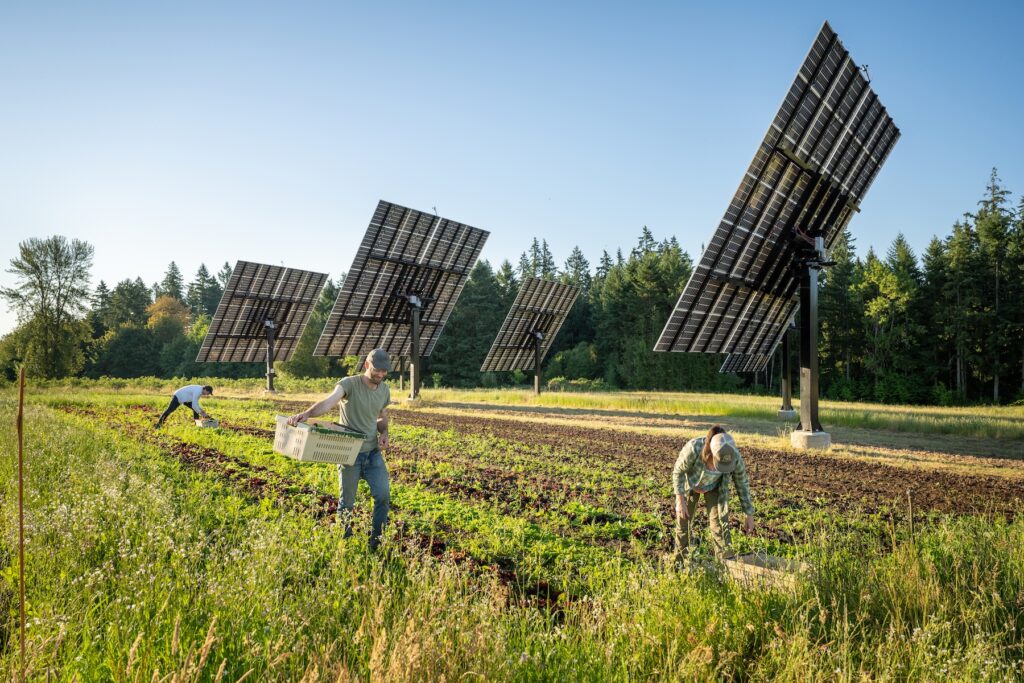
Most solar tracking solar power devices, including solar harvesters, rotate around a single axis. In contrast, each “strucker” mounts a rectangular array of 28 solar panels high off the ground on a steel pole with a single pivot at the top. This causes the system to behave like a giant sunflower, twisting and rotating around two axes, forever pointing toward the sun.
Normally, the Tracker only rotates slightly toward the sun every few minutes, but Freddie Sennhauser, the company’s head of global expansion, said Varma and others will soon be able to further customize the exact orientation of the panels. Currently, Our Table’s six stretchers generate 75 kilowatts of power and shade one-third of an acre while occupying just 30 square feet of total site space.
rest in the shade
Regulating shade reduction is more important than simply managing heat and supports agricultural efficiency. Even sun-filled crops like corn, beans, squash and tomatoes can only absorb about six hours of direct light “before their muscles get tired,” Higgins said.
“Beyond that, they’re basically just stressed out,” Varma added. “It uses more water. It changes the taste. It doesn’t produce as much.”
In open fields, growers can do nothing but cope with rising temperatures. But devices like Strackers could change the game and represent a major advance in how farmers manage their fields. “We have irrigation systems to manage our water resources, and we have tillage plans and fertilizer plans to manage our soil resources,” Higgins said. “So we will also need equipment and plans to manage our solar resources.”
To Varma and Sennhauser’s knowledge, when their Lettuce Shine system was installed in October 2024, there was no other system like it in the world. To investigate how to make the most of this new approach to agricultural power generation, Varma planned to partner with Higgins’ lab. The researchers planned to install sensors throughout the farm and sample plants to collect data that would help optimize Our Table’s strategy. Unfortunately, research funding was among the many budget lines that were erased when the Trump administration took over the federal ledger.
“We have irrigation systems to manage water resources. We have tillage plans and fertilizer plans to manage soil resources. So we probably also need equipment and plans to manage solar resources.”
Chad Higgins
Even without that data, Varma felt his first year at Strackers was a success. “Water usage under the panels is about half that of other locations,” he said.
However, these new panels were not without controversy. After Slacker’s was first installed, when people shopped at the farm’s on-site grocery store, some found Slacker’s ugly, Varma said. Some looked out the window and saw the future. Chasing the heat, the worker-owner was harvesting greenery as giant black-faced sunflowers swirled in the sky.
Initially skeptical, cooperative member-owners were easily swayed by the energy bill savings that microgrids provided. Still, while some may think of solar power itself as a cash crop, Varma believes that “the value of the dollar is more in the crop than in the energy.” Granted, the power itself is worth at most $30,000 a year to Our Table, but “if we can improve the yield of lettuce in July and August, we can generate $50,000 or $60,000 worth of additional lettuce,” Varma says.
a matter of priorities
Too often, Varma said, “agriculture takes a backseat to solar power.” The result is barren solar fields that swallow up fertile farmland across the country.
That’s why many rural communities are skeptical about solar power, says Carrie Siefleming, an environmental sociologist at the University of Arizona. In places like Pinal County, Arizona, where Siefleming is talking to many farmers, thousands of acres of land are being lost to industrial solar power. “There’s already been a lot of animosity,” she said. Residents of Pinal County also tend to be interested in agriculture. Meanwhile, in nearby Tucson, young small-scale farmers are eager to experiment with the approach in hopes of making it easier to manage their farm’s finances.
Higgins sees similar divisions in rural Oregon, especially when agricultural power generation is planned on land zoned “for farm use.” Coming from a rural area, Higgins knows what her community has to offer and what they’re carrying. “I want to do everything I can to support them,” Higgins said. He sees agrivoltaics as a way to do that. But if the community doesn’t want that, he added, “that’s the community’s prerogative and should be respected.”
Still, that hasn’t stopped major solar developers from putting agrivoltaic experts on regional planning boards to downplay community criticism, Seeflemming said. Higgins is concerned about such a possibility. “My biggest fear is that my research will be used to legitimize projects and circumvent community demands,” he says.
In Higgins and Seeflemming’s view, if a proposed agrivoltaics project gains community support without cumulative testimony, not only must the dual-use promise be honored, but the developer must also provide tangible benefits to the surrounding community. To ensure that, we need legislation that establishes clear rules for agriculture that support locally-led projects.
“One farmer told me that agrivortacus is like a ripe peach waiting to be picked,” Siefleming said. But questions about funding and technical hurdles have prevented agricultural power generation from being moved away from branches.
That’s why the support of the Oregon Clean Power Cooperative was critical to Our Table’s success. Varma already knew about solar power, but with the help of the co-op, the team was able to navigate the delicate hurdles and pay for the project’s $460,000 price tag through a $324,000 grant from Portland General Electric, with the rest covered by federal tax credits.
If more farmers can overcome the hurdles of installing solar power on their farms, the potential is significant. At a time when farming is more difficult than ever and retired farmers struggle to find replacements, they can help save water, improve yields and reduce energy costs. As Higgins’ research showed, converting just 1% of the world’s agricultural land to agrivoltaics could offset global energy needs and meet international climate change targets, proving once again that what’s good for land workers is good for the planet.
Go deeper:
- clock Local news features from Our Table Cooperative.
- read A farmer’s guide to solar power.
- explore See more Magic Canoe articles about food systems.
