


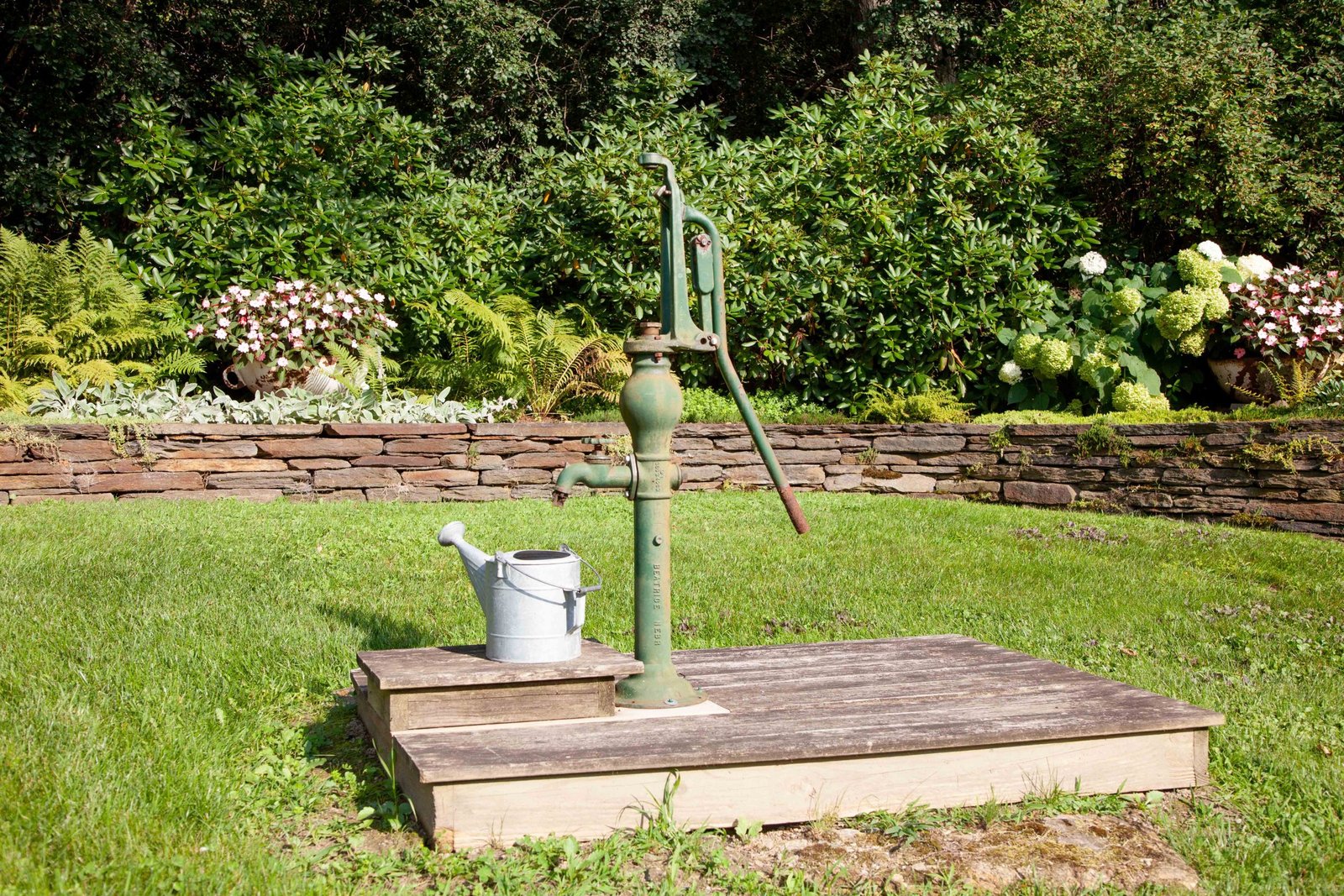
 A decorative antique water well was installed where a drinking water well contaminated with PFOA had been capped. File photo: Mike Dougherty/VTDigger
Vermont is providing well testing, free water and other assistance to South Bennington and Shaftesbury following a study last year that found PFAS contamination in the Bennington area was widespread and worsening over time.
The state is also actively negotiating with the current corporate owners of Bennington’s now-closed ChemFab factory, which manufactured Teflon-coated fiberglass fabrics containing PFOA (perfluorooctanoic acid).
PFOA is a specific type of PFAS, or per- and polyfluoroalkyl substances, a group of thousands of synthetic toxic compounds found in common items such as cookware and sporting goods. Dangerous levels of PFOA have been found in a wide range of private wells in the Bennington area.
South Bennington and Shaftesbury residents are considering possible legal remedies, and the town of Shaftesbury wants the state to go further and provide blood testing after exposure to toxic chemicals.
PFOA was recently detected in wells in south Bennington and southeast Shaftesbury. This means that the pollution plume has spread beyond the original area of concern. A study last year conducted by Bennington College professors and student researchers in collaboration with the state Department of Environmental Conservation found that PFOA continues to steadily seep into the soil, and groundwater contamination levels generally continue to rise in the Bennington area.
The study found that about three-quarters of private wells tested between 2016 and 2024 showed elevated PFAS levels over an eight-year period.
Nearly a quarter of a century later, Bennington area residents are still dealing with the effects of these man-made chemicals leaching into groundwater, said David Bond, a Bennington College professor and one of the project’s principal investigators.
“PFAS is a generational disaster, and we are only now beginning to understand what it means to respond to an environmental crisis of this magnitude and persistence,” Bond said.
State well sampling
The state Department of Environmental Protection is currently collecting samples of private well water for households in the newly identified contaminated areas, said Richard Spiese, the department’s hazardous site manager.
Spiese said the province has identified about 250 wells in South Bennington and 50 in Shaftesbury as needing testing, but not all households have responded to the province’s approach.
In late January, the state narrowed the allowable level for PFOA in the state’s groundwater protection rules to four parts per trillion, said Ben Montross, the department’s drinking water program manager. The state found private wells in South Bennington and Shaftesbury with PFOA levels as high as about 60 ppa, 15 times the permissible limit. Although most of the affected wells had 1 in 20 to 30 trillion, PFOA was not detected in nearly half of the wells tested, Spiese wrote in an email.
Spiese said an emerging area of concern is that the state is distributing bottled water or installing filtration systems to households that exceed new standards for contaminated drinking water.
Spiese said plans are underway to connect the Southshire area to municipal water supplies, and the ultimate goal is to connect all affected communities to public water supplies free of PFAS contamination.
village
A French multinational called Saint-Gobain Performance Plastics Corporation acquired the Bennington ChemFab plant before it closed in 2002. The state of Vermont entered into a settlement with Saint-Gobain in 2019, in which Saint-Gobain agreed to provide most of the funding needed to connect Bennington homes to the city’s drinking water supply from Morgan Springs.
Attorney General Charity Clark said in a statement that current settlement negotiations with Saint-Gobain are confidential, although the Natural Resources Agency has asked Saint-Gobain to carry out additional work in new areas of concern.
“Discussions are ongoing and we look forward to reaching a positive outcome,” Clark said in a statement.
Meanwhile, as first reported by the Bennington Banner, attorneys Stephen Schwartz and David Silver also convened about 100 South Bennington and southeast Shaftesbury residents whose private wells are in the new contamination area to discuss the process of filing a class action lawsuit.
Mr. Silver represented Bennington residents who received $34 million in financial compensation and medical monitoring support from Saint-Gobain following a class action settlement in 2022.
Schwartz successfully filed a class action lawsuit on behalf of residents of Hoosick Falls, New York due to PFOA water contamination. According to a recent report in the Times Union, Saint-Gobain, Honeywell International and DuPont have agreed to pay Hoosick Falls residents more than $90 million in financial compensation and a medical monitoring program in separate settlements.
After the settlement with Bennington, Silver said in an interview that the Vermont Legislature passed the Medical Monitoring Act in 2022, codifying Vermont’s right to sue companies for the cost of medical monitoring after exposure to toxic chemicals.
What about blood tests?
Schwartz said in an interview that the blood test results were instrumental in an earlier settlement arguing that the companies were responsible for exposures and should pay for medical monitoring of the public. He added that blood tests are expensive and not easily available, but are valuable in assessing health risk factors such as cancer in people exposed to PFOA.
The Town of Shaftesbury is currently petitioning the state for free blood tests, which were offered to Bennington and North Bennington residents in 2016. In March, the province denied the town of Shaftesbury’s request, claiming it was no longer offering blood tests.
“PFAS are present in the blood of nearly all Americans, and blood tests cannot determine whether exposure to PFAS causes a health problem, whether a given symptom is caused by PFAS, or how exposure occurred,” wrote Julie Moore, director of the Vermont Agency of Natural Resources.
read more

March 20, 2025, 5:32 PM March 20, 2025, 9:15 PM
On April 21, members of the Town of Shaftesbury task force sent back a letter saying the state’s reasoning was not consistent with scientific understanding of the risks of PFOA in the bloodstream.
The town noted that the Environmental Protection Agency considers PFOA to be a possible human carcinogen. The Associated Press reported this month that officials are now lifting limits on PFAS levels in drinking water in the Biden region.
The International Agency for Research on Cancer considers PFOA a human carcinogen, primarily because of sufficient evidence that it can cause kidney cancer, the town said in the letter.
“There is no scientific, logical, or fair reason to treat Shaftesbury residents differently than Bennington residents when it comes to state-funded blood testing,” Shaftesbury Select Committee members wrote in an April letter.
The Vermont Department of Health understands the community’s concerns, but blood tests for PFOA levels are available through individual health care providers, spokesperson Kyle Casteel wrote. Casteel said in an emailed statement that the state previously supported testing in 2016 to study and establish a link between PFOA concentrations in the blood of affected communities and PFOA exposure in drinking water.
“We continue to work with health care providers and the public to inform them about the risks of PFOA/PFAS exposure and to help reduce those risks,” Casteel wrote.
