



The proposed merger between NextEra Energy, the nation’s largest power company by market value, and Dominion, the No. 6 company, would create a giant company at a time when the industry is being reshaped by surging demand for data centers and electricity.
The proposal, announced Monday morning and subject to approval by state and federal regulators, would create a company with leadership in nearly every aspect of U.S. power and utilities, including overall power generation, natural gas generation and renewable energy.
The $67 billion contract combines NextEra’s scale and scope with Dominion’s position as the regional power provider for the world’s largest data center concentration in Northern Virginia. But consumer advocates and analysts say the result would likely be harmful to consumers and the environment, and create companies with enormous financial and political power that would be difficult to regulate effectively.
For perspective, only Exxon Mobil and Chevron are considered larger among U.S.-based energy companies based on market value.
“Mergers aren’t about consumers. They’re about shareholders,” said Ari Pesko, director of the Power Law Initiative at Harvard Law School. “For Dominion shareholders, they are selling their stock at a premium. Assuming all goes well, executives are being paid huge sums to facilitate this, and clearly NextEra believes this deal will add value to the company. Ratepayers are all an afterthought.”
Morningstar equity analyst Andrew Bischoff said the partnership makes financial sense for both companies.
“We believe this transaction allows us to accelerate NextEra’s data center ambitions, which have lagged behind regulated peers, by leveraging Dominion’s expertise and relationships to accelerate NextEra’s data center hub plans,” he said in a note to clients.
Based in Juno Beach, Florida, NextEra includes Florida Power & Light, the state’s largest regulated electric utility, and NextEra Energy Resources, a wholesale electricity provider with power plants across the United States. Dominion is a regulated utility company based in Richmond, Virginia that serves much of Virginia, parts of North and South Carolina, and other properties across the United States.
The company’s name will be NextEra Energy, and NextEra CEO John W. Ketchum will serve in the same role upon closing. Robert M. Blue, Dominion’s CEO, will become CEO of the combined company’s regulated utilities division. The parties said they expect regulatory approval to take 12 to 18 months.
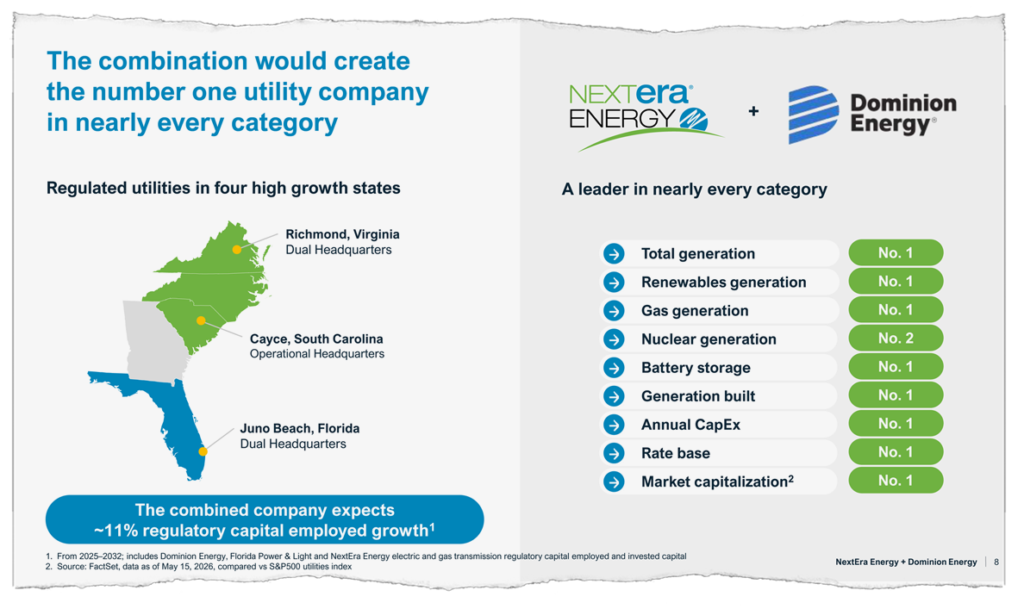 NextEra Energy and Dominion’s investor presentation pages show the states in which each company regulates utilities and the combined companies’ rankings in various categories.
As a result of the all-stock transaction, NextEra shareholders will own 74.5% of the combined company, and Dominion shareholders will own 25.5%.
“We are combining NextEra Energy and Dominion Energy because, now more than ever, scale matters. Not because of scale, but because scale leads to capital and operating efficiency,” Ketchum said in a statement.
“It will make the pollution problem even worse.”
The combined company, NextEra, will be the leader in so many categories in the U.S. utility sector that it’s easy to list the categories it won’t lead in. The company ranks second in nuclear power generation capacity and number of regulated utility customers, both behind Exelon Corp. of Chicago.
Although NextEra and Dominion both have significant carbon emissions, they are not among the nation’s top five electric utilities in 2024, according to the Natural Resources Defense Council’s latest Air Emissions Benchmarking Report. NextEra ranked 6th and Dominion 11th, with their totals lower than the combined total of their respective leaders, Vistra Energy and Duke Energy.
But the emissions from companies that are trying to become even more influential because of their size remain enormous.
“If we continue to add dangerous climate pollution to this, the people who are already suffering and are usually the first and worst hit will suffer even more,” said Susan Glickman, vice president of policy and partnerships at the Florida-based CLEO Institute, a nonprofit climate change education and advocacy group. She pointed out that people with the least resources are often the most affected by disasters like hurricanes, and that disasters are intensifying as the Earth’s climate warms due to fossil fuel emissions.
“These companies will continue to be squeezed in as they build more methane gas plants to provide additional power to their data centers, further adding to the climate-warming pollution problem.”
 Amazon’s data center looms above homes on the edge of a neighborhood in Loudoun County, Virginia. Credit: Jahi Chikwendiu/The Washington Post via Getty Images
consumers will lose out
In a conference call Monday morning, company officials said the agreement will lead to economies of scale and provide savings that will benefit ratepayers. The agreement includes $2.25 billion in bill credits over two years for Dominion customers.
But Marissa Paslick Gillette, who chaired the Connecticut Public Utilities Commission from 2019 to 2025, said utility mergers have no track record of providing long-term benefits to consumers. She resigned after clashes with the state’s power companies and is now a senior fellow at the American Economic Liberties Project, a think tank that seeks to limit the concentration of corporate power.
“I’m still a little surprised by how tone-deaf I am,” she says. “None of us can point to any large utility mergers and acquisitions that have taken place over the last decade…that have decisively delivered the synergies that they told us would generate fees.”
This story is funded by readers like you.
Our nonprofit newsroom provides free advertising for our award-winning climate coverage. We rely on donations from readers like you to continue our work. Donate now to support our work.
donate now
Mr. Gillette’s experience includes serving on the staff of the Maryland Public Service Commission during the 2012 merger of Exelon and Maryland-based Constellation Energy, one of the largest utility mergers in U.S. history.
One of the main problems arising from utility mergers is that they create companies that are difficult to regulate because of their complexity, he said.
“We know how this is going to play out, and we know the real, concrete problems of having to regulate a huge company like this,” she said.
Stephen Smith, executive director of the Southern Alliance for Clean Energy, said the merger could be a good thing if NextEra remains accountable to its customers and continues to expand its renewable energy portfolio. He pointed to NextEra’s status as the nation’s largest renewable energy developer, but was also concerned about the company’s growing political influence, particularly in Florida.
“You have a very large utility with enormous financial resources and enormous political power, and that doesn’t necessarily bode well for ratepayers,” he said. “The more political power a utility has, the more likely it is to use that power to the detriment of ratepayers.”
Smith cautioned that the merger should not be viewed as a done deal. NextEra has attempted to acquire other power companies in the past, but failed, with talks with Duke Energy scrapped in 2020.
“Their acquisition track record is not that great,” he says. “Going after Dominion is the biggest fish they’ve tried to reel in.”
Virginia law still applies
Despite these concerns, Dominion and its out-of-state parent company will still have to comply with Virginia laws and regulations, said William Schaub, research professor emeritus of public policy at the University of Virginia.
“The regulations don’t talk about Dominion. They talk about utilities that cover Dominion’s footprint, whatever the name,” he said.
These laws include the Virginia Clean Economy Act, the state’s 2020 law to decarbonize the electric grid by 2050, and recently passed legislation increasing Dominion’s battery storage development goals.
Instead, NextEra’s track record as a leader in solar and wind power could “infiltrate” Dominion’s culture, which “has been less enthusiastic about adding non-emissions technologies,” Shobe said.
 Dominion Energy headquarters in downtown Richmond, Virginia. Credit: Charles Paullin/Inside Climate News
He said the acquisition of Dominion was attractive to NextEra Energy because Virginia has a policy environment friendly to building grid infrastructure, high profit margins and a booming data center market. NextEra said the merger would create a pipeline of 130 gigawatts worth of demand from data centers, which critics say is speculative, with an opportunity to more than double power generation capacity to 225 gigawatts by 2032.
In November, state regulators approved a $7 billion rate hike for Florida Power & Light. Consumer groups characterized the rate hike, which faces legal challenges in state courts, as the largest in U.S. history.
Bradley Marshall, a senior attorney at Earthjustice, said the rate hike puts NextEra in a financial position to pursue a merger.
“In the past, we’ve seen bills go up even more as utilities get more powerful,” he says. “Consumers need to know what is going on and make sure that preventing bill increases is a top priority.”
About this story
As you may have noticed, this article, like all news we publish, is free to read. That’s because Inside Climate News is a 501c3 nonprofit organization. We don’t charge subscription fees, keep our news behind paywalls, or fill our website with ads. We provide climate and environmental news free to you and anyone who wants it.
That’s not all. We also share our news for free with dozens of other news organizations across the country. Many of them cannot afford to do environmental journalism themselves. We’ve established bureaus across the country to report on local news, partner with local newsrooms and co-publish stories to ensure this important work is shared as widely as possible.
The two of us started ICN in 2007. Six years later, we won the Pulitzer Prize for national reporting and now run the nation’s oldest and largest dedicated climate newsroom. We tell the story in its entirety. We hold polluters accountable. We expose environmental injustice. We debunk misinformation. We explore solutions and inspire action.
Donations from readers like you fund all aspects of our work. If you haven’t already, will you support our ongoing work, our coverage of the biggest crises facing our planet, and help us reach more readers in more places?
Please make a tax-deductible donation. Each one makes a difference.
thank you,
