


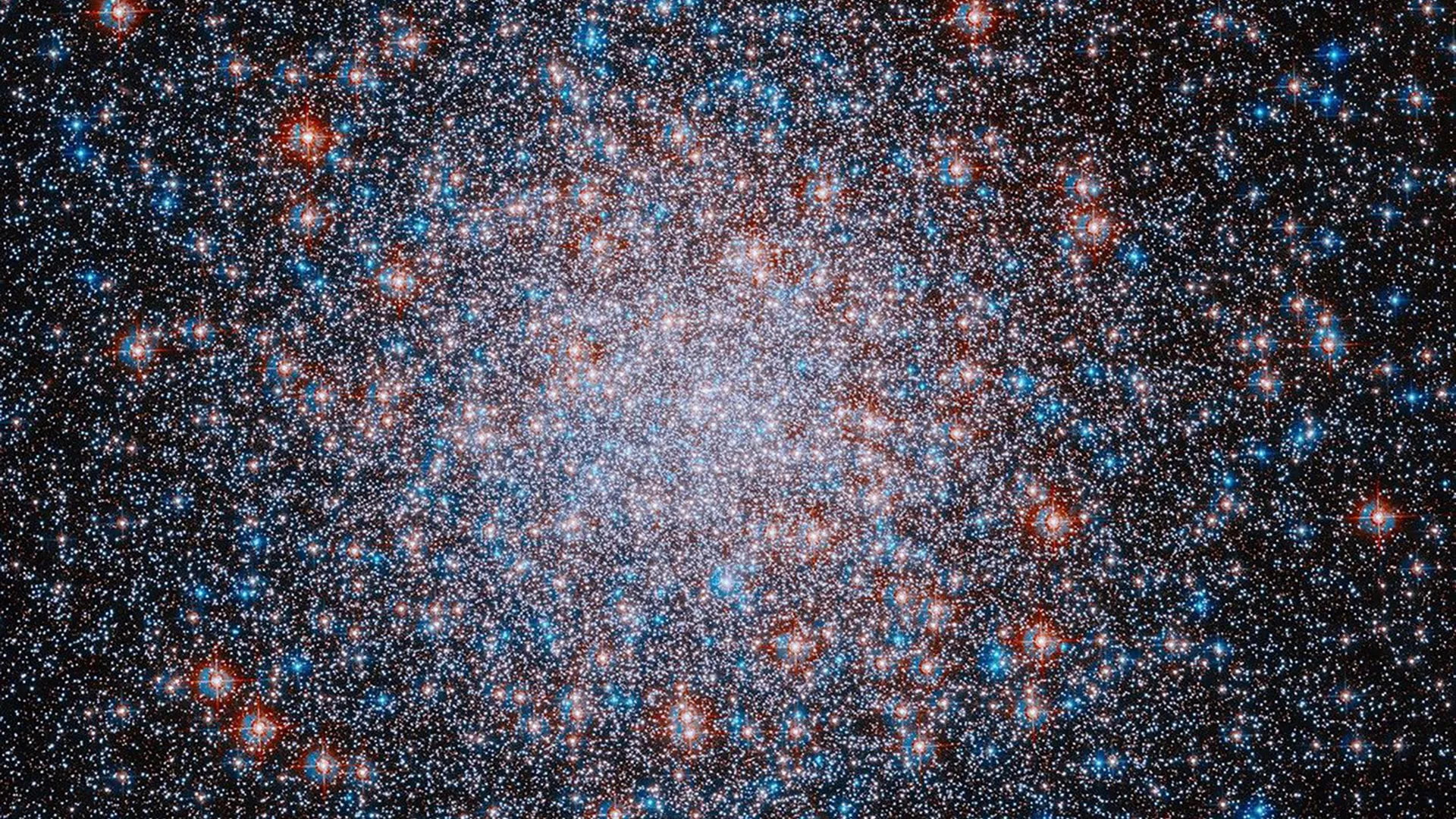
NASA’s Hubble Space Telescope has released a dazzling new image featuring more than 500,000 stars glowing in shades of red, white, and blue. Unveiled to commemorate the United States’ 250th anniversary, this breathtaking view highlights Messier 3 (M3), one of the largest and most impressive globular clusters in the Milky Way.
A globular cluster is a dense, spherical collection of stars bound together by gravity. Unlike young star clusters that continue to evolve, the stars in globular clusters formed from the same cloud of gas at about the same time billions of years ago. This common origin preserves an ancient record of the galaxy’s history. Astronomers have identified about 150 globular clusters orbiting the outer circumference of our galaxy.
A notable star cluster with many rare stars
Messier 3’s huge size isn’t the only thing that’s notable about it. It is also located relatively far from the center of the Milky Way and contains an unusual population of RR Lyra variable stars. More than 240 of these stars have been identified in M3, more than any other known globular cluster in the Galaxy.
These ancient variable stars are especially important because they brighten and dim in predictable patterns. This regular cycle allows astronomers to determine its actual brightness. By comparing its intrinsic brightness to how bright the star is visible from Earth, researchers can accurately calculate the star’s distance. This works similarly to estimating the distance of a car at night if you know the brightness of its headlights.
The mystery of the blue straggler star
About 70 candidates for a rare type of star called blue stragglers have been identified in M3. These stars shine in a bright blue color, making them appear much younger than the older, reddish stars around them.
This cluster is where astronomers first discovered blue stragglers. Scientists believe that these stars likely pulled material away from nearby companion stars through gravitational interactions. That extra mass essentially gave them a second life, making them hotter, brighter, and bluer, despite actually being as old as their neighboring stars.
Evidence of ancient cosmic collisions
Astronomers suspect that M3’s unusual features may date back to dramatic events in the distant past. This cluster contains two different star clusters, raising the possibility that it was formed when two globular clusters merged into one.
These original galaxy clusters are thought to have belonged to the same dwarf galaxy before the smaller galaxy was eventually absorbed into the Milky Way, leaving M3 as a possible relic of an ancient galactic encounter.
How Hubble uses color to reveal a star’s temperature
Hubble has observed Messier 3, also known as NGC 5272, several times over the years, helping scientists study its unusual stellar population and complex structure in more detail.
The colors in this image are not solely for visual effect. Blue represents shorter wavelengths of visible light, and red corresponds to longer visible wavelengths along with some near-infrared light. Hubble images are processed using standard techniques that assign colors based on the wavelengths captured through the telescope’s filters. A star’s color is closely related to its temperature, so the blue stars shown here are hotter and the red stars are cooler.
Piecing together the past of the Milky Way
This image is part of the Hubble Treasury program, which is investigating about half of the known globular clusters in the Milky Way. By comparing these ancient star systems, astronomers hope to build a detailed timeline of how our galaxy formed and evolved over billions of years.
After more than 30 years of groundbreaking observations, Hubble remains one of NASA’s flagship space observatories. In conjunction with the infrared-enabled James Webb Space Telescope and the upcoming Nancy Grace Roman Space Telescope, it will continue to uncover new details about the universe and help scientists assemble an increasingly complete picture of the history of the universe.
